100926 L1 Chemistry 221 Video Lecture
 Watch on YouTube →
Overview
Michael Russell explains how quantum numbers, the Aufbau principle, and Hund's rule determine electron configurations, then applies those configurations to ions, magnetism, and periodic trends. He connects orbital filling to the periodic table, shows how atomic and ionic sizes and electron-removal energies vary across it, and closes by reviewing ionic and covalent compound naming.
Key takeaways
- For multi-electron atoms, the n + l rule predicts subshell energy order: 2s is lower than 2p, and 4s fills before 3d.
- Hund's rule places one electron in each equal-energy orbital before pairing; this explains why oxygen is paramagnetic despite having an even number of electrons.
- An element's group reflects its outer-electron configuration, which helps explain similar chemical behavior among members of the same group.
- Transition-metal cations lose electrons from the highest principal quantum number first: iron loses 4s electrons before 3d electrons.
- Atomic size generally grows down and left across the periodic table, while cations shrink and anions expand relative to their neutral atoms.
- Among species with the same number of electrons, fewer protons mean a larger radius; P³⁻ is larger than S²⁻, Cl⁻, and Ar because it has only 15 protons.
Chapters
- Students are asked to submit the nomenclature lab and Prompt Set 3, self-correct Seminar Self-Quiz 3, and bring a calculator for Quiz 3.
- The Chemistry in the Library assignment uses Mount Hood Libraries databases to find peer-reviewed articles about each student's presentation element.
- The upcoming hydrogen spectrum lab will examine hydrogen emission lines associated with models of the atom.
- Each electron has four quantum numbers: n, l, m_l, and m_s; in a neutral uranium atom, 92 electrons each have their own set.
- Unlike the Bohr model, where energy depends only on n, the multi-electron model orders subshells using n + l.
- For example, 2s has n + l = 2 while 2p has n + l = 3, so 2s is lower in energy.
- The ordering also places 4s below 3d for filling, helping explain the structure of the periodic table.
- An Aufbau diagram uses diagonal arrows to give the filling order, beginning 1s, 2s, 2p, 3s, and 3p.
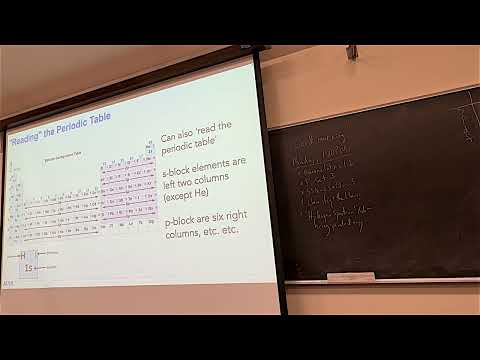
- The periodic table's two-column s block and six-column p block correspond to their subshells.
- For d-block elements, the d subshell number is one less than the period number; for f-block elements, it is two less.
- Either the diagonal-arrow diagram or the periodic table can be used to determine the order of orbitals.
- In spectroscopic notation, a subshell label such as 1s identifies n and l, while its superscript gives the number of electrons.
- Hydrogen is 1s¹ and helium is 1s²; the two helium electrons share the 1s orbital with opposite m_s values.
- Orbital box notation represents electrons as arrows, with spin-up written before spin-down.
- Each orbital holds at most two electrons, which must have opposite spins.
- Noble gas notation replaces a filled inner configuration with a bracketed noble gas, such as aluminum written [Ne] 3s² 3p¹.
- Elements in the same group have similar outer-electron configurations, as illustrated by boron and aluminum and by nitrogen and phosphorus.
- For chlorine, the configuration is [Ne] 3s² 3p⁵, totaling 17 electrons.
- Chromium and copper are common deviations from the simple filling prediction: their configurations are [Ar] 4s¹ 3d⁵ and [Ar] 4s¹ 3d¹⁰; Russell says such exceptions are not required for quizzes and exams.
- Phosphorus gains three electrons to form phosphide, P³⁻, with the argon configuration; sulfur and chlorine commonly form S²⁻ and Cl⁻.
- Aluminum loses its 3p and 3s electrons to form Al³⁺ with the neon configuration; sodium similarly forms Na⁺.
- For transition-metal cations, electrons are removed from the highest n level first, so iron loses its 4s electrons before its 3d electrons.
- Iron is [Ar] 4s² 3d⁶ as a neutral atom; Fe²⁺ is [Ar] 3d⁶ and Fe³⁺ has one fewer 3d electron.
- More unpaired electrons generally mean stronger paramagnetism: Zn²⁺ is diamagnetic, Fe²⁺ has four unpaired d electrons, and Mn²⁺ has five.
- A configuration with an empty 4s subshell and 3d⁷ can identify Co²⁺ as [Ar] 3d⁷.
- The same 3d⁷ pattern does not fit Rh²⁺, which would involve 4d electrons, or Ca²⁺, which has no d electrons.
- Counting electrons and checking the orbital subshells narrows down candidate ions.
- Atomic size generally increases down and to the left: sodium is predicted larger than magnesium, and potassium larger than sodium.
- Cations are smaller than their neutral atoms because removing electrons reduces electron-electron repulsion; anions are larger because added electrons spread out.
- For isoelectronic species with 18 electrons, P³⁻ is larger than S²⁻, Cl⁻, and Ar because its 15 protons exert the weakest pull.
- These are useful trends rather than perfect rules, so measured radii can include exceptions.
- Ionization energy is the energy required to remove an electron; first, second, and third ionization energies refer to successive removals.
- Ionization energy generally increases up and to the right, making helium the example with the greatest electron-removal energy discussed.
- Electron affinity describes the energy change when an atom gains an electron; some atoms release energy while others require it.
- Russell presents electron affinity as generally increasing up and to the right, while noting that the trend is imperfect and the terminology can be contentious.
- Covalent or molecular compounds usually form between nonmetals and use Greek prefixes in their names.
- Ionic compounds pair cations and anions, commonly metals with nonmetals; charge crossover often gives the formula.
- Nonmetal anions use an -ide ending and often follow group number minus eight, such as chlorine forming Cl⁻ and oxygen forming O²⁻.
- Group 1A metals generally form +1 ions, group 2A metals form +2 ions, and common fixed-charge metals include Zn²⁺, Ag⁺, and In³⁺.
Transcript excerpt
0:00 All right, good morning. Happy Friday. I hope you've had a good week and I hope you have an even better weekend. Monday 1:10 p.m. Several things happening. Let's go through the list again. The nomenclature lab that we started on Monday. You'll turn that into me. Prompt set number three is up. Turn that in. Selfcorrected, etc., etc. Like before, we'll start by taking seminar selfquiz 3. We'll self-correct it. You'll turn it in. Then we'll take the actual quiz number three. Definitely bring your calculator. uh going to be some math involved. Nothing you can't handle. One thing that's different this week is that the chemistry in the library assignment is due. So, I'm hoping by now you all have your class presentation element. And if you don't, email me ASAP kind of thing. But anyway, chemistry in the library hopefully won't take you very
0:47 long. It's a to make you use the Mount Hood Libraries databases that we have access to to find peer-reviewed articles on your element. Um, it's in the companion. It's all Well, wait a minute. Let me back up on that. I gave you a copy on the first day of lab. It was the class presentations uh kind of booklet. The chemistry and the library are a couple of the pages in there. It's also available online, so you should be able to have a copy. If you don't, you can't find it, please let me know. Uh, I'm all over helping you out. And then we'll go next door and do a different kind of lab called the hydrogen spectrum lab. We're actually going to see some emission lines for hydrogen. We'll see the sharp line spectra that poor used to figure out his model of the atom, stuff like that
This is the start of the transcript. Save this video free for the whole transcript, searchable and time-coded.
Related notes
Summary, takeaways, and chapters were generated by AI from the video's transcript and may contain errors. The video belongs to its creator, Michael Russell.