102226 L2 Chemistry 221 Video Lecture Part I
 Watch on YouTube →
Overview
Michael Russell introduces Chapter 4 of Chemistry 221 by connecting ionic and covalent bonding to electrostatic attraction, electron sharing, and molecular structure. He explains Coulomb’s law, electronegativity and bond polarity, then develops Lewis structures from valence-electron counts, using HCl and NH3 to illustrate bonding pairs, lone pairs, and the octet rule.
Key takeaways
- Ionic attraction becomes stronger when ion charges are larger or the distance between ions is smaller, which helps explain the robust NaCl lattice and its melting point near 800°C.
- A covalent bond’s stable length reflects a balance: electron-nucleus attractions favor bonding, while electron-electron and nucleus-nucleus repulsions prevent atoms from collapsing together.
- Bond polarity depends on the electronegativity difference between atoms: OH is more polar than OF in Russell’s examples, and identical-atom bonds such as F2 are nonpolar.
- Main-group valence-electron counts can be read from group numbers, and the number of core electrons in a neutral atom is its total electrons minus its valence electrons.
- In a Lewis structure, each bond line represents two shared electrons and each lone-pair symbol represents two unshared electrons; NH3 uses three bonding pairs and one lone pair.
- The octet rule is a useful common pattern rather than an absolute rule: many atoms have four electron pairs, while hydrogen generally has only one.
Chapters
- For the next Tuesday 8:30 class, students should submit problem set 4 on Chapter 4, complete seminar self-quiz 4 and quiz 4, and turn in the unknown-compound lab identification.
- Students should bring a printed Lewis structures lab and submit the rough draft of their class presentation paper.
- The rough draft requires a cover sheet, at least two typed pages about the assigned element, and at least one abstract and citation from a peer-reviewed science article.
- Russell frames bonding around two interactions: protons attract electrons, while electrons repel other electrons.
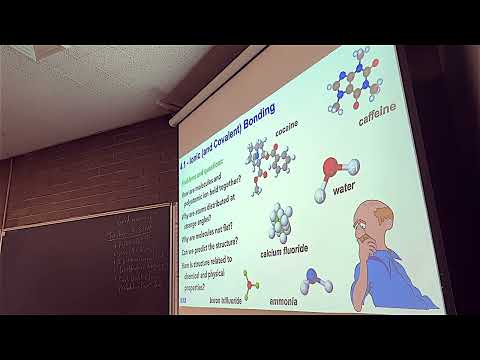
- The chapter aims to explain why ammonia, NH3, is pyramidal while boron trifluoride, BF3, is flat.
- The same structural principles apply to organic and biochemical molecules, including caffeine, vitamin C, and proteins.
- Ionic bonding commonly forms between a metal and a nonmetal when an electron transfer produces oppositely charged ions, as in Na+ and Cl-.
- Sodium chloride forms a three-dimensional ion lattice and melts near 800°C, reflecting strong ionic attractions.
- Covalent bonds generally join nonmetals and are more flexible than ionic bonds; many real bonds fall between fully ionic and fully covalent.
- Metallic bonding applies to pure metals such as copper, iron, and silver; metavalent bonding is mentioned for metalloids but is not covered in the course.
- The potassium bromide crystal lattice displays alternating K+ and Br- ions in a regular arrangement.
- Coulomb’s law relates electrostatic force to the magnitude of the charges and the distance between them.
- Larger ionic charges strengthen attraction, while decreasing the distance between ions also increases the attractive force.
- Russell uses handshakes and increasing physical closeness as analogies for charge magnitude and ion separation.
- When two hydrogen atoms approach, each atom’s electrons attract the other atom’s nucleus, while electron-electron and nucleus-nucleus interactions repel.
- A chemical bond forms when the attractive interactions outweigh the combined repulsions at a favorable separation.
- The H2 bond is most stable near 74 picometers; atoms farther apart bond less strongly, and atoms pushed too close experience stronger repulsion.
- Identical atoms such as the two nitrogen atoms in N2 share bonding electrons equally, producing a nonpolar covalent bond.
- Different atoms often attract shared electrons unequally, creating a polar covalent bond with partial positive and partial negative ends.
- In HCl, chlorine draws electron density away from hydrogen; delta-plus and delta-minus symbols represent partial charges, not full ionic charges.
- Polar molecules respond to an electric field by orienting their partial charges, while nonpolar molecules do not align in the same way.
- Electronegativity measures an atom’s pull on shared electrons and generally increases up and to the right on the periodic table; fluorine is the highest in the classic scale.
- For the OH bond, the electronegativity difference is 1.4, compared with 0.5 for OF, so OH is more polar and oxygen is the negative end of OH but the positive end of OF.
- A bond’s polarity depends on the difference between the two atoms, not simply on whether one atom has a high electronegativity; F2 is nonpolar because both atoms pull equally.
- Russell notes that students should use periodic trends rather than memorize electronegativity values, and that classic classroom values typically omit noble gases.
- Gilbert N. Lewis developed the electron-dot representation used to track bonding and lone pairs in molecules.
- Lewis structures count available valence electrons and arrange them into bonding pairs and lone pairs, helping predict electron distribution, reactivity, and geometry.
- Core electrons are too close to the nucleus to participate in ordinary bonding; the outermost valence electrons are the ones used to construct structures.
- For the main-group elements discussed, valence-electron count follows the group number: boron has 3, fluorine has 7, and phosphorus has 5.
- For a neutral atom, core electrons equal total electrons minus valence electrons; phosphorus, for example, has 15 total electrons and 10 core electrons.
- Lewis structures use lines for bonding pairs and dots for lone pairs; each line represents two shared electrons, as shown in HCl.
- The octet rule describes the common pattern of four electron pairs around an atom, though Russell emphasizes that Chemistry 221 will examine exceptions; hydrogen generally needs only one pair.
- Ammonia has 8 valence electrons: 5 from nitrogen and 1 from each of its three hydrogen atoms, giving 4 electron pairs.
- Nitrogen is the central atom because it is less electronegative than hydrogen and hydrogen cannot serve as the central atom in this structure.
- Three N-H single bonds use three pairs; the remaining lone pair goes on nitrogen, giving nitrogen four pairs and each hydrogen one pair.
- Russell notes that a lone pair occupies more space than a bonding pair, a distinction that will matter when predicting molecular shape.
Transcript excerpt
0:01 Good morning. I hope your morning is going well. >> I'm glad to have you here. Uh I want to talk about what's happening next week, Tuesday at 8:30. And next Tuesday at 8:30, we will go over uh you'll turn in, excuse me, problem set number four. Problem set number four is over chapter four, which is what we're going to talk about today. And then like the previous weeks, then we'll start up by taking seminar self quiz four. We'll then do the actual quiz number four. Uh you'll also turn in the ID of the unknown compound lab that we did this last Tuesday. You should bring a printed copy of the Lewis structures lab. We'll do that afterwards. But also on Tuesday, the rough draft class presentation paper is due. And I want to talk about that just
0:50 a little bit. The rough draft is basically just I want to see that you're thinking about it, working on it, you've got the right elements, stuff like that. The rough draft basically has three parts to it. First part is to have the cover sheet. The cover sheet is in the companion uh excuse me, the class presentation uh document I gave you on the first day. Uh if you look through there, it's uh oh jeez, page eight or something like that. If you don't have the cover page though, uh you can also get it online. I can send you the link, it's no problem. Second thing for the rough draft is that you should have at least two typed pages on your element. More is fine, uh but at least pages, that way I know you're thinking about it. And then the third thing is I'd like to see one of the
1:37 abstracts with the citation uh that's a
This is the start of the transcript. Save this video free for the whole transcript, searchable and time-coded.
Related notes
Summary, takeaways, and chapters were generated by AI from the video's transcript and may contain errors. The video belongs to its creator, Michael Russell.