102626 L1 Chemistry 221 Video Lecture
 Watch on YouTube →
Overview
Michael Russell connects Lewis structures to molecular shape and polarity using VSEPR, then introduces valence bond theory as an explanation for how atomic orbitals form bonds and hybridize. Examples including SF4, H2O, CO2, BF3, boron trifluoride, and methane show how electron-pair geometry predicts molecular shape, how symmetry determines whether bond dipoles cancel, and how trigonal-planar and tetrahedral central atoms correspond to sp2 and sp3 hybridization.
Key takeaways
- VSEPR predicts electron-group arrangements by minimizing repulsion: three groups are trigonal planar, four are tetrahedral, five are trigonal bipyramidal, and six are octahedral.
- A lone pair can change molecular shape and polarity: SF4 has five electron groups but a seesaw molecular shape, while lone pairs make H2O and NH3 asymmetric and polar.
- Polar bonds do not guarantee a polar molecule: the two C=O dipoles cancel in linear CO2, and the three B–F dipoles cancel in trigonal-planar BF3.
- Water and methane have similar molar masses, but water boils near 100 °C while methane boils near −161 °C; water’s polarity also lets it dissolve ionic compounds such as sodium chloride.
- In valence bond theory, end-on overlap of atomic orbitals forms a sigma bond; H2 uses two 1s orbitals, while methane uses carbon sp3 orbitals overlapping with hydrogen 1s orbitals.
- The lecture’s hybridization correspondences are trigonal planar to sp2 and tetrahedral to sp3, with the central atom’s electron-pair geometry used to select the hybrid orbital set.
Chapters
- Monday’s class checklist includes turning in self-corrected problem set 4, completing seminar self-test 4, and taking quiz 4.
- Students must submit the unknown-compound lab identification and a class-presentation rough draft of at least 2 typed pages.
- The presentation draft needs its cover page and at least one abstract citation from a peer-reviewed science article.
- The Lewis structures lab uses worked examples followed by student practice, with a printed copy recommended.
- Valence-shell electron-pair repulsion theory predicts that electron groups arrange themselves to minimize repulsion.
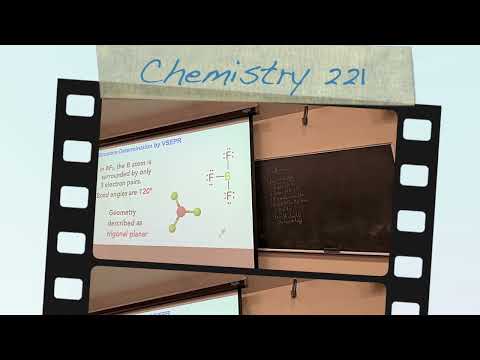
- Three electron groups form trigonal planar geometry with roughly 120-degree angles; four form tetrahedral geometry.
- Five electron groups form trigonal bipyramidal geometry, with a trigonal-planar middle and two axial positions; six form octahedral geometry.
- SF6 illustrates octahedral geometry, which includes 90-degree and 180-degree relationships between positions.
- SF4 has five electron groups around sulfur: four bonding pairs and one lone pair, giving trigonal bipyramidal electron-pair geometry.
- The lone pair occupies an equatorial position to reduce unfavorable 90-degree interactions, producing a seesaw molecular shape.
- Five electron groups can produce trigonal bipyramidal, seesaw, T-shaped, or linear molecular geometries depending on the number of lone pairs.
- Six electron groups can produce octahedral, square pyramidal, or square planar molecular geometries; molecular polarity also depends on whether bond dipoles cancel.
- Water and methane have similar molar masses, about 18 and 16 g/mol, but very different boiling points: water boils near 100 °C and methane near −161 °C.
- Water’s oxygen pulls electron density away from hydrogen, giving oxygen a partial negative charge and the hydrogen side a partial positive charge.
- A negatively charged balloon attracts and reorients water molecules, demonstrating water’s polarity despite its overall neutral charge.
- Water dissolves ionic compounds such as sodium chloride far more effectively than nonpolar methane because its partial charges interact with ions.
- A polar molecule needs polar bonds and an arrangement in which the bond-dipole vectors do not cancel.
- CO2 is nonpolar because its two C=O bond dipoles point in opposite directions along a linear molecule.
- BF3 is nonpolar overall because its three polar B–F bonds are arranged symmetrically in a trigonal planar shape.
- H2O and NH3 are polar because their lone pairs disrupt symmetry; NH4+ has four equivalent surrounding hydrogens and is symmetric.
- COCl2 is polar because its central carbon is surrounded by a double-bonded oxygen and two chlorines, not identical substituents.
- BCl3, CO2, and N2 are nonpolar examples, while ClF is polar because chlorine and fluorine have different electronegativities.
- In the series from CH4 to CCl4, the fully uniform endpoints are nonpolar, while mixed H/Cl substitution produces polar molecules.
- For the examples discussed, a nonzero dipole indicates polarity; symmetry and cancellation explain why some molecules with polar bonds remain nonpolar.
- Valence bond theory, associated here with Linus Pauling, models a bond as overlap between half-filled atomic orbitals, concentrating electron density between nuclei.
- Molecular orbital theory, developed by Robert Mulliken, combines atomic orbitals as wave functions to form molecular orbitals spread across a molecule.
- Valence bond theory is presented as practical to apply by hand, while molecular orbital theory can offer more powerful results but becomes computationally demanding.
- The molecular orbital diagram introduced for O2 previews a later comparison of the two theories.
- Atoms have an ideal bond length: at greater distances they do not bond effectively, while excessive closeness increases proton–proton and electron–electron repulsion.
- The H2 bond’s ideal length is about 74 picometers, and forming H2 releases energy.
- Overlapping two hydrogen 1s orbitals creates electron density between the nuclei; this end-on overlap is a sigma bond.
- In HF, hydrogen’s 1s orbital overlaps with fluorine’s singly occupied 2p orbital to form a sigma bond.
- Boron’s valence configuration is 2s2 2p1; its 2s and two 2p orbitals are described as mixing into three equal-energy sp2 hybrid orbitals.
- The three sp2 orbitals orient themselves trigonal-planarly, creating the 120-degree arrangement observed in BF3.
- Each singly occupied boron sp2 orbital can overlap with a fluorine orbital to form a B–F sigma bond.
- For the central atom in this model, trigonal planar electron-pair geometry maps to sp2 hybridization; the outer fluorines use atomic orbitals.
- Carbon’s 2s and three 2p valence orbitals are described as mixing into four equivalent sp3 hybrid orbitals.
- The four sp3 orbitals point toward the corners of a tetrahedron, accounting for methane’s tetrahedral geometry.
- Each carbon sp3 orbital overlaps with a hydrogen 1s orbital to form one of methane’s four C–H sigma bonds.
- The lecture’s mappings include tetrahedral to sp3 and trigonal planar to sp2, with outer atoms generally using their atomic orbitals.
- The Lewis structure and central-atom electron-pair geometry provide the route to identifying a hybrid orbital set.
- The listed mappings include linear sp, trigonal planar sp2, tetrahedral sp3, trigonal bipyramidal sp3d, and octahedral sp3d2.
- The BF3 example contains an empty p orbital, which Russell identifies as a topic for the next lecture.
Transcript excerpt
0:00 Good morning. I hope you had a great weekend. Glad to have you here. For those of you in Mondays, section L Warren. Today at Warn 10. Let's talk about here real fast. What's going on? You'll turn in self-corrected set problem set four, which is over chapter 4 stuff. Then we'll take right away, seminar self is four, which will self-correct, followed by the actual quiz four. You'll turn in the ID of the unknown compound lab from last week, which we did. Also, the rough draft class presentation paper is due. Again, that's at least 2 type pages on your element. Make sure to include the rough draft cover page, which is in the class presentations document I gave you on the 1st day, or you can get one online. just a one page kind of thing.
0:47 And also make sure you turn in at least one abstract with a citation from a science peer-reviewed article. More of anything is great. All right? So you want to turn in more than 2 pages? Fantastic. You want to turn in both of the 2 of the peer-reviewed class presentation abstract citations. Awesome, but at least one of them, those kind of things. Good to go. And then we do have a lab, we'll do the Lewis structures lab. It's really cool if you bring a printed copy. We can then work on it and laugh, or you can listen to me. I'll go through a couple of the examples from the lab in a group and then you can do what you want from there. questions on anything. All right. Vesper stands for valence, shell, electron
1:35 pair, repulsion theory, which you don't need to know, but what it means is that when electrons come together, they reap help, and they want to try and get in the farthest positions
This is the start of the transcript. Save this video free for the whole transcript, searchable and time-coded.
Related notes
Summary, takeaways, and chapters were generated by AI from the video's transcript and may contain errors. The video belongs to its creator, Michael Russell.