102326 L1 Chemistry 221 Video Lecture
 Watch on YouTube →
Overview
Michael Russell explains how to construct Lewis structures and use formal charges and VSEPR theory to infer stability, reactivity, molecular shape, and bond angles. Examples including BF3, SF4, SO2, NO2, CO2, H2O, methanol, and acetonitrile show octet-rule exceptions, resonance, odd-electron structures, and how electron-pair arrangements determine geometry.
Key takeaways
- Lewis structures should be built by counting total valence electrons, connecting the central atom to surrounding atoms, completing outer-atom octets, and placing any remaining electrons on the center.
- Boron, aluminum, and gallium often form electron-deficient structures, while beryllium can have fewer than four electron pairs; period 2 atoms cannot expand beyond an octet.
- Formal charges help compare Lewis structures: their sum must equal the molecule's or ion's total charge, and structures with fewer nonzero charges are generally favored.
- Resonance structures represent alternative electron distributions, as in SO2 and NO2; neither drawing alone fully represents the molecule's electron distribution.
- VSEPR predicts geometry from electron groups around a central atom: two groups are linear, three are trigonal planar, and four are tetrahedral, with angles near 180°, 120°, and 109° respectively.
- Electron-pair geometry includes lone pairs, while molecular geometry describes the arrangement of bonded atoms; this distinction makes NH3 trigonal pyramidal and H2O and SCl2 bent despite tetrahedral electron-pair geometry.
Chapters
- Russell lists Monday deadlines: the unknown-compound lab, problem set 4, quizzes, and a two-page class-presentation paper draft with a peer-reviewed abstract and citation.
- For BF3, boron is the central atom because it is less electronegative than fluorine; the molecule has 24 valence electrons, or 12 electron pairs.
- After three B-F bonds and fluorine lone pairs are placed, boron has only six electrons, illustrating an incomplete octet.
- October 23 celebrates Avogadro's number, 6.022 × 10^23; Russell notes the traditional celebration from 6:02 a.m. to 6:02 p.m.
- Boron, aluminum, and gallium commonly form Lewis structures with three electron pairs, while beryllium can sometimes have only two.
- These elements are exceptions to the usual octet pattern, which typically gives atoms four electron pairs.
- SF4 has 34 valence electrons, or 17 pairs; after bonding and filling the fluorine octets, sulfur retains a lone pair.
- Sulfur therefore has five electron pairs around it, exceeding the octet commonly expected in introductory chemistry.
- Russell contrasts period 2 elements, which cannot exceed an octet, with period 3 and heavier central atoms that can accommodate more than four pairs.
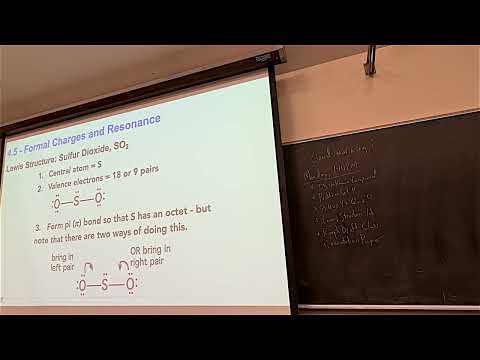
- SO2 has 18 valence electrons; completing the oxygen octets leaves sulfur with an extra pair that can be used to form a double bond.
- The double bond can be drawn to either oxygen, producing two equivalent resonance structures with no preference for one side.
- The actual molecule is described as a resonance hybrid, with electron density distributed across both S-O bonds rather than a fixed alternating double bond.
- NO2 has 17 valence electrons: 12 from its two oxygens and five from nitrogen, leaving one unpaired electron.
- Russell places the unpaired electron on nitrogen and forms an N=O double bond so nitrogen approaches an octet; either oxygen can form that double bond.
- The unpaired electron makes NO2 paramagnetic, and its resonance and electron deficiency help explain its reactivity.
- Formal charge is calculated as valence-electron group number minus the number of bonds minus nonbonding electrons; equivalently, bonding electrons can be halved.
- The formal charges on all atoms must sum to the overall charge of the molecule or ion, and structures with fewer nonzero charges are generally preferred.
- For HCN, formal charges are zero; the HNC isomer has a -1 charge on carbon and a +1 charge on nitrogen, supporting HCN as the more stable arrangement.
- The O=C=O Lewis structure gives carbon and both oxygens formal charges of zero, while a triple-bond/single-bond alternative puts +1 and -1 charges on the oxygens.
- Russell's formal-charge guide identifies common neutral patterns: carbon with four bonds, oxygen with two bonds and two lone pairs, and halogens with one bond and three lone pairs.
- In BF3, a B=F alternative would give boron a negative formal charge and fluorine a positive one, an unfavorable distribution because fluorine is highly electronegative.
- For the formate ion, the oxygen-carbon-oxygen formal charges are 0, 0, and -1; including hydrogen, their sum matches the ion's -1 charge.
- VSEPR, or valence-shell electron-pair repulsion theory, predicts arrangements by placing bonding and lone electron pairs as far apart as possible.
- Two electron groups give a linear arrangement with a 180° angle, as in CO2; three give trigonal planar geometry with 120° angles, as in BF3.
- Four groups arrange tetrahedrally rather than at 90° intervals, producing bond angles of about 109° and showing why flat Lewis-structure drawings do not convey molecular shape.
- NH3 has four electron groups around nitrogen, so its electron-pair geometry is tetrahedral; with one lone pair, its molecular geometry is trigonal pyramidal.
- H2O has two bonding pairs and two lone pairs around oxygen, giving tetrahedral electron-pair geometry but a bent molecular shape.
- SCl2 has the same two-bond, two-lone-pair arrangement as water and is also bent; Russell uses about 109° as the tetrahedral angle estimate in these examples.
- Methanol can be analyzed around both carbon and oxygen: carbon has four bonding groups, while oxygen has two bonds and two lone pairs, giving tetrahedral electron-pair arrangements at both sites.
- Russell estimates both the H-C-H angle and the C-O-H angle in methanol at about 109° using the local electron-group geometry.
- In acetonitrile, CH3-C≡N, the methyl carbon is tetrahedral at about 109°, while the carbon in the C≡N region has two electron clouds and a linear 180° arrangement.
Transcript excerpt
0:00 All right, good morning. Happy Friday. I hope your week has been going well. I'm certainly glad it's Friday. I don't know about you. Monday, 1:10 p.m. Here's what's going down. Uh the ID of the unknown compound lab you'll turn in. Problem set number four, uh have that ready to go and turn in. We'll start off by taking seminar self quiz four followed by the actual quiz four, which will have stuff over chapter four. Um for the quizzes, if you can know the Vesper names up to the tetrahedron, I totally blinked. All right. Um I'm hoping to talk about Vesper today. Uh when we get there, you'll see there's lots of names. And if you can know [clears throat] just the ones up to tetrahedron, you're going to be really great for the quiz. We will do tetrahedron and beyond in the Lewis
0:48 structures lab. There's going to be a lot of Lewis structures in our future. It's a real powerful tool for chemists. And then also on Monday at 1:10, the rough draft of your class presentation paper is due. Uh at least two typed pages, the cover page uh that I gave you with the class presentations frequently asked questions document on the first day of class, uh as well as at least one peer-reviewed uh abstract and citation. Should be good to go. Questions? Anything like that? Okay. Um as an example of the Lewis structure stuff we did on Wednesday, here's boron trifluoride. And when you want to make a Lewis structure which shows how the electrons are distributed, you have bonding pairs which are drawn as lines between the
1:36 atoms and lone pairs which are always drawn as dots. So, to create this Lewis structure in boron trifluoride, usually the first atom listed is your central
This is the start of the transcript. Save this video free for the whole transcript, searchable and time-coded.
Related notes
Summary, takeaways, and chapters were generated by AI from the video's transcript and may contain errors. The video belongs to its creator, Michael Russell.