102226 L2 Chemistry 221 Video Lecture Part III
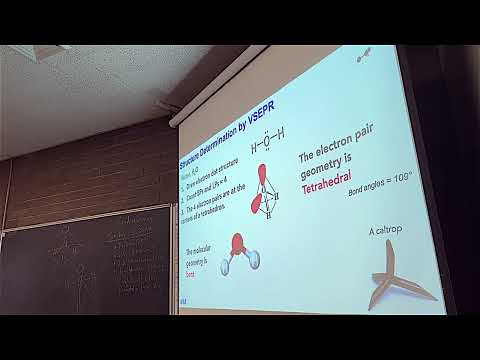 Watch on YouTube →
Overview
Michael Russell explains how VSEPR theory uses repulsion between electron domains to predict molecular geometry, approximate bond angles, and the distinction between electron-pair geometry and molecular geometry. He applies the method to molecules including NH3, H2O, BF3, SF4, and SF6, then connects molecular symmetry and polar bonds to overall polarity, using CO2, water, and substituted methane examples.
Key takeaways
- VSEPR predicts molecular arrangements by counting electron domains around the central atom; two, three, four, five, and six domains correspond to linear, trigonal planar, tetrahedral, trigonal bipyramidal, and octahedral electron-pair geometries.
- A double or triple bond counts as one VSEPR domain, so the carbon in acetonitrile's C≡N group has two domains and a linear arrangement.
- Electron-pair geometry includes lone pairs, while molecular geometry names the arrangement of atoms; NH3 is tetrahedral in electron-pair geometry but trigonal pyramidal in molecular shape.
- Molecular polarity requires considering both polar bonds and three-dimensional symmetry: the polar bonds in linear CO2 and trigonal planar BF3 cancel, while those in bent H2O do not.
- Identical substituents arranged symmetrically around a central atom often yield nonpolar molecules, as with CH4 and CCl4; replacing some, but not all, substituents can create a net dipole.
Chapters
- Lewis structures show which atoms are connected but do not specify a molecule's three-dimensional shape.
- VSEPR means valence-shell electron-pair repulsion: bonding pairs and lone pairs arrange themselves to reduce repulsion.
- For a two-domain example such as CO2, the domains point 180° apart to maximize separation.
- Two electron domains form a linear arrangement with a 180° angle, as in BeF2 or CO2.
- Three domains form trigonal planar geometry with approximately 120° angles, as in BF3.
- Four domains form tetrahedral electron-pair geometry with ideal angles of about 109.5°, rather than 90° or 180°.
- Count bonding pairs and lone pairs around the central atom to determine electron-pair geometry; four total domains correspond to tetrahedral geometry.
- NH3 has three N–H bonds and one nitrogen lone pair: its electron-pair geometry is tetrahedral, while its molecular geometry is trigonal pyramidal.
- H2O has two O–H bonds and two oxygen lone pairs: its electron-pair geometry is tetrahedral and its molecular geometry is bent.
- Electron-pair geometry includes lone pairs, while molecular geometry describes the arrangement of atoms; the two are the same when the central atom has no lone pairs.
- Sulfur in SCl2 has two S–Cl bonding domains and two lone pairs, giving tetrahedral electron-pair geometry and a bent molecular shape.
- For methanol, examine each angle around its own central atom: the carbon has four bonding domains, and the oxygen has two bonds plus two lone pairs.
- Four domains give an ideal tetrahedral reference angle near 109.5°; lone pairs can alter actual molecular bond angles.
- In acetonitrile, CH3–C≡N, the methyl carbon has four bonding domains and a tetrahedral arrangement, giving an H–C–H angle near 109.5°.
- A double or triple bond counts as one electron domain for VSEPR, not as multiple separate domains.
- The carbon in the C≡N portion of acetonitrile has two domains, so that region is linear with an angle near 180°.
- Five electron domains produce trigonal bipyramidal electron-pair geometry; PF5 is an example with five bonding domains.
- SF4 has four bonding pairs and one lone pair around sulfur, producing trigonal bipyramidal electron-pair geometry and a seesaw molecular shape.
- Six bonding domains produce octahedral geometry, as in SF6, with 90° and 180° arrangements.
- Lone-pair placement changes molecular-shape names, so Russell recommends using the geometry and polarity guide for trigonal bipyramidal and octahedral cases.
- A polar bond forms when bonded atoms have different electronegativities, but polar bonds do not guarantee a polar molecule.
- In a symmetric molecule, bond dipoles can point in opposite directions and cancel, leaving no net molecular dipole.
- Water has polar O–H bonds and a bent shape, so its charge distribution does not cancel; the molecule is polar.
- A static-charged balloon attracting a thin stream of water illustrates how polar water molecules respond to electric charge.
- CO2 has polar C=O bonds, but its linear, symmetric arrangement makes the bond dipoles cancel, so CO2 is nonpolar.
- H2O is bent because oxygen has two lone pairs, making its O–H dipoles fail to cancel and leaving a net dipole.
- BF3 is trigonal planar and has three identical B–F bonds arranged symmetrically, so it is nonpolar despite its polar bonds.
- NH3 is trigonal pyramidal with one nitrogen lone pair, which breaks symmetry; Russell identifies it as polar.
- Among BCl3, CO2, N2, and ClF, Russell identifies ClF as polar; the others have identical atoms or symmetric bond dipoles.
- For tetrahedral carbon compounds, CH4 and CCl4 are nonpolar because all four substituents are identical.
- Replacing one, two, or three hydrogens in CH4 with chlorine can create a net dipole because the substituents are no longer all the same.
- Use a Lewis structure, identify the geometry, and check whether bond dipoles cancel; the chapter concludes with the Lewis structures lab and geometry guide as practice resources.
Transcript excerpt
0:00 So earlier, we drew the ammonia Lewis structure. The version I had looked something like that. But I also said that you didn't have to draw it like that. Like you could have the lone pair on the bottom or the hydrogens and stuff like in a X, you know, whatever. A Lewis structure doesn't have any information on what the molecule actually looks like. And I really believe Excuse me. This has to do with the fact that chemists can't draw. I am really bad at drawing. Now, I've seen some of your little doodles in here. I know a lot of you draw a lot better than I do, which is freaking awesome. But you don't have to draw as an artist in chemistry. However, to understand the geometry, chemists will apply what's called Vesper to Lewis structures and you can actually figure out what the molecules look like
0:48 in space. And it's amazing. So Vesper is an acronym for valence shell electron pair repulsion theory. You'll never have to spell that or know what it is even. But what Vesper comes down to is that if you have two lone pair electrons, they're going to try and repel. All right? They could be lone pair and lone pair, bonding pair and lone pair, bonding pair lone bonding pair. They want to stay as far apart from each other as they can. So as you begin to have more bonds and lone pairs, the molecule actually takes on different forms. >> [clears throat] >> So I'm going to show you in this this little second here, uh this video. And how this video works, in the middle here would be the central atom and outside here would be outside atoms. So pretend for a second that this
1:36 is CO2. The carbon would be in the
This is the start of the transcript. Save this video free for the whole transcript, searchable and time-coded.
Related notes
Summary, takeaways, and chapters were generated by AI from the video's transcript and may contain errors. The video belongs to its creator, Michael Russell.