102226 L2 Chemistry 221 Video Lecture Part II
 Watch on YouTube →
Overview
Michael Russell develops a practical Lewis-structure workflow: count valence electrons, choose a central atom, connect atoms with single bonds, complete outer-atom octets, then adjust bonding to satisfy central-atom rules and minimize formal charges. Examples including sulfite, CO2, BF3, SF4, SO2, NO2, HCN, and formate demonstrate resonance, odd-electron species, incomplete or expanded octets, and how formal charges help compare structures.
Key takeaways
- For SO3^2-, count 26 valence electrons by adding sulfur's 6, the three oxygens' 18, and 2 electrons for the ion's negative charge.
- A reliable Lewis-structure sequence is to connect the atoms with single bonds, complete outer-atom octets first, then place leftover pairs on the central atom and add multiple bonds if needed.
- Central-atom octet exceptions include under-octet BF3, where boron has three pairs, and expanded-octet SF4, where period-3 sulfur has five pairs.
- SO2 has two equivalent resonance forms, so its bonding is better represented as a hybrid with partial double-bond character on both S-O bonds.
- Neutral NO2 has 17 valence electrons and one unpaired electron, making it a paramagnetic molecule.
- Formal charges help rank Lewis structures: prefer fewer nonzero charges, and verify that all formal charges sum to the molecule's or ion's net charge.
Chapters
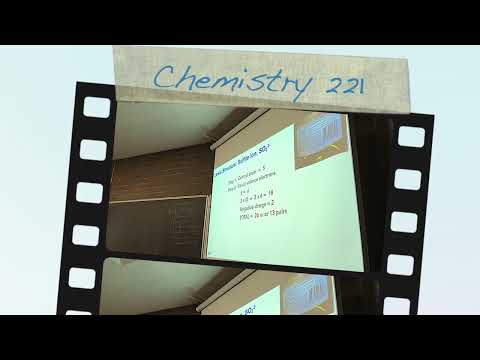
- For sulfite, SO3^2-, count 6 electrons from sulfur, 18 from three oxygens, and 2 more for the negative charge, for 26 total.
- Divide 26 valence electrons by 2 to get 13 electron pairs; negative charge adds electrons, while positive charge removes them.
- Choose sulfur as the central atom because it is listed first, is less electronegative than oxygen, and hydrogen is never a central atom in this method.
- Connect central sulfur to three outer oxygens with single bonds, using 3 of the 13 pairs and leaving 10.
- Give each oxygen three lone pairs in addition to its sulfur-oxygen bond, so all three outer atoms reach an octet.
- Place the remaining lone pair on sulfur; this initial structure gives sulfur an octet and is shown in brackets with a 2- charge.
- CO2 has 16 valence electrons, or 8 pairs, from carbon's 4 and two oxygens' 6 each.
- After connecting carbon to both oxygens and completing the oxygen octets, carbon has only two pairs, so it needs additional bonding.
- Each oxygen contributes a lone pair to form a second bond to carbon; each double bond contains one sigma bond and one pi bond, giving every atom an octet.
- Count electron pairs around each atom to check octets; carbon, nitrogen, and oxygen generally cannot exceed four pairs.
- In the N2O structure comparison, a depicted nitrogen with five pairs is the clear octet violation, while structures with four pairs around the atoms pass that check.
- Double and triple bonds are common, with examples including CO2, acetylene's carbon-carbon triple bond, and formaldehyde's carbon-oxygen double bond.
- BF3 has 24 valence electrons, or 12 pairs; after three boron-fluorine single bonds and fluorine octets, boron has only three pairs.
- Boron, aluminum, gallium, and beryllium are common exceptions that can be stable with fewer than four pairs around the central atom.
- The outer fluorines still have octets, so the incomplete octet is centered on boron rather than the surrounding atoms.
- SF4 has 34 valence electrons, or 17 pairs; after four S-F bonds and complete fluorine octets, the remaining pair sits on sulfur.
- Sulfur consequently has five pairs around it, an expanded octet that is possible for some central atoms in period 3 and below.
- First- and second-period atoms do not exceed an octet in this framework, while sulfur, phosphorus, silicon, selenium, and arsenic can be exceptions.
- SO2 has 18 valence electrons, or 9 pairs; its Lewis structures can place a double bond between sulfur and either of the two oxygens.
- Because the two double-bond placements are equivalent, the actual bonding is represented as a resonance hybrid rather than a bond that literally flips between structures.
- The resonance hybrid is described as having approximately 1.5 bond order on each side, and resonance generally increases stability.
- Neutral NO2 has 17 valence electrons, so its Lewis structure contains an unpaired electron rather than only electron pairs.
- The unpaired electron is placed on central nitrogen, and the required nitrogen-oxygen double bond can resonate between the two oxygen atoms.
- Molecules with an unpaired electron are paramagnetic; nitrogen dioxide and nitric oxide are cited as familiar examples.
- Use the simplified formal-charge calculation: valence-group number minus number of bonds minus number of lone-pair electrons.
- HCN has zero formal charge on each atom, while HNC has a -1 charge on carbon and a +1 charge on nitrogen, though both molecules are neutral overall.
- Structures with fewer and smaller formal charges are generally more stable; the sum of the atoms' formal charges must equal the molecule's or ion's total charge.
- The usual O=C=O structure gives zero formal charge on carbon and both oxygens; a triple-bond/single-bond alternative instead creates +1 and -1 oxygen charges.
- A quick reference for common zero-charge patterns includes oxygen with two bonds and two lone pairs, and carbon with four bonds and no lone pairs.
- BF3 remains most favorable with three single bonds because that arrangement keeps boron and fluorine at zero; a B=F double bond would make boron negative and fluorine positive.
- In the formate ion, HCOO-, the singly bonded oxygen has formal charge -1, while carbon and the other oxygen are zero; the charges sum to the ion's -1.
Transcript excerpt
0:00 So, earlier, we drew created the Lewis structure for ammonium, NH3. The nitrogen had a lone pair and three bonding pairs around it. We got the eight valence electrons from the fact that nitrogen was group five by valence, hydrogen was one and there's three of them, so eight valence electrons. Uh Joanna asked about the pairs, which was a really good question. Usually, you take the valence electrons divided by two to get the pairs. We distributed them and we're good to go. We're now going to look at another example of drawing a Lewis structure, and this one is uh the sulfate suppla- blankity blank sulfite polyatomic ion. And sulfites, uh if you've ever looked on the back of a wine bottle, a lot of
0:48 times wines will have sulfites. It's a preservative, but apparently a lot of people are allergic to sulfites, so that's why sometimes they have other types of wine. Just say no, kids, whatever you need to do. But anyway, sulfite, SO3-2. So, let's count the valence electrons on sulfite. Sulfur and oxygen, both in group 6A, all right? So, that means both sulfur and oxygen have six, so the one sulfur would be six electrons by itself. Three oxygens would be three times six, 18 valence electrons from the oxygens. So, six from the sulfur, 18 from the oxygens, but this also has a negative two charge. And then the negative charges are like extra electrons.
1:37 Positive charge would be fewer electrons. So, negative charges, you would add to the valence electrons. So, we're going to add two electrons here to sulfite. If you had ammonium, NH4+, uh you would take away an electron. It has fewer electrons than you might think. So, negative means to add, positive means to take away. >> Which is I'll be honest with you.
This is the start of the transcript. Save this video free for the whole transcript, searchable and time-coded.
Related notes
Summary, takeaways, and chapters were generated by AI from the video's transcript and may contain errors. The video belongs to its creator, Michael Russell.