01: Natural Selection - Evolutionary Anthropology Fall 2026
 Watch on YouTube →
Overview
Richard McElreath frames evolutionary anthropology as a historical science built on geoscience, especially radiometric dating, and explains how natural processes can produce adaptation without a designer. He presents Darwin’s three-part logic of natural selection—population growth constrained by finite resources, consequential variation, and inheritance—then illustrates it with Rosemary and Peter Grant’s study of Galápagos finches during the 1976–78 drought. He closes with evolutionary imperfections, including the giraffe’s recurrent laryngeal nerve, dolphin pelvic bones, and the developmental path of mammalian testes, and previews how modern evolutionary theory revises Darwin’s incomplete account.
Key takeaways
- Radiometric dating changed evolutionary anthropology from speculation about time to a historical science: Earth is about 4.5 billion years old, providing the timescale needed to interpret fossils and evolutionary change.
- Darwin’s natural-selection argument requires three conditions: finite environmental support, consequential variation among individuals, and inheritance of at least some of that variation.
- The Grants’ records from Daphne Major show natural selection in real time: during the 1976–78 drought, hard seeds favored deeper-beaked medium ground finches, while beak size later remained subject to changing environmental pressures and energetic costs.
- Evolutionary history can be revealed by imperfections: the giraffe’s long recurrent laryngeal nerve, dolphins’ residual pelvic bones, and the testes’ passage through the inguinal canal reflect inherited developmental constraints.
- Darwin’s account was influential but incomplete because it lacked a genetic theory of inheritance; the early-20th-century modern synthesis combined evolutionary reasoning with heredity and mathematical population genetics.
- In evolutionary anthropology, large datasets do not interpret themselves: fossil and genomic evidence is biased or incomplete, and theoretical frameworks are needed to distinguish description of change from causal explanation.
Chapters
- McElreath presents evolutionary anthropology as dependent on geoscience methods such as radiometric dating, which make dating fossils and evolutionary change possible.
- Before radiometric dating, Lord Kelvin estimated Earth’s age at roughly 20–400 million years; modern estimates place it at about 4.5 billion years.
- The acceptance of plate tectonics in the 1960s transformed explanations of how landscapes and habitats change over deep time.
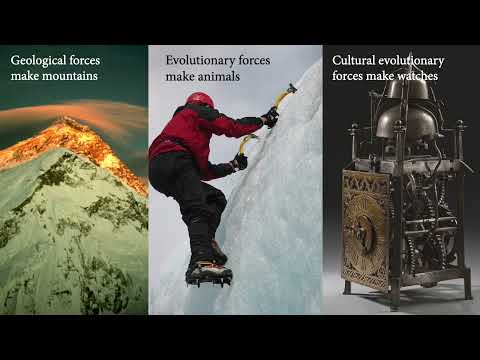
- Mountains and leaf vascular systems can look similarly complex, but erosion and continental movement shape mountains while biological development shapes leaves.
- McElreath contrasts natural structures with objects such as bicycles, whose purposes are intentionally designed, to introduce the scientific problem of biological adaptation.
- William Paley’s 1802 watch analogy argues that a complicated, functional object implies a designer; McElreath counters that even a mechanical watch depends on millennia of accumulated human knowledge and technology.
- The course moves from general evolutionary theory to primates, then to the evolution of bipedal tool-using apes and human behavior.
- The human-behavior section includes cultural and technological evolution, dispersals, urbanization, and plant and animal domestication.
- McElreath asks students to learn the field’s consensus and methods while actively finding weaknesses in arguments rather than merely memorizing conclusions.
- Many evolutionary questions cannot be tested experimentally because they concern events millions of years ago or would require unethical experiments on humans.
- Fossils are a biased and incomplete sample, while geological processes can move, crush, and distort evidence used in paleontology and archaeology.
- McElreath distinguishes describing what happened from explaining its causes, arguing that causal inference is harder than reconstructing the sequence of events.
- Large genomic datasets can crowd out theoretical training; interpreting computational results still requires population-genetic theory.
- The Earth is about 4.5 billion years old, while Homo sapiens is geologically recent and has dramatically reshaped the biosphere.
- Bipedalism evolved before the major increase in human brain size, overturning the older intuition that enlarged brains came first.
- Evidence established Africa as the origin of humans, against earlier Europe- and Asia-centered claims, including the fraudulent Piltdown fossil.
- Most traits involve many genetic loci, and human populations have repeatedly mixed rather than existing as historically pure, isolated groups.
- Ideas about life’s origins and the unity of living forms reach back to ancient philosophical traditions and diverse cultural histories.
- The 14th-century scholar Ibn Khaldun described incremental change across generations, though he lacked the later mathematical tools for a formal evolutionary theory.
- The European Enlightenment’s emphasis on empiricism and open debate helped establish the conditions for systematic evolutionary science.
- Charles Darwin supplied the foundational logic of natural selection, but he did not know about genes or modern theories of heredity.
- Gregor Mendel’s pea experiments helped establish inheritance principles that early-20th-century theorists later combined with evolutionary theory.
- McElreath calls contemporary theory post-Darwinian: it retains Darwin’s central insight while rebuilding the framework mathematically around heredity.
- Modern evolutionary research connects to medicine, agriculture, animal domestication, functional genomics, and studies of development and life-history evolution.
- Monarch caterpillars feed largely on toxic milkweed and sequester its compounds, leaving adult butterflies distasteful or poisonous to bird predators.
- The monarch’s migration and breeding cycle links its physiology to the seasonal distribution of milkweed across North America.
- McElreath uses the viceroy’s resemblance to the monarch to introduce mimicry: predators can avoid a recognizable warning pattern, creating an ecological opportunity for lookalikes.
- The example shows how complex, apparently purposeful adaptations can emerge through interactions among organisms and their environments without conscious planning.
- A fish’s lens is adapted to vision in water, where the refractive contrast differs from the air-filled environment in which human eyes operate.
- Human lenses have a different shape to focus light correctly through the eye’s fluids; a fish eye does not simply work unchanged on land.
- McElreath uses these differences to show that physiological traits can be quantitatively tuned to an organism’s environment.
- Darwin came from wealthy British families, left medical school after about two years, and gravitated toward collecting beetles, butterflies, and other specimens.
- Family connections helped him join Captain Robert FitzRoy’s HMS Beagle expedition, which departed in 1831 and returned in 1836.
- In the Galápagos, Darwin collected finches and other birds whose beaks, body sizes, and feet differed from mainland South American specimens.
- After returning to England, Darwin organized his collections and built a scientific career; he married his cousin Emma Wedgwood, a historically common marriage pattern in many societies.
- First, populations can grow beyond what finite environments can support, creating competition and a struggle for survival.
- Second, individuals vary in observable traits, and some differences affect survival or reproduction in a particular environment.
- Third, at least some consequential variation passes from parents to offspring, allowing advantageous traits to become more common.
- When all three conditions hold, natural selection can produce adaptation; McElreath emphasizes that Darwin’s framework captures key logic but is not a complete modern theory.
- Rosemary and Peter Grant have studied Darwin’s finches in the Galápagos since the 1970s, tracking thousands of birds, nests, parentage, and physical measurements.
- Daphne Major’s relatively simple ecology makes it possible to connect finch survival and reproduction with food availability and environmental change.
- The Grants’ long-term individual-level records let researchers observe selection directly in a wild population—evidence Darwin could not collect during his expedition.
- A severe southern Pacific drought between 1976 and 1978 altered Galápagos vegetation and reduced the supply of small, easy-to-crack seeds.
- As smaller seeds became scarce, the average hardness of available seeds increased, favoring medium ground finches with larger, deeper beaks.
- The Grants documented higher survival among birds better able to crack the remaining hard seeds, linking environmental limits to individual differences in survival.
- The Grants found a strong relationship between offspring beak depth and the average beak depth of the two parents, illustrating inherited variation.
- During the drought, the population’s mean beak depth increased and its variation narrowed; later environmental changes could push the trait in the opposite direction.
- Larger beaks can also impose costs: because flight is energetically expensive, a heavier beak may increase juvenile mortality when food is limited.
- Selection can therefore be directional during a drought and stabilizing when intermediate beak sizes balance seed-cracking ability against energetic costs.
- McElreath presents maladaptations and imperfect structures as evidence of evolutionary history: selection can modify inherited forms but does not redesign organisms from scratch.
- The examples include the giraffe’s recurrent laryngeal nerve, pelvic bones in dolphins, and the developmental migration of mammalian testes.
- The key distinction is between a trait that is currently adaptive and a structural remnant or complication left by the process that produced adaptations.
- The recurrent laryngeal nerve descends from the brainstem, loops around the aorta, and returns toward the jaw; in giraffes, the elongated neck makes this route especially long.
- The nerve’s detour reflects vertebrate anatomy inherited from fish ancestors, where the aorta lies close to the jaw, and developmental structures constrain how the route can change.
- Dolphins retain pelvic bones that are no longer attached to hind limbs, consistent with their ancestry among land mammals that had functional rear limbs.
- McElreath treats these features as historical traces, not as purposeful designs for the animals’ current way of life.
- In fish such as sharks, testes are located within the body; mammalian testes begin high in embryonic development and descend toward the external body wall.
- The descent passes through the inguinal canal, leaving a potential weak point in the abdominal wall.
- An inguinal hernia occurs when tissue such as the small intestine pushes through this region, illustrating a medical consequence of inherited developmental anatomy.
- Intermediate eye forms are functional and occur across living organisms, showing how complex camera-type eyes can arise through incremental changes.
- McElreath warns that personal disbelief that a structure could evolve is not evidence; empirical comparisons can reveal plausible intermediate forms.
- The assigned discussion asks students to identify what Darwin’s postulates leave unexplained, preparing for the next lecture on the modern synthesis and genetic inheritance.
Summary, takeaways, and chapters were generated by AI from the video's transcript and may contain errors. The video belongs to its creator, Richard McElreath.