VRMIT at Parallax Conference 2026
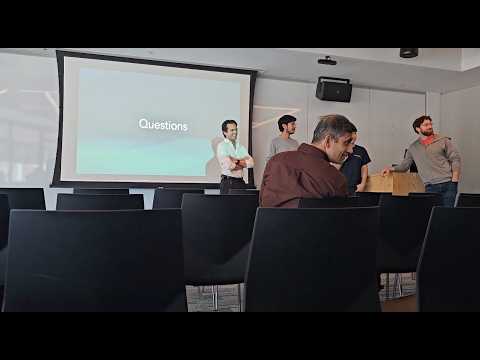
Overview
VR MIT, a team of MIT lecturers, students, and club members, is building open-source extended-reality tools to help students develop intuition for multivariable calculus, circuits, and electromagnetism. Piloted in MIT’s Experimental Study Group classes, the Godot-based system combines interactive 3D math and vector-field visualizations, circuit simulation, and dynamic electric and magnetic fields, with optimized C code supporting real-time performance.
Key takeaways
- VR MIT’s math tools let students enter arbitrary functions and explore 3D surfaces, tangent planes, level curves, and gradients from within a spatial headset view.
- The circuit workbench currently solves non-transient circuits assembled with hand gestures, while transient simulation and richer current visualizations remain planned extensions.
- Moving charges and rotating bar magnets update electromagnetic field visualizations dynamically, giving students a way to inspect otherwise invisible physical quantities.
- The team combines optimized C code and specialized symplectic solvers with Godot GDExtension and WebAssembly to target real-time performance across headsets, computers, and phones.
- Small MIT Experimental Study Group classes enable rapid classroom iteration, with instructors testing headset activities and sharing the view with the whole class.
- The open-source project could extend beyond coursework into XR development tools, including physical-object tracking and interactive inspection of transformations.
Chapters
- The team brings together MIT’s Experimental Study Group, math and physics faculty, and the VR/AR MIT club, with support from MIT educational innovation funds.
- Required MIT courses move students from AP calculus into multivariable calculus, differential equations, mechanics, and electromagnetism, where fields and forces are difficult to picture.
- The project aims to make invisible quantities immersive and interactive so students can connect equations to spatial and dynamic behavior.
- In small Experimental Study Group classes of about 12 students, instructors test headset activities and cast headset views to the classroom for shared demonstrations.
- The math module plots 3D surfaces and vector fields, with overlays including tangent planes, level curves, gradients, and slope information.
- The circuit workbench lets students assemble components and solve circuits; its demonstrated version handles non-transient analysis, with time-dependent simulation planned.
- The electromagnetism module displays electric and magnetic field lines that update as students reposition charges or rotate bar magnets.
- Students can select preset functions or enter arbitrary equations, then manipulate surfaces and tangent planes and inspect level curves and gradient vectors.
- Hand gestures let users wire circuit components and solve examples such as a resistor divider, with calculated values displayed in the headset.
- The vector-field tool supports preset and user-entered fields, letting students inspect vectors spatially from inside the 3D visualization.
- In the electromagnetism demo, users move positive and negative charges and arrange bar magnets while the resulting field patterns update dynamically.
- Ryan Maguire’s math engine and optimized C implementations use low-level vectorized math and specialized solvers to support demanding real-time visualizations.
- The team cites performance of up to 90 frames per second for suitable simulations, using specialized symplectic solvers for systems with conserved quantities.
- Godot’s GDExtension allows C functions to run alongside the project, while WebAssembly supports browser-based use; visualizations can also appear on screens and phones.
- Planned integrations include linking circuit behavior to electromagnetic fields and demonstrating energy exchange in a magnetic pendulum.
- The project is available on GitHub under an MIT-style open-source license, and the team offers conference attendees a chance to try it on a headset.
- John Bloom describes students entering their own multivariable functions and physically gathering around the resulting surfaces to explore extrema.
- Future ideas include 3D electric-field hockey, visible force vectors on moving charges, and physical objects tracked with AprilTags so fields can be overlaid in the room.
- Audience members suggest applying the visualizations to XR development and debugging; the team is interested in exploring a sandbox for inspecting and manipulating transformations and other values.
Transcript excerpt
0:01 Thank you guys very much. >> All right, beautiful. Hi, good afternoon. I think it's noon now. And our group is called VR MIT or I hope you don't pronounce it. And what we're going to do is talk about giving life to math and physics with extended reality. And like any presentation that involves a group of people that are highly motivated, show a shot, those highly motivated individuals in the middle of a meeting involving nutrition, food. Um we are from all walks of life. The MIT experimental study group which is an experimental college within MIT will get to test curriculum ideas and small scale department of math and physics and the VR AR MIT club and we made this possible with some money from the educational innovation funds at MIT. Um the team comprises these excited individuals and
0:50 one who is not here in person but whose face we will blow up. And who are we? So this is John Bloom. I am a senior lecturer in math department and also the instrumental study group. We have John undergrad sophomore majoring in electrical engineering computing. >> Hey I'm Ryan again current co-president of the club and we have >> Ryan who was a math postto now at Draper but is still contributing to the project. Christian. So I managed to avoid the overlapping variables. We don't name our variables in code this way. These are names of past undergraduate students with this as well. Fernando J and Andy Chen. Um what we're going to talk about with you is a
1:38 fundamental thing that we deal with at MIT. >> All right. So yeah, this began about a year ago. Um and I want to give you a little motivation. So at MIT we uh teach every undergrad some math
This is the start of the transcript. Save this video free for the whole transcript, searchable and time-coded.
In this course
Related notes
Summary, takeaways, and chapters were generated by AI from the video's transcript and may contain errors. The video belongs to its creator, ChristianAltoSax.