ES.1802, October 21, 2026
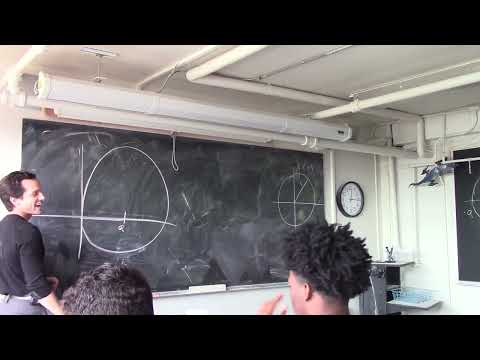 Watch on YouTube →
Overview
The lesson builds from polar coordinates to the general Jacobian change-of-variables rule for double integrals. It derives the area element r dr dθ, models a circle of radius a shifted by a as r = 2a cos θ, calculates the mass of a quarter-annulus with density x² + y², and explains how the absolute Jacobian determinant scales area between coordinate systems.
Key takeaways
- For polar coordinates, the area element is dA = r dr dθ, not simply dr dθ; the factor r accounts for the widening of angular wedges as their distance from the origin increases.
- A circle of radius a centered at (a, 0) has polar boundary r = 2a cos θ, demonstrating that a circle not centered at the origin generally does not have a constant polar radius.
- For the first-quadrant annulus with radii 1 and 2 and density σ = x² + y², the mass integral is ∫₀^{π/2}∫₁² r³ dr dθ = 15π/8.
- A smooth coordinate transformation scales local area by the magnitude of its Jacobian determinant, because the transformed coordinate directions span a parallelogram.
- When changing an integral from Cartesian coordinates to new coordinates, the area factor must be solved in the direction needed; the inverse mapping contributes the reciprocal determinant when converting dx dy into du dv.
Chapters
0:00
Polar Coordinates and the Area Element
- A point in Cartesian coordinates is represented in polar form by x = r cos θ and y = r sin θ.
- The class introduces the polar area element, which includes an extra factor of r rather than simply using dr dθ.
- Double integration in polar coordinates is presented as a way to simplify regions with circular boundaries.
2:00
Finding a Circle’s Area with Polar and Cartesian Bounds
- For a circle of radius a centered at the origin, polar bounds are 0 ≤ r ≤ a and 0 ≤ θ ≤ 2π.
- Integrating r dr dθ gives πa², matching the familiar area formula.
- A Cartesian setup requires bounds involving y = ±√(a² − x²), illustrating why polar coordinates are more convenient for circles.
7:00
Deriving the Polar Equation of a Shifted Circle
- A circle of radius a centered at (a, 0) is substituted into x = r cos θ and y = r sin θ.
- Simplifying the resulting equation gives r² = 2ar cos θ, and division by r yields r = 2a cos θ for the circle’s boundary.
- The class notes that division by r omits the origin as a solution, so it checks the boundary behavior at relevant angles.
13:50
Setting Polar Bounds for the Shifted Circle
- The shifted circle’s interior is described by 0 ≤ r ≤ 2a cos θ over the angles that sweep the region.
- A constant radial bound such as r = 2a would describe a different shape, showing why the boundary must depend on θ.
- The circle’s center is offset from the origin, so the polar coordinate r measures a varying distance from the origin, not the circle’s fixed radius.
18:10
Modeling Mass in a Quarter-Annulus
- A planar region in the first quadrant is bounded by circular arcs with radii 1 and 2.
- The mass density is σ(x, y) = x² + y², so points farther from the origin have greater mass per unit area.
- The mass is modeled as a double integral of density over the region, with polar coordinates matching both the circular boundaries and the density.
26:10
Evaluating the Quarter-Annulus Mass Integral
- In polar form, the density becomes r² and the area element is r dr dθ, making the integrand r³.
- The bounds are 1 ≤ r ≤ 2 and 0 ≤ θ ≤ π/2.
- The radial integral is ∫₁² r³ dr = 15/4, so the total mass is (15/4)(π/2) = 15π/8.
30:00
Visualizing Area Scaling Under Coordinate Changes
- A coordinate-mapping applet illustrates how a Cartesian image changes when x and y are replaced by polar coordinates.
- A small Cartesian square maps to a wedge in polar coordinates, and its area scaling produces the r factor in r dr dθ.
- The class also tests mappings such as u = x³ and v = x + y to show that general coordinate changes distort local shapes and areas.
36:30
Using the Jacobian to Transform Local Directions
- For coordinates u(x, y) and v(x, y), the Jacobian matrix is [[uₓ, uᵧ], [vₓ, vᵧ]].
- Applying the Jacobian to the Cartesian direction vectors (dx, 0) and (0, dy) gives two transformed vectors in uv-space.
- Those transformed vectors span a small parallelogram, whose area measures how the coordinate mapping scales a local area element.
43:00
The Determinant and the General Change-of-Variables Rule
- The area of the transformed parallelogram is the absolute value of the Jacobian determinant multiplied by dx dy.
- For the mapping from (x, y) to (u, v), the relation is du dv = |∂(u, v)/∂(x, y)| dx dy.
- When rewriting an integral in uv-coordinates, the inverse relation introduces the reciprocal Jacobian factor, extending the derivative adjustment used in single-variable u-substitution.
Summary, takeaways, and chapters were generated by AI from the video's transcript and may contain errors. The video belongs to its creator, ChristianAltoSax.