ES.1802, October 20, 2026
 Watch on YouTube →
Overview
The lecture develops double integrals as tools for computing area, volume, mass, centers of mass, average values, and moments of inertia, emphasizing that the integration bounds describe the region while the integrand describes what is accumulated there. A tetrahedron with axis intercepts a, b, and c illustrates how to derive a plane, project its shadow onto the xy-plane, set bounds in either integration order, and obtain volume abc/6; the lesson closes by deriving the polar area element r dr dθ.
Key takeaways
- A double integral of 1 over a region gives area, while integrating a height function over that region gives volume.
- Area density δ(x,y) integrates to mass, and multiplying density by x or y before integration gives the corresponding center-of-mass numerator.
- For a plane with positive axis intercepts a, b, and c, the intercept equation is x/a + y/b + z/c = 1 and the first-octant tetrahedron has volume abc/6.
- The bounds describe the integration region independently of the integrand; for the tetrahedron’s triangular projection, x can range from 0 to a(1-y/b) as y ranges from 0 to b.
- Polar coordinates require the area element dA = r dr dθ because a small angular change sweeps an arc of length r dθ.
Chapters
0:00
From Single Integrals to Double-Integral Area
- A single integral of 1 over an interval accumulates length, while a double integral of 1 over a region R accumulates area.
- Changing the order from dx dy to dy dx can require changing the bounds to describe the same region.
- A double integral of a height function f(x,y) over R accumulates volume above the region.
3:48
Density, Center of Mass, Average Value, and Inertia
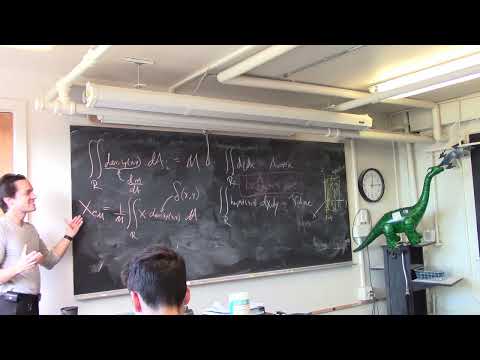
- Integrating an area density δ(x,y) over R gives total mass, because density times a small area element dA gives a small mass element.
- The center-of-mass coordinates are x̄ = (1/M)∬R xδ(x,y)dA and ȳ = (1/M)∬R yδ(x,y)dA.
- The average value of f over a region of area A is (1/A)∬R f(x,y)dA.
- Moment of inertia about a chosen axis is accumulated as ∬R distance-to-axis² δ(x,y)dA, using a varying density when mass is nonuniform.
13:48
Set Up the Tetrahedron Volume Problem
- The example asks for the volume of a first-octant tetrahedron cut off by a plane with intercepts x=a, y=b, and z=c.
- Its vertices are the origin and the three axis-intercept points (a,0,0), (0,b,0), and (0,0,c).
- The problem combines plane equations, projections onto the xy-plane, double-integral bounds, and volume accumulation.
19:41
Find the Intercept Plane and Its Height Function
- The intercept form of the plane is x/a + y/b + z/c = 1, which can also be recovered from the three intercept points.
- Solving for z gives the height function z = c(1 - x/a - y/b) above each point in the base region.
- For a volume integral, this height function is the integrand, while the projected base determines the region and bounds.
22:37
Project the Plane and Set Bounds in Either Order
- The plane’s shadow in the xy-plane is a right triangle with vertices (0,0), (a,0), and (0,b).
- The sloping edge satisfies y = b(1 - x/a), equivalently x = a(1 - y/b), as follows from its endpoints or the plane equation with z=0.
- One valid setup is ∫₀ᵇ∫₀^{a(1-y/b)} c(1 - x/a - y/b) dx dy; reversing the order uses x from 0 to a and y from 0 to b(1 - x/a).
30:01
Evaluate the Double Integral to Get Volume abc/6
- Integrate the plane’s height over the triangular base, treating the outer variable as constant during each inner integration.
- Either order of integration yields the same tetrahedron volume, abc/6, matching the familiar geometric formula.
- Keeping track of whether integration is with respect to x or y helps avoid errors when substituting the inner bounds.
34:51
Separate the Integrand from the Region of Integration
- The integrand specifies the quantity being accumulated, such as height for volume; it does not by itself determine the base region R.
- A different subset of the tetrahedron can use the same height function but produce a different volume because its bounds describe a different region.
- For an inner integral with x running from 0 to a(1-y/b), the outer y bounds can simply run from 0 to b because the inner limits already encode the triangular boundary.
- The small pieces being summed are base rectangles whose height changes with the outer variable, multiplied by the surface height to form volume pieces.
39:42
Convert Cartesian Coordinates to Polar Coordinates
- Polar coordinates describe a point by its distance r from the origin and its angle θ from the positive x-axis.
- The coordinate conversions are x = r cos θ and y = r sin θ, with r = √(x²+y²).
- Constant-r curves are concentric circles, while constant-θ curves are rays; common axis angles include 0, π/2, π, and 3π/2.
43:37
Derive the Polar Area Element r dr dθ
- A small polar area patch has radial width dr and arc length r dθ, so its area is approximately r dr dθ.
- The factor r is necessary because the arc swept by the same angular change dθ grows with distance from the origin.
- For double integrals, replace dA with r dr dθ in polar coordinates; examples follow in the next class, with more general coordinate changes and Jacobians planned afterward.
Summary, takeaways, and chapters were generated by AI from the video's transcript and may contain errors. The video belongs to its creator, ChristianAltoSax.