ES.1802, September 30, 2026
 Watch on YouTube →
Overview
The lecture develops multivariable derivatives geometrically, moving from contour lines and directional rates of change to partial derivatives and the gradient. It then motivates tangent planes by slicing a surface in the x and y directions: the resulting tangent vectors span the plane, and their cross product supplies a normal vector; the class ends by setting up a tangent-plane exercise that is not completed in the transcript.
Key takeaways
- A directional derivative is a rate of function change per step length in a specified direction; on a contour plot, it can be estimated as Δf/Δs.
- Moving along a level curve gives zero directional change, while the direction of steepest ascent is perpendicular to the level curve.
- For f(x,y), ∂f/∂x measures change with y fixed and ∂f/∂y measures change with x fixed; these values form the gradient.
- For z = f(x,y), x- and y-direction slices yield tangent vectors (1, 0, ∂f/∂x) and (0, 1, ∂f/∂y), which span the tangent plane.
- The cross product of two independent tangent vectors gives a normal to their plane, and swapping the vector order reverses the normal’s direction but not its magnitude.
Chapters
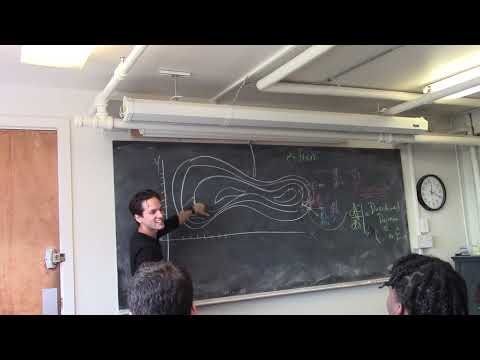
- Contour lines, also called isolines, topographic lines, or level curves, connect points where a function has the same value, such as f = 100, 200, 300, or 400.
- Walking along a contour produces zero change in height, so the directional rate of change is df/ds = 0.
- Moving toward lower contours gives a negative directional derivative; moving perpendicular to contours toward higher values gives positive change.
- The rate df/ds depends on the direction of travel, so a directional derivative must identify a direction such as u or w.
- A direction vector such as (5, 4) is not a unit vector; the lecture flags unit vectors as important when computing directional derivatives.
- The x and y axes are singled out as the standard directions used to define partial derivatives.
- The directional derivative in the i direction is the partial derivative ∂f/∂x, found by varying x while holding y constant.
- The directional derivative in the j direction is ∂f/∂y, found by varying y while holding x constant.
- For a general direction, the lecture names df/ds the directional derivative of f in that direction and identifies steepest ascent as perpendicular to the level curves.
- On a labeled contour plot, estimate df/ds by dividing the change in function value between contours by the length of the step along the indicated arrow.
- The class practices partial derivatives for f(x,y) = 1 - x² - y², obtaining ∂f/∂x = -2x and ∂f/∂y = -2y.
- For f(x,y) = xy - x², the partials are ∂f/∂x = y - 2x and ∂f/∂y = x; the other variable is treated as constant in each calculation.
- A small step in the xy-plane has components dx and dy, while its length is ds; the corresponding function change is df.
- The two partial derivatives are organized into the gradient vector, ∇f = (∂f/∂x, ∂f/∂y), which generalizes the ordinary derivative to functions of multiple variables.
- The lecture connects the gradient to the direction of greatest increase, while contrasting it with other possible directions of travel.
- In single-variable calculus, the derivative at a point determines the tangent line to y = f(x).
- For a surface z = f(x,y), tangency at a point requires a tangent plane rather than one tangent line.
- A cake-cutting demonstration is introduced to illustrate how two cross-sections through a surface can reveal the plane’s tangent directions.
- An x-direction slice holds y constant; its tangent vector can be represented as (1, 0, ∂f/∂x), using a unit change in x and the corresponding change in z.
- A y-direction slice holds x constant and gives the corresponding tangent vector (0, 1, ∂f/∂y).
- The two tangent vectors span the tangent plane, and their cross product gives a normal vector; reversing cross-product order changes only its sign.
- For an explicit surface z = f(x,y), the lecture gives a normal-vector form built from the two partial derivatives and notes that implicit surfaces require a related but adjusted method.
- The implicit-surface example x² + y² + z² = 5 contrasts with writing z explicitly as a function of x and y.
- The class begins a tangent-plane problem for z = 2xy - 5x² at the stated point (3, 2, 3), but the transcript ends before students provide or verify the equation.
Transcript excerpt
0:00 We have Okay, to summarize, we don't have your test grades. I'm going to get you a clapper. Okay. Okay. Awesome. All right. But, um, it'll be all right. It'll be all right. Um, if you if you haven't met her, Sandy, my mother-in-law, is in town. And, um, she's the S in the markup diagram of Sandy, John, and Redhead. So, you'll meet her. She'll probably come over tomorrow along with my mother. Um, and I'll probably bring over No, actually, yeah, we'll figure it out. Okay. Um, I would like to find my notes. left him in my office. All right. Um Darren, can you do me a favor? You run to the corner, grab a big black line that says 1802. You're the best. Thank you. Um so Darren doesn't miss a whole lot. Let's just recap real quick. Um what did we talk about? We talked about Fortnite and we talked about this stuff.
0:55 >> Talked about this. I'll throw one more in there. Um, >> okay. What were these? You're the best. Thank you very much. Okay. What are these called? >> Isolines. >> Isolines. >> Topographic. >> Topographic. Uh, contours, level curves. >> The thesaurus is your oyster. And the key thing here is that well actually iso you say iso iso isocines. What you call them? >> No isol because iso means same, right? isometric, isobaric, iso things you learn in thermodynamics if you ever want to know again. Um, so this is maybe f the function is 100, this is f is 200, this is f is 300 and this is f is 400. And these lines are where that value of
1:44 that function f ofxy is constant at these values. Okay, everyone's good with that. And what we were talking about was rates of change
This is the start of the transcript. Save this video free for the whole transcript, searchable and time-coded.
Related notes
Summary, takeaways, and chapters were generated by AI from the video's transcript and may contain errors. The video belongs to its creator, ChristianAltoSax.