ES.1802 September 23, 2026
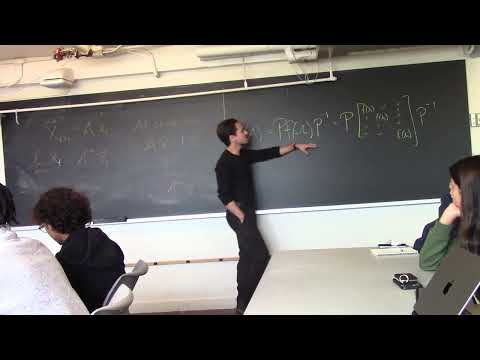 Watch on YouTube →
Overview
Christian reviews matrix diagonalization and Markov steady states, then introduces parametric motion using position, velocity, speed, acceleration, and arc length. He connects equations such as a circular path and a helix to hands-on LED and long-exposure camera demonstrations, ending with the cycloid traced by a rolling wheel.
Key takeaways
- Diagonalization writes a matrix as A = PDP⁻¹, separating a transformation into basis changes and independent scaling along eigenvector directions.
- A steady-state vector for a discrete transition system satisfies Ax = x, so it is an eigenvector associated with eigenvalue 1.
- For a parametrized path r(t), velocity is r′(t), speed is |r′(t)|, and total distance traveled is the integral of speed over the time interval.
- A circle parametrized by (R cos(ωt), R sin(ωt)) becomes a helix when a coordinate such as z(t) = t is added.
- A wheel rolling without slipping combines linear translation of its center with circular rotation, tracing a cycloid.
Chapters
- An eigenvector satisfies Av = λv: the matrix changes its magnitude by a factor of λ without changing its direction.
- Writing A = PDP⁻¹ expresses a diagonalizable transformation as a change of basis, scaling by the diagonal eigenvalue matrix D, and a change back.
- For a function of a diagonalizable matrix, f(A) = P f(D) P⁻¹; applying f to D means applying it to each diagonal eigenvalue.
- A discrete system evolves by x(t+1) = Ax(t), so its long-term behavior depends on repeated applications of A.
- At steady state, Ax = x, making the steady-state vector an eigenvector with eigenvalue 1.
- In a diagonalized system, eigenvalue components with magnitude less than 1 decay under repeated iteration; components greater than 1 can grow.
- Christian says every Markov matrix has an eigenvalue of 1 and identifies steady-state behavior as the material's final test topic.
- A 3D line through (x₀, y₀, z₀) with direction (a, b, c) has position r(t) = (x₀, y₀, z₀) + t(a, b, c).
- Reading the vector equation component by component gives x(t) = x₀ + at, y(t) = y₀ + bt, and z(t) = z₀ + ct.
- For a general trajectory r(t) = (x(t), y(t), z(t)), velocity is the componentwise derivative r′(t), and speed is its magnitude.
- Velocity r′(t) points tangent to a trajectory; the unit tangent vector is T(t) = r′(t)/|r′(t)| when velocity is nonzero.
- Acceleration is r″(t), the derivative of velocity; it is perpendicular to velocity in uniform circular motion, not for every possible trajectory.
- Displacement between times t₁ and t₂ is r(t₂) − r(t₁), while distance traveled is arc length.
- Arc length from t₁ to t₂ is ∫ₜ₁ᵗ² |r′(t)| dt, integrating speed over time.
- A circle of radius R in the xy-plane is parametrized by x(t) = R cos(t) and y(t) = R sin(t), with t from 0 to 2π for one revolution.
- Using an angular parameter ωt makes the rotation rate explicit: x(t) = R cos(ωt), y(t) = R sin(ωt).
- Adding a linear coordinate such as z(t) = t combines circular motion with forward motion, producing a three-dimensional helix.
- Christian attaches an LED to a rotating wheel and uses a DSLR long exposure of about 3 seconds to capture its path.
- The light trail makes circular and helical motion visible, while a participant's jitter suggests how small variations could be added to x(t) and y(t).
- Class demonstrations use the recorded shapes to connect parametric equations with physical motion through three-dimensional space.
- For the final demonstration, the wheel rolls without slipping while its center moves linearly and points on the wheel rotate in a circle.
- A long exposure records the resulting curve, identified in class as a cycloid.
- Christian notes that the cycloid is derived in the course notes and appears in applications involving physical systems.
Transcript excerpt
0:01 Okay, this is >> rolling >> 23rd of September 2026. Say hello to your freshman cells. Actually, Barbara, you want to practice panning it? Show everyone's face. You can also just pick it up at this point. Just go empty. There you go. Yes. Okay. This is this is and this is what Christian looks like at 301. All right. So, um I want to review one thing about um well, I want to remind you have a test next week. Okay. Tuesday or as the Brits say, Tuesday. And um it will be okay. >> Okay. Um let's review what the heck we talked about last time and then we're going to talk about parametric equations and then we're actually going to do some problem. What happened? All right. >> Well, you've been replaced. >> Oh man. >> Yeah, I know. His heart aches. We will measure the frequency of the ache of his
0:50 heart. Use some math. It's good to see you again. Okay, so let's remember what we did last time. What did we say? What did all of our conversations come from? They came from this AB= lambda B. English, please. What does this mean? >> Huh? >> Matrix. >> It's a matrix times a vector. What does the matrix do to the vector? >> Transforms it. In this particular case, what does it do? It only >> it changes the magnitude. Does not change the >> direction. Correct. It stretches it. And we know that if we have a complete matrix in um a particular number of dimensions and that means that we have a full set of igen vectors. Yes. And if we have a full set of vectors, we know that
1:39 a * vector number one vector number two. You can stop here if it's 2D or keep
This is the start of the transcript. Save this video free for the whole transcript, searchable and time-coded.
Related notes
Summary, takeaways, and chapters were generated by AI from the video's transcript and may contain errors. The video belongs to its creator, ChristianAltoSax.