The Tremendous Power Of Solar Storms | Naked Science Season 6 Episode 2
 Watch on YouTube →
Overview
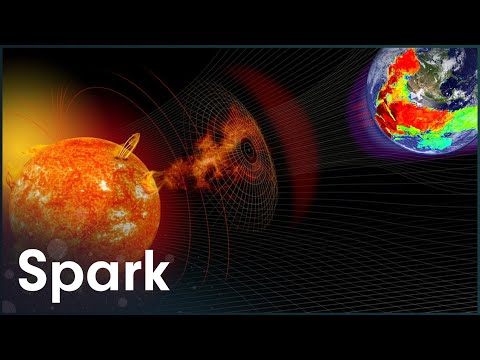
The March 1989 solar storm overloaded Quebec's power grid, cutting electricity to six million people for 12 hours, after a coronal mass ejection reached Earth from the Sun. The program explains how solar magnetic fields produce flares and CMEs, how Earth's magnetosphere and power infrastructure respond, and how evidence from the 1859 Carrington superstorm informs the modern risk. Satellites including Hinode and STEREO could improve forecasts, but precise warnings remain difficult.
Key takeaways
- The 1989 Quebec blackout began when a CME induced electrical currents in the power grid, leaving six million people without electricity for 12 hours.
- Solar flare radiation can reach Earth in about eight minutes, while a CME may take days, making the CME the more actionable warning window for grid protection.
- Earth's magnetosphere deflects most solar particles, but storm-driven changes can still disrupt radio, GPS, aircraft communications, satellites, and power systems.
- The 1859 Carrington event was estimated to be about three times stronger than the 1989 storm; modern transformer replacement delays could turn a major grid failure into a months-long crisis.
- Hinode maps solar magnetic structures that can precede flares, while STEREO's separated spacecraft provide views that help estimate CME paths and arrival times.
- Sunspot counts track the Sun's roughly 11-year activity cycle, but they signal elevated risk rather than the precise timing or direction of an individual storm.
Chapters
0:00
Quebec's 1989 Blackout Reveals the Solar Storm Threat
- At 2:44 a.m. on March 13, 1989, a transformer overload triggered a blackout that left six million people in Quebec without power.
- The outage lasted 12 hours; damage to only a few additional transformers could have taken down parts of the US East Coast.
- The cause was a solar storm from an eruption 93 million miles away, not sabotage or human error.
- A stronger storm could disrupt a continent-wide power grid and threaten services dependent on electricity.
5:58
Solar Magnetic Loops Produce Flares
- The Sun's equator rotates once every 25 days while its poles take 35 days, twisting magnetic fields that rise through its plasma atmosphere.
- Paul Bellan recreates arched magnetic fields, conductive plasma, and electric currents in a laboratory to study how unstable loops collide and release energy.
- These magnetic reconnection events produce solar flares, which can release energy equivalent to millions or more nuclear bombs.
- A flare's radiation is only the first stage of a solar storm; the more damaging material eruption can follow later.
11:50
Solar Radiation Threatens Skylab and Astronauts
- Solar radiation heats Earth's upper atmosphere from about 500 to 1,500 degrees and can expand it by as much as 1,000 miles.
- In 1979, atmospheric drag helped bring the abandoned Skylab out of orbit after heightened solar activity.
- Solar storms can increase orbital drag on the International Space Station, which ordinarily loses about 75 yards of altitude per day.
- A 1972 solar event narrowly missed the Apollo missions; astronauts on the Moon could have received a potentially lethal radiation dose without an atmosphere for protection.
17:03
Earth's Magnetosphere Channels Storm Effects into Auroras
- Earth's magnetosphere deflects most charged solar particles, but some enter near the poles and disturb the planet's magnetic environment.
- Auroras appear when solar particles collide with atmospheric gases; the March 1989 storm made them visible unusually far south.
- Solar activity can disrupt GPS and radio signals, and intense polar disturbances may force aircraft to fly lower to restore air-traffic communications.
- The visible aurora is one sign of a larger interaction between incoming solar particles and Earth's magnetic shield.
21:06
A Coronal Mass Ejection Induces Currents in Quebec's Grid
- A coronal mass ejection, or CME, sends billions of tons of magnetized, charged solar material into space; it is distinct from the flare's fast-moving radiation.
- The flare's radiation reached Earth in about eight minutes, while the CME took roughly four days to arrive during the 1989 event.
- The CME disturbed the ionosphere, creating electrical fields that induced currents at Earth's surface and surged through Quebec's power network.
- Unlike the flare's brief warning, a CME can provide hours or days of lead time, but its arrival speed and impact are difficult to estimate.
25:28
Ice Cores Trace the 1859 Carrington Superstorm
- Researchers examine nitrate spikes in Arctic ice cores as evidence of past intense solar storms.
- The September 1859 Carrington event disrupted telegraph services in North America and Europe and produced auroras reported as far south as Calcutta.
- Estimated at roughly three times the strength of the 1989 Quebec storm, the 1859 event would pose a severe risk to modern infrastructure.
- Large grid transformers can take months to replace, so a widespread outage could interrupt water, sanitation, transport, food supplies, and economic activity.
28:48
Young Stars Produce Superflares and Shape Planet Formation
- Eric Feigelson's observations found young stars producing X-ray flares up to 10,000 times stronger than the Sun's strongest flares, sometimes once or twice a week.
- The young stars in the Orion Nebula rotate much faster than the present-day Sun, and faster rotation is associated with stronger magnetic activity.
- Gibor Basri describes the early Sun as a rapidly rotating, magnetically active star with enormous starspots and magnetic structures.
- One hypothesis is that activity from the young Sun helped dust in the early solar system clump into larger bodies and eventually planets.
35:09
Hinode Maps Solar Magnetic Fields and Sunspot Cycles
- Japan launched Hinode in 2006 to map the Sun's magnetic fields; its observations captured a magnetic arc snapping and a flare erupting.
- Carol Schrijver used Hinode data to model the electrical currents that build up in intertwined magnetic structures before a flare.
- Sunspots remain a practical forecasting indicator: their numbers rise and fall in an approximately 11-year cycle, with more activity near solar maximum.
- Sunspot cycles indicate periods of heightened risk but cannot reliably say exactly when or where a particular storm will strike.
40:29
STEREO Improves CME Tracking and Solar Storm Warnings
- Space-weather forecasts remain comparatively immature because a CME aimed directly at Earth is difficult to track and measure for speed.
- NASA's twin STEREO spacecraft observe the Sun from different orbital positions, providing a three-dimensional view of CMEs along the Sun-Earth line.
- STEREO was intended to extend warning time from a few hours toward a couple of days, allowing grid operators to prepare or shut down vulnerable equipment.
- Hinode modeling and future satellite data may eventually help predict eruptions before they occur, but exact timing remains uncertain.
Summary, takeaways, and chapters were generated by AI from the video's transcript and may contain errors. The video belongs to its creator, Spark.