The Most Powerful Tornado in Recorded History 2023 | The Science of How Tornadoes Form
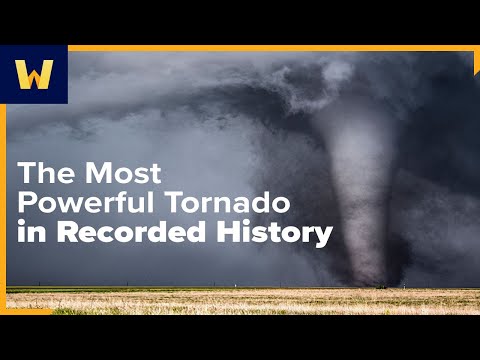 Watch on YouTube →
Overview
The Great Courses explains tornado genesis as a storm-scale process inside supercells, not simply the clash of Canadian and Gulf air masses. The core mechanism involves wind shear, wall clouds, forward- and rear-flank downdrafts, hook echoes, stretching of low-level vortices, and vortex breakdown, with the 1999 Moore, Oklahoma tornado and the 2007 EF-scale update used to show how modern radar and damage surveys improved warning and classification. The discussion connects theory to practice through the Washington, Illinois tornado, Greensburg, Kansas, mobile Doppler-on-Wheels measurements, and storm-chasing safety guidance. It also corrects common myths about tornado motion, overpasses, and ditch sheltering while emphasizing that knowledge of radar, storm structure, and warning procedures can save lives.
Key takeaways
- Tornadoes are generated by storm-scale circulation inside supercells, especially the interaction of forward-flank and rear-flank downdrafts with a mesocyclone.
- The wall cloud is not a separate storm feature but a visible lowering caused by the supercell ingesting its own near-saturated outflow air.
- Rear-flank downdraft flow can curl into vertical tubes; when one tube is stretched upward, conservation of angular momentum intensifies rotation into a tornado.
- Only about 30% of supercells produce tornadoes, because the storm’s internal circulations must line up at the right time and place.
- The 1999 Moore, Oklahoma tornado was measured by Doppler on Wheels at roughly 301 mph, making it a landmark in tornado research and a last-recorded F5 event.
- The Enhanced Fujita scale, introduced in 2007, uses 28 damage indicators and lower wind thresholds than the original F-scale, with EF5 beginning at 200 mph.
Chapters
- Challenges the oversimplified explanation that tornadoes come directly from Canada-versus-Gulf air masses.
- Defines tornado genesis as the birth of a tornado within a specific storm structure, especially a supercell.
- Introduces wind shear in the lowest mile of the atmosphere as the starting point for tornadic rotation.
- Low-level jet flow creates horizontally spinning tubes that thunderstorms tilt upright into a rotating updraft.
- That rotating updraft becomes the mesocyclone, the central engine of a supercell.
- The wall cloud forms when the storm ingests near-saturated outflow and condensation lowers the cloud base.
- Forward-flank downdraft precipitation hits the ground and spreads outward, colliding with warm inflow air.
- That collision creates small-scale wind shear and a new horizontal vortex that can be lifted beneath the mesocyclone.
- The rear-flank downdraft wraps around the storm, producing the hook echo seen on radar and contributing to tornadic rotation.
- As the rear-flank vortex is pulled upward, it bends into vertical tubes; one often survives while the other dissipates.
- Vertical stretching tightens rotation through conservation of angular momentum, allowing the tornado to form.
- Only about 30% of supercells produce tornadoes because timing and location of the storm’s internal circulations must align.
- Uses the November 17, 2013 Washington, Illinois supercell as a detailed case study with multiple tornadoes along one track.
- Radar reflectivity reveals the forward flank, hail core with softball-sized hail, rear-flank downdraft, hook echo, and debris ball.
- Field striations show a multivortex tornado, where suction vortices can leave some homes destroyed and nearby structures relatively intact.
- Explains Theodore Fujita’s original F-scale and its later 2007 upgrade to the Enhanced Fujita scale with 28 damage indicators.
- Notes that the 1999 Moore, Oklahoma tornado produced Doppler-on-Wheels wind measurements near 301 mph and was the last F5.
- Shows how the 2007 Greensburg, Kansas EF5 benefited from radar warnings, and closes with safety rules: avoid overpasses, keep a vehicle if no shelter is available, and use radar plus a clear escape plan.
Summary, takeaways, and chapters were generated by AI from the video's transcript and may contain errors. The video belongs to its creator, The Great Courses.