How One Man Won The Space Race For America (Apollo Program: Saturn V Documentary) | Spark
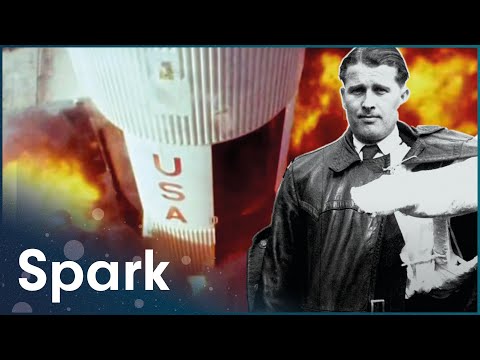 Watch on YouTube →
Overview
The Apollo program, driven by President Kennedy's 1961 goal, culminated in the Saturn V rocket, the most powerful ever built. This documentary traces its development from V2 rocket technology and the early space race spurred by Sputnik, through the engineering challenges of the F1 and J2 engines, the critical role of Project Gemini, and the tragic Apollo 1 fire, ultimately leading to the successful Apollo 11 moon landing in 1969 and subsequent lunar missions.
Key takeaways
- Wernher von Braun's expertise, gained from developing the German V2 rocket, was instrumental in the US space program, particularly in the development of the Saturn V.
- The Soviet Union's early successes with Sputnik 1 and Yuri Gagarin's orbit created a critical sense of urgency for the United States, directly fueling President Kennedy's moon landing goal.
- The Saturn V rocket's development involved overcoming immense engineering challenges, including combustion instability in the F1 engines and the complex common bulkhead design for the second stage.
- Project Gemini's 10 manned missions were crucial for developing and perfecting the techniques necessary for a lunar landing, such as rendezvous, docking, and spacewalks.
- The tragic Apollo 1 fire, while devastating, led to critical safety improvements and reinforced the determination to achieve the lunar landing goal.
- Apollo 8's mission to orbit the moon in December 1968 was a bold step that proved the Saturn V's capability and provided humanity with a new perspective of Earth from space.
Chapters
0:00
Apollo 11 Launch and Kennedy's Moon Challenge
- Apollo 11 launched in July 1969, four days from landing a man on the moon.
- President Kennedy's 1961 pledge to land a man on the moon faced immense technical challenges for NASA.
- The Saturn V rocket was developed as a colossal machine to meet this challenge.
3:37
V2 Rocket Technology and Wernher von Braun's Role
- World War II saw the development of the German V2 rocket, the first ballistic missile.
- Post-war, US agents recruited Wernher von Braun and over 100 German scientists, bringing V2 technology and paperwork.
- Von Braun and his team advanced V2 technology, developing two-stage rockets like the V2-WAC Corporal.
8:22
The Space Race and Sputnik's Impact
- The Cold War framed space exploration as a technological arms race between the US and Soviet Union.
- The Soviet launch of Sputnik 1 in 1957 shocked the US, highlighting a perceived technological gap.
- Sputnik 2, carrying the dog Laika, further intensified the crisis for the United States.
13:51
America's First Satellite and NASA's Formation
- The failed Vanguard TV3 launch on December 6, 1957, was dubbed 'Flopnik'.
- Von Braun and the US Army were tasked with launching a satellite within 60 days.
- Explorer 1, the first American satellite, launched on January 31, 1958, leading to NASA's formation in 1958.
16:54
Yuri Gagarin's Orbit and Project Mercury
- Yuri Gagarin became the first human to orbit the Earth in April 1961, a major Soviet triumph.
- This pressured the US, leading to President Kennedy's renewed commitment to space exploration.
- Project Mercury launched Alan Shepard as America's first man in space in May 1961.
20:32
Kennedy's Moon Goal and the Nova Rocket Concept
- President Kennedy, inspired by Shepard's flight, challenged NASA to land a man on the moon by the end of the decade.
- Von Braun's initial concept was the colossal Nova rocket, designed for a direct lunar landing.
- The Nova design was abandoned due to cost and complexity, leading to an alternate multi-stage rocket design.
25:11
Saturn V Development and Saturn I Testing
- The Saturn V, a three-stage rocket, was developed as an iconic symbol of the Apollo program.
- The Saturn I, a smaller test vehicle, was crucial for trialing stage designs and perfecting liquid fuel dynamics.
- Ten successful Saturn I launches between 1962 and 1965 helped perfect multi-stage designs for the Saturn V.
27:21
Engineering the Saturn V's First Stage and F1 Engines
- Construction of the Saturn V began in 1963, featuring the most powerful engines ever built.
- The first stage, 42 meters high, contained kerosene and liquid oxygen for five F1 engines.
- The F1 engines, developed since 1955, produced over 620 tons of thrust each, facing challenges with combustion instability.
32:31
Solving F1 Engine Combustion Instability
- A critical problem was combustion instability, causing engines to fail spectacularly.
- Engineers discovered that installing baffles to balance fuel flow created a smoother, more stable burn.
- The first five-engine cluster test achieved 7.5 million pounds of thrust, meeting von Braun's specifications.
38:39
Apollo Spacecraft, Saturn 1B, and Project Gemini
- Construction of the Apollo spacecraft began in parallel with the Saturn V's first stage.
- The Saturn 1B was built for flight testing the Apollo hardware and manned missions.
- Project Gemini, with 10 manned missions, developed critical techniques like rendezvous, docking, and spacewalks.
40:13
Kennedy's Assassination and Renewed Resolve
- President Kennedy was assassinated in Dallas in November 1963, creating a sense of loss.
- His death deepened the resolve to fulfill his commitment to landing a man on the moon.
- NASA defiantly pressed on with Project Gemini, making strides towards Kennedy's dream.
45:42
Saturn V's Second and Third Stages and J2 Engine Issues
- The Saturn V's third stage, with a single J2 engine, required precise firing for Earth orbit and lunar trajectory.
- The second stage faced redesigns due to the Apollo spacecraft's weight, leading to a common bulkhead design.
- Testing of the J2 engine revealed rupturing fuel tanks due to a faulty weld, requiring sophisticated modifications and over-testing.
50:30
Common Bulkhead Challenge and IBM's Instrument Unit
- The second stage's common bulkhead separated intensely cold, flammable liquids (hydrogen and oxygen) with minimal insulation.
- IBM manufactured the instrument unit, containing flight guidance, detection systems, and flight control gyros.
- The limited computing power of 1960s computers was a significant challenge for guidance and control.
Summary, takeaways, and chapters were generated by AI from the video's transcript and may contain errors. The video belongs to its creator, Spark.