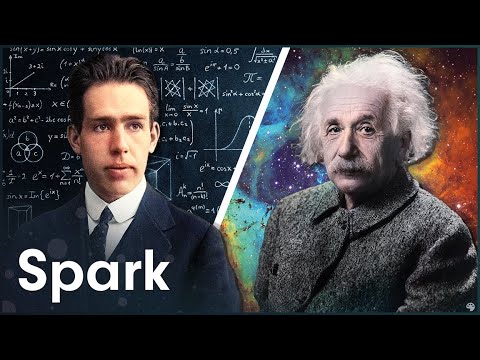
Einstein vs Bohr: The Secrets Behind Quantum Physics
 Watch on YouTube →
Overview
The history of quantum mechanics unfolds from Max Planck’s attempt to explain blackbody radiation and Albert Einstein’s 1905 light quanta to Niels Bohr’s probabilistic interpretation and the Einstein–Podolsky–Rosen challenge of entanglement. John Bell’s inequality and experiments by John Clauser and Alain Aspect later showed that quantum correlations violate the limits of local hidden-variable theories; the account closes with quantum technologies and the possibility that deeper explanations remain undiscovered.
Key takeaways
- Planck’s blackbody-radiation work exposed a failure of classical physics: the predicted ultraviolet catastrophe did not match the observed spectrum of heated objects.
- Einstein explained the photoelectric effect by proposing that light transfers energy in frequency-dependent quanta, so ultraviolet photons can eject electrons when red photons cannot.
- Electrons sent through a double slit one at a time still build an interference pattern, challenging the idea that each electron follows a simple classical path.
- Einstein, Podolsky, and Rosen proposed hidden, pre-existing particle properties to explain entanglement without faster-than-light influence; Bell later derived a testable bound for such local explanations.
- Experiments associated with John Clauser and Alain Aspect reported Bell-test violations, supporting quantum predictions over local hidden-variable theories under the tests’ assumptions.
- Quantum mechanics has practical consequences beyond its foundational puzzles, including semiconductors, lasers, quantum-security research, and materials analysis using Diamond Light Source X-rays.
Chapters
0:00
Everyday Certainty Gives Way to the Quantum World
- At everyday scales, familiar examples such as a stone’s trajectory appear predictable and governed by common-sense rules.
- At microscopic scales, quantum mechanics describes particles as capable of superposition and outcomes as probabilistic.
- The central question becomes whether quantum uncertainty reflects reality itself or limits in what can be known.
2:02
Max Planck, Light Bulbs, and the Ultraviolet Catastrophe
- Around 1900, Max Planck investigated how a heated filament’s temperature determines the frequency and color of its light.
- Blackbody measurements showed that hotter objects emit more intense, whiter light but relatively little ultraviolet radiation.
- Classical physics predicted an ultraviolet catastrophe, while Planck derived a mathematical relationship between light frequency and energy.
8:30
The Photoelectric Effect Challenges Light-as-a-Wave Physics
- In photoelectric-effect experiments, ultraviolet light removed electrons from metal while even bright red light did not.
- A gold-leaf electroscope demonstrated that ultraviolet illumination discharged a negatively charged metal surface.
- The result contradicted the expectation that brighter waves should transfer more energy and eject more electrons.
14:18
Einstein’s 1905 Light Quanta Explain the Anomalies
- Albert Einstein proposed that light arrives in discrete energy packets, later called photons, rather than behaving only as a continuous wave.
- A photon’s energy depends on its frequency, explaining why ultraviolet photons can eject electrons while lower-frequency red photons cannot.
- The quantum model also helps account for the scarcity of high-frequency ultraviolet radiation from heated objects.
- Einstein’s particle account of light conflicted with wave evidence from phenomena such as interference and diffraction.
20:39
Electron Double-Slit Interference Raises the Wave–Particle Puzzle
- In the 1920s, electron-scattering experiments revealed patterns associated with wave interference, despite electrons being treated as particles.
- In a double-slit setup, waves passing through both openings overlap to produce alternating bands of reinforcement and cancellation.
- When electrons are sent through the apparatus one at a time, individual detections accumulate into an interference pattern.
- The result extends wave–particle duality from light to matter and motivates a probabilistic description of electrons.
27:26
Bohr’s Copenhagen Interpretation and Measurement
- Niels Bohr and colleagues developed quantum mechanics to predict the outcomes of experiments involving electrons and other microscopic systems.
- Before measurement, the electron is represented by a wavefunction that gives probabilities and can produce interference across both slits.
- A measurement yields a definite detection, while the theory predicts probabilities rather than a single pre-existing trajectory.
- This family of ideas became known as the Copenhagen interpretation and drew Einstein’s objection that reality should not depend on observation.
31:40
Einstein, Podolsky, and Rosen Challenge Quantum Entanglement
- Albert Einstein, Boris Podolsky, and Nathan Rosen argued that quantum mechanics might be incomplete because entangled particles show linked measurement outcomes.
- Einstein objected to correlations that appear independent of distance, calling the implication “spooky action at a distance.”
- His alternative was that particle properties were fixed in advance but hidden from observers, like left- and right-handed gloves in separate boxes.
- The dispute asked whether quantum theory permits an objective reality with local, pre-existing properties.
36:34
Quantum Mechanics Succeeds While John Bell Pursues Its Foundations
- After World War II, many physicists focused on quantum mechanics’ practical successes rather than its interpretation.
- The theory underpins semiconductors, lasers, medical technologies, and nuclear power, encouraging a pragmatic “shut up and calculate” approach.
- John Bell, a physicist from Belfast who worked at Harwell, continued investigating whether quantum mechanics concealed a deeper reality.
- Bell sought a test that could distinguish Einstein’s hidden-variable proposal from quantum predictions.
41:43
John Bell’s Inequality Turns the Reality Debate into a Test
- John Bell published an inequality in 1964 that sets limits on correlations predicted by local hidden-variable theories.
- A card-game analogy illustrates the issue: a dealer cannot prearrange every result if measurement settings are selected only after dealing.
- If measured correlations exceed Bell’s bound, pre-set local properties cannot explain the data under the test’s assumptions.
- Bell’s mathematical result made a long-running philosophical argument experimentally addressable.
47:35
Clauser and Aspect Test Entangled Photons
- In 1972, John Clauser helped conduct an early Bell-test experiment using entangled photons; Alain Aspect’s team later improved the tests.
- A crystal generated photon pairs, and detectors measured their polarization under different settings.
- The experiment’s reported combined result was 2.53, exceeding the local hidden-variable bound of 2.
- Bell-test violations support quantum predictions and rule out local hidden-variable explanations within the experiments’ assumptions; they do not by themselves establish one unique interpretation.
53:52
Quantum Reality, Diamond Light Source, and Emerging Technologies
- The experimental results challenge Einstein’s preferred local account, but the deeper meaning of quantum measurement remains debated.
- The Diamond Light Source uses X-rays described as 10 billion times more powerful than a hospital X-ray to study materials.
- Entanglement is being applied to quantum security and communication, with faster computing among the technologies under development.
- The account concludes that quantum mechanics remains successful yet counterintuitive, and that new discoveries may still reveal deeper principles.
Summary, takeaways, and chapters were generated by AI from the video's transcript and may contain errors. The video belongs to its creator, Spark.