The Stoichiometry of Titrations L23 1412 2026
 Watch on YouTube →
Overview
Titration stoichiometry uses a measured aliquot and a known titrant to determine reactant amounts at the endpoint, with balanced-reaction mole ratios linking the two. Worked examples cover household vinegar, sulfuric acid, and cocaine, then extend the stoichiometry to equivalence-point pH and practical indicator selection, including phenolphthalein for weak acids and bromophenol blue for titrating a base with strong acid.
Key takeaways
- Titration calculations are mole-based because the solution volume changes during delivery; use the balanced equation to convert known titrant moles into unknown analyte moles.
- Keep the original aliquot volume in the denominator when calculating the unknown’s starting molarity; include the combined solution volume only for later equilibrium concentration calculations.
- Indicator choice depends on the steep pH jump near equivalence, not merely on whether an indicator changes color; phenolphthalein works well for many weak acids titrated with strong base.
- Polyprotic acids require stoichiometric coefficients that account for their acidic protons: sulfuric acid consumes two moles of hydroxide per mole of acid.
- At equivalence, a weak acid’s conjugate base can hydrolyze and raise pH above 7; for acetate, Ka = 1.8 × 10⁻⁵ leads to an estimated pH of about 9.26.
- Titration methods can quantify a component in a mixture by converting measured titrant volume to analyte mass; the cocaine example determines 45.29% by mass.
Chapters
- An aliquot is the measured sample being tested; the titrant is a well-characterized solution whose concentration and delivered volume determine its moles.
- A burette’s titer is the volume delivered, found by subtracting its initial reading from its final reading; the scale typically increases downward.
- The equivalence point is the exact stoichiometric match, while the indicator’s color change marks an observable endpoint used to estimate it.
- Drop-wise titrations can use an approximate conversion of 20 drops per milliliter, but a burette provides greater precision.
- The example titrates 100 mL of vinegar with 43.35 mL of approximately 2 M sodium hydroxide using phenolphthalein.
- Vinegar’s acetic acid reacts with sodium hydroxide in a 1:1 mole ratio to produce water and sodium acetate.
- Find the NaOH moles from its volume and molarity, use the reaction ratio to find acetic acid moles, then divide by the original 0.100 L vinegar sample.
- Because both reactants are matched at the endpoint, titration is a special limiting-reactant problem that can be solved with mole-based stoichiometry.
- The faster stoichiometry method converts NaOH volume to moles, applies the balanced equation’s mole ratio, and converts the resulting acetic acid moles to molarity.
- Do not include the added NaOH volume when calculating the vinegar’s original molarity; the original sample volume is 100 mL.
- Converting acetic acid moles to grams and then to milliliters using density gives approximately 5 mL of pure acetic acid per 100 mL of vinegar, or 5% by volume.
- Household white vinegar is typically diluted to 5% acidity; glacial acetic acid is near 100% and is hazardous and far more concentrated.
- Before equivalence, a weak-acid titration contains acid and conjugate base and behaves as a buffer; at half-equivalence, pH equals pKa.
- A strong-acid titration has a steep pH jump near equivalence, so methyl orange, litmus, and phenolphthalein can all give useful endpoints.
- For weak acids such as acetic acid, phenolphthalein is suitable because its color range, about pH 8.3 to 10.3, overlaps the steep equivalence region.
- An indicator is unreliable if its color changes gradually far from equivalence; for example, litmus can begin changing around 7 mL and continue to about 25 mL in the illustrated weak-acid curve.
- Sulfuric acid requires two hydroxide ions per acid molecule because it has two acidic protons: 1 mol H₂SO₄ reacts with 2 mol NaOH.
- The example uses 40 mL of sodium hydroxide to titrate 60.30 mL of sulfuric acid, then applies the balanced-equation ratio to determine the acid concentration.
- Millimoles are convenient when volumes are in milliliters: the milli-units cancel, avoiding conversions to liters and back.
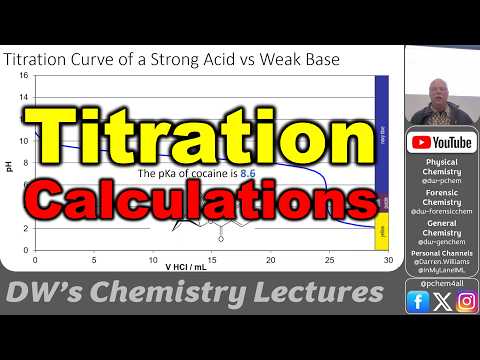
- Cocaine is treated as a weak base with pKa 8.6, so phenolphthalein’s color range would not give a suitably sharp endpoint when titrating it with strong base.
- A strong acid is used instead, with bromophenol blue changing from navy blue through purple toward yellow; stop at the purple endpoint before overshooting.
- The example titrates a 2.011 g powder sample with 24 mL of HCl and uses a 1:1 acid-base mole ratio to calculate cocaine content.
- Converting the cocaine moles to grams and dividing by the sample mass gives 45.29% cocaine by mass.
- After the stoichiometric reaction, the remaining salt can react with water, so equivalence does not always mean pH 7.
- Strong acid and strong base produce spectator ions such as Na⁺ and Cl⁻, leaving a roughly neutral solution at equivalence.
- Acetic acid and NaOH produce acetate, a conjugate base that reacts with water to form acetic acid and hydroxide, making the equivalence solution basic.
- The example has 87.44 mmol of acetate after titration and uses the combined volume of 100 mL vinegar plus about 43 mL NaOH to find its concentration.
- For the acetate hydrolysis equilibrium, acetate reacts with water to produce acetic acid and OH⁻; the weak-base approximation treats the initial change as small.
- Calculate acetate’s Kb from Kw/Ka using Ka = 1.8 × 10⁻⁵ and Kw = 1.0 × 10⁻¹⁴, then estimate [OH⁻] with the square-root weak-base expression.
- The calculation gives pOH ≈ 4.74 and pH ≈ 9.26; checking the small equilibrium change supports the approximation.
- A pH probe can map a titration curve or measure pH, while a suitable color indicator is cheaper and sufficient when the endpoint is sharp.
- Drop-wise tests and soil kits can assess pH and nutrients such as nitrate, phosphate, and potassium; measuring first can help prevent unnecessary fertilizer use.
- Excess fertilizer runoff can promote algal blooms and eutrophication; when decomposing algae consume dissolved oxygen, aquatic dead zones can form, including near the Mississippi River’s Gulf outlet.
- The same titration principles apply beyond analytical labs, from checking pool chlorine to testing household acids and bases.
Transcript excerpt
0:00 Okay, good morning. Today we're going to shift gears a little bit. We're going to We're going to leave behind equilibrium for a little bit. We'll We'll finish up with it um at the end, but we're going to talk about titration stoichiometry. Now, you did maybe a little bit of this in Gen Chem 1 with stoichiometry, but we're going to review it, so that's nice. Also, we're going to really focus in on the the vocabulary associated with titrations. But, y'all probably already done titrations in the lab, yes? Yeah. Like, how many did you have to do? Three? Did you do like a trial one and then two really careful ones? That's typically what what Yeah, what happens. Um Oh, good. So, you probably know this vocabulary, but it doesn't know It doesn't hurt to to emphasize it. So, this is What we're doing with titration
0:48 is we're actually trying to do a very careful stoichiometry experiment. So, we're trying to match the the two reactants perfectly, okay? So, the first reactant is the is the aliquot. It's just a small sample of of whatever you're wanting to um explore or or test, and then we have the titrant. So, that's a well-characterized reagent. So, we know the concentration, we know the volume that we deliver, so therefore we can count the number of moles. So, titrations really because the volume is changing all of the time as you go through the experiment, we have to get away from molarity and you use moles. So, our ICE table, the lab units for a titration ICE table are going to be moles, not molarity, because we're changing the volume all of the time.
1:36 And so, that's the titrant. And then we we have If you look at the burette, the
This is the start of the transcript. Save this video free for the whole transcript, searchable and time-coded.
Related notes
Summary, takeaways, and chapters were generated by AI from the video's transcript and may contain errors. The video belongs to its creator, DWs General Chemistry Videos.