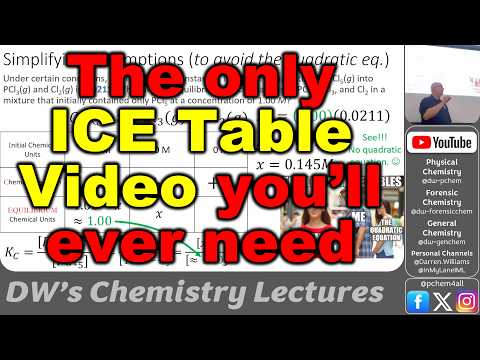
The only ICE Table Video you'll ever need 1412 2026 L19
 Watch on YouTube →
Overview
The lesson develops a decision-based method for solving equilibrium ICE tables: use initial zeros to determine reaction direction, build changes from stoichiometric coefficients, and choose between exact quadratic solutions and justified approximations based on K. Worked examples cover PCl5 decomposition, large- and small-K shortcuts, Le Chatelier shifts, equilibrium concentration and pressure calculations, and a final ammonia reaction where one measured equilibrium pressure determines the entire ICE table.
Key takeaways
- Initial zeros in an ICE table identify the direction of change: a missing product generally signals forward progress, while a missing reactant signals reverse progress.
- Solve quadratic ICE equations by checking both roots against nonnegative, physically possible concentrations; mathematical validity alone does not make a root chemically valid.
- Use the size of K to judge approximations: K far below 1 can support small x from reactant-rich conditions, while K near 1 usually cannot.
- When K is large but the initial mixture contains only reactants, first model complete conversion to products, then use a small reverse shift to simplify the equilibrium calculation.
- A measured equilibrium concentration or partial pressure can directly determine x through its stoichiometric coefficient, making an otherwise complicated ICE table straightforward.
- For gas equilibrium expressions, include each concentration or pressure raised to its balanced-equation coefficient, as in the ammonia reaction’s H2O⁶ and N2² terms.
Chapters
- Homework is formative assessment, while exams are summative; the instructor reports a 0.9 correlation between ALEKS grades and exam averages.
- ALEKS contributes 35% numerically to the weighted course average, while the instructor estimates a 91% conceptual relationship between ALEKS performance and exam performance.
- Students can recover up to 45% of the ALEKS grade by completing missed topics after active assignments end, but the 55% tied to meeting deadlines cannot be recovered.
- The advice is to spread work across the week rather than cram on deadline days, supporting retention and steadier learning.
- For PCl5 decomposition with Kc = 0.0211 and initial [PCl5] = 1.0 M, zero initial product concentrations show the reaction proceeds forward.
- The ICE changes are −x for PCl5 and +x for each product, giving equilibrium concentrations 1 − x, x, and x.
- Substituting the table into the equilibrium expression produces a quadratic equation, which has two mathematical roots that must be checked against physically possible concentrations.
- The valid root is x = 0.135 M, yielding approximately 0.865 M PCl5 and 0.135 M of each product; the negative root implies impossible concentrations.
- Because Kc = 0.0211 favors reactants, the example approximates 1 − x as 1, reducing the quadratic to x² = 0.0211.
- The approximation gives x = 0.145 M, compared with the exact value of 0.135 M, an error of about 7%.
- Subtracting the approximate x from the initial reactant concentration improves the reactant estimate to 0.855 M, close to the exact 0.865 M.
- A small K supports a small-x assumption, but K near 1 signals substantial reaction progress and makes the approximation unreliable.
- For an example with Kc = 776 and initial reactants, the equilibrium strongly favors products, so the table is first advanced all the way to the product side.
- The system then shifts backward by a small amount x; the product concentration is approximated as 1 while the initially absent reactants become x.
- The simplified expression 1/x² = 776 gives x = 0.0359, avoiding a cumbersome quadratic calculation.
- The exact value is 0.0353, so the shortcut has only about 0.8% error; the method applies when a large K opposes an initial mixture containing reactants.
- K indicates which side an equilibrium favors: large K favors products, very small K favors reactants, and K near 1 often means substantial amounts of both.
- For the carbon disulfide, oxygen, carbon dioxide, and sulfur dioxide equilibrium, adding SO2 shifts the reaction left, increasing CS2 and O2 while consuming CO2.
- Removing O2 also shifts that reaction left, which increases the other reactant CS2 and decreases the product CO2.
- For a small K when starting with products, the reverse of the large-K shortcut applies: move toward reactants, then allow a small forward shift.
- In a 250 mL flask containing 0.7 mol O2 and 1.7 mol SO3, converting moles to molarity gives initial concentrations of 2.8 M O2 and 6.8 M SO3.
- Because SO2 is not listed in the initial mixture, its initial concentration is taken as zero; that zero signals a reverse shift to produce SO2.
- For the sulfur oxide equilibrium, stoichiometric coefficients determine the ICE changes, giving the displayed equilibrium entries 2x, 2.8 + x, and 6.8 − 2x.
- When a problem gives moles and a flask volume, divide by volume in liters before entering concentrations into the ICE table.
- A carbon monoxide, water, carbon dioxide, and hydrogen example starts at 2.8 M CO, 1.6 M H2O, 4.0 M CO2, and 0 M H2.
- The zero product concentration means the reaction proceeds forward, giving equilibrium entries 2.8 − x, 1.6 − x, 4 + x, and x.
- With Kc = 1.03, the quadratic gives roots of about 0.54 and 2.84; x = 2.84 is invalid because it would make a reactant concentration negative.
- Using x ≈ 0.54 gives about 0.54 M H2, 4.5 M CO2, and 1.1 M H2O; K near 1 explains why assuming x is small would be poor.
- A pressure-equilibrium problem with K = 10⁻⁶ would produce a cubic equation if solved exactly, beyond the algebraic tools being used.
- Since K is extremely small, the reaction advances only slightly, so the approximations 12 − 2x ≈ 12 and 13 − x ≈ 13 are justified.
- The simplified calculation gives x ≈ 0.43 and an equilibrium pressure of about 0.09 atm.
- The general strategy is to inspect K before expanding the ICE expression; a well-supported approximation can avoid solving a cubic.
- For 4NH3 + 3O2 ⇌ 2N2 + 6H2O, the initial partial pressures are 4.1 atm NH3, 1.7 atm O2, and zero for N2 and H2O.
- The zero product pressures establish a forward shift, with changes tied to the reaction coefficients.
- The measured equilibrium nitrogen pressure of 0.91 atm is the key value: setting 2x = 0.91 gives x = 0.455 and lets the other equilibrium pressures be calculated.
- The final Kp expression must use the stoichiometric powers, including N2 squared and H2O to the sixth power; the example also notes ammonia’s toxicity and its high liquid vapor pressure.
Transcript excerpt
0:00 cuz we have a lot to cover. So, today's a huge day because we're going to be talking about the equilibrium ICE tables and so on. But, before we do that, let me let me walk through some of the numbers that I run. After we have a couple of exams, I like to go through and kind of see for one, I want to see how the homework system is behaving relative to the exams. Like, can you use the homework grade as sort of a gauge as to how well you're doing in the course? Because you have access to your homework grade a lot more frequently than you have access to an exam grade. And so, the homework is what we would call in education circles formative assessment. You're forming your knowledge. And then the exams are called summative assessment. They're higher stakes and they have a like a summary point. Like,
0:47 how much have you learned to this point? And there's not much you can do about the summative assessments cuz they're so infrequent. But, the homework, you can say, "Wow, I didn't get 100 I didn't get 100% on the money nice homework. I got a start earlier on the Thursday homework." So, you can adjust your behaviors with the homework much more quickly and and improve your grade that way. So, this is I'm very pleased with this. So, that did the exam analysis and the relevance of Alex. So, um what I do is I take the the the scores for all the students and I've assigned from the weighted average I assigned the grade grade categories A, B, C, D, F. Okay? So, that's why there's only five data points on here. And I take for the A group, I average all of their exam
This is the start of the transcript. Save this video free for the whole transcript, searchable and time-coded.
Related notes
Summary, takeaways, and chapters were generated by AI from the video's transcript and may contain errors. The video belongs to its creator, DWs General Chemistry Videos.