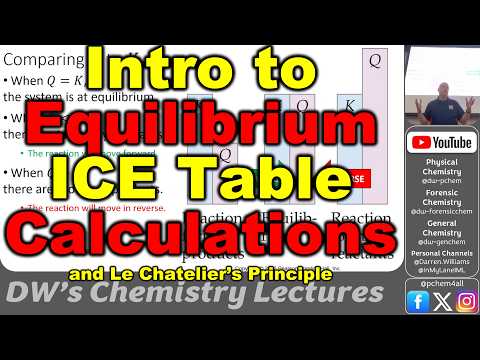
Introduction to ICE Table Calculations 1412 2026 L18
 Watch on YouTube →
Overview
Equilibrium calculations require interpreting the reaction and choosing the right approach, not following one fixed procedure. The lesson applies Le Chatelier’s principle to concentration, pressure, temperature, and catalysts, then introduces ICE tables, equilibrium-constant calculations, and ways to judge whether algebraic results make chemical sense.
Key takeaways
- At a fixed temperature, changing concentration or pressure shifts the equilibrium composition but does not change K; temperature can change K because it changes the reaction’s thermodynamic balance.
- For the Haber-Bosch reaction N₂ + 3H₂ ⇌ 2NH₃, doubling hydrogen pressure can increase the equilibrium ammonia pressure by nearly a factor of three because hydrogen’s pressure is cubed in Kp.
- An ICE table is a bookkeeping framework, not a fixed sign recipe: determine the direction of change from the initial mixture before assigning positive and negative changes.
- Pure solids and liquids are left out of equilibrium expressions; in the TiCl₄ decomposition example, only chlorine gas appears and its concentration is squared.
- A small equilibrium constant means reactants dominate, and reversing the reaction reciprocates K while multiplying all coefficients by a factor n raises K to the nth power.
- When quadratic algebra gives two candidate changes, chemical feasibility and the ICE-table direction determine which root is valid.
Chapters
- At equilibrium, forward and reverse reactions continue at equal rates, so concentrations remain steady even as molecules keep reacting.
- Equilibrium problems are not all procedural: identify what information is given and decide which part of the table or expression to use.
- An equilibrium constant remains fixed at a given temperature, even when the equilibrium position changes.
- Adding a reactant pushes equilibrium toward products, while adding a product pushes it toward reactants.
- Removing a reactant shifts equilibrium toward reactants; removing a product shifts it toward products as the system counteracts the disturbance.
- Opening a carbonated drink lowers CO₂ pressure, prompting dissolved CO₂ to leave the liquid and form bubbles.
- The Haber-Bosch process combines atmospheric nitrogen and hydrogen to produce ammonia, an important feedstock for fertilizer.
- Feeding nitrogen and hydrogen into the reaction pushes equilibrium toward ammonia; removing ammonia by cooling it into a liquid pulls products from the system.
- A catalyst increases forward and reverse reaction rates, helping the system reach equilibrium faster without changing the equilibrium constant.
- Treat heat as a product in an exothermic reaction: adding heat shifts equilibrium backward, while removing heat shifts it forward.
- The cobalt example changes from a more blue appearance when heated to a more pink appearance when cooled, illustrating a temperature-driven equilibrium shift.
- A catalyst lowers activation energy for both reaction directions but does not change the energy difference between reactants and products or the value of K.
- For N₂ + 3H₂ ⇌ 2NH₃, the pressure expression is Kp = pNH₃²/(pN₂ · pH₂³).
- When Kp and equilibrium pressures for two species are known, solve directly for the third pressure without an ICE table.
- In the example, doubling hydrogen pressure from 1 to 2 atm raises the calculated ammonia pressure from about 0.245 to 0.693 atm, nearly threefold.
- ICE means initial, change, and equilibrium; the equilibrium row supplies the concentrations used in the K expression.
- Changes are not automatically negative for reactants: their signs depend on reaction direction and the initial conditions, such as whether a species starts at zero.
- Concentrations in molarity or gas partial pressures can serve as table quantities when they track amounts of reacting substances.
- When an equilibrium concentration is supplied directly, use it to determine the change variable and calculate K without solving a more complicated equation.
- For N₂ + O₂ ⇌ 2NO at 2000 °C, the example uses KC = 4.1 × 10⁻⁴ and given equilibrium concentrations of nitrogen and oxygen to solve for NO.
- The calculated nitric oxide concentration is approximately 3.6 × 10⁻⁴ M, a small concentration that can still matter for air quality and health.
- Substituting the calculated concentration back into the equilibrium expression gives about 4.0 × 10⁻⁴, a useful check against the stated KC.
- Pure solids and liquids are omitted from equilibrium expressions because their effective concentrations do not vary in the expression.
- For TiCl₄ decomposition into solid titanium and chlorine gas, chlorine is the only variable species in the expression; its concentration is squared because its coefficient is 2.
- A K much smaller than 1 indicates reactant-favored equilibrium, while a K much larger than 1 indicates product-favored equilibrium.
- Reversing a reaction replaces K with 1/K; multiplying every reaction coefficient by 3 raises the original K to the third power.
- A full ICE-table substitution can produce a quadratic equation in x, solved with the quadratic formula, but the algebra may yield two candidate roots.
- Select the root consistent with the initial conditions and reaction direction; if a reactant starts at zero, the reaction must proceed forward rather than produce a physically impossible backward change.
- Use the table and chemical context to reject roots that imply negative concentrations or contradict the required direction of change.
- Estimating powers of ten, such as recognizing that a small K cubed remains near 10⁻¹⁵, can quickly flag calculator or exponent errors.
Transcript excerpt
0:01 All right. So, we're going to be talking about equilibrium some more today. In fact, the next really this is the largest chunk of the course. I think it's the most difficult concept in Chem2 is dealing with equilibrium because u I guess early on in science you've got a lot of things going on. You're learning a new skill and you're coming out of an education system that was almost 100% procedural. Meaning you're put in this situation. What's the procedure I follow? Follow the steps. Equilibrium is not that way. It's you've got to understand the concepts. You get dropped into a problem. It's not the same procedure every time. That's why I tried to teach you the mass action table, the tablebased way to do uh limiting
0:51 reactant problems and so on. Because once you're comfortable with that table, there's really no procedure on how to fill the table out. It depends on which column you want to fill out. And so you have to make the decision. Do I want to fill out the reactants column, you know, the first one or the second one? Do I want to do the products column? So you you have a tool, but you use the tool differently in different circumstances. Everybody follow that? So if you're thinking that these equilibrium problems are going to be procedural, they're not. you're going to drop into this problem and you're going to say, "Okay, I have to understand the situation and make a decision on how to solve the question that I'm being asked." So, let's with that in mind, let's jump into equilibrium. So, we're going to focus on Lash Lee's principle today and then we'll get into
1:38 a few of the equilibrium calculations. So, this is a great illustration. I
This is the start of the transcript. Save this video free for the whole transcript, searchable and time-coded.
Related notes
Summary, takeaways, and chapters were generated by AI from the video's transcript and may contain errors. The video belongs to its creator, DWs General Chemistry Videos.