Introduction to Equilibrium 1412 2026 L17
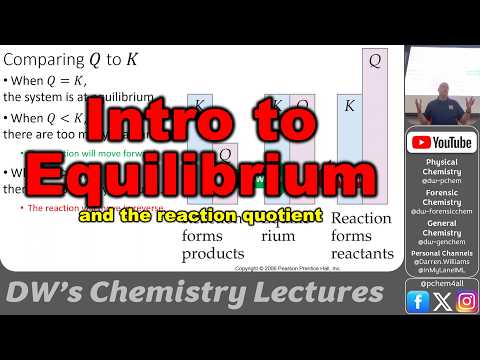 Watch on YouTube →
Overview
The lecture introduces dynamic chemical equilibrium using the N₂O₄ ⇌ 2 NO₂ system, explaining that forward and reverse reactions continue at equal rates once equilibrium is reached. It develops equilibrium expressions, Kc and Kp, reaction quotient Q, Le Chatelier’s principle, constant manipulations, and the exclusion of pure solids and liquids, then applies these ideas to solubility and gas-equilibrium examples.
Key takeaways
- Chemical equilibrium is dynamic: forward and reverse reactions continue, but their rates are equal, leaving macroscopic concentrations constant.
- Compare the reaction quotient with the equilibrium constant to predict direction: Q < K shifts forward, Q > K shifts in reverse, and Q = K indicates equilibrium.
- For a balanced reaction, equilibrium-expression exponents come from stoichiometric coefficients; Kp and Kc are related by Kp = Kc(RT)^Δn for gaseous species.
- Changing a reaction’s coefficients by a factor n raises K to the nth power, reversing the reaction replaces K with 1/K, and adding reactions multiplies their constants.
- Pure solids and liquids are excluded from equilibrium expressions; for PbCl₂ dissolution, Ksp = [Pb²⁺][Cl⁻]².
- A concentration raised to a large stoichiometric power can make an equilibrium highly sensitive to small changes; the aqueous example’s [H⁺]¹⁴ term makes acidity especially consequential.
Chapters
- The colorless N₂O₄ ⇌ 2 NO₂ system becomes browner as temperature rises and the equilibrium mixture contains more NO₂.
- Temperature changes the forward and reverse reaction rates and can shift the equilibrium composition without adding or removing molecules.
- At equilibrium, concentrations appear steady even though N₂O₄ continues forming NO₂ and NO₂ continues recombining into N₂O₄.
- Equilibrium is dynamic: the forward and reverse rates are equal, not zero, so products continue forming while also returning to reactants.
- An equilibrium expression places product concentrations over reactant concentrations, with each concentration raised to its balanced-equation coefficient.
- The N₂O₄ example illustrates why equilibrium expressions are based on the balanced reaction rather than treating the mixture as a one-way stoichiometry problem.
- Kc uses molar concentrations, while Kp uses partial pressures for gaseous species.
- Dalton’s law, Ptotal = ΣPi, lets you find an unknown partial pressure by subtracting known gas pressures from the total.
- The ideal gas law, PV = nRT, relates gas concentration to partial pressure and gives the standard relationship Kp = Kc(RT)^Δn, where Δn counts gaseous product moles minus gaseous reactant moles.
- The reaction quotient Q has the same products-over-reactants form as K, but uses the current concentrations or partial pressures before equilibrium.
- For the sulfur dioxide and oxygen example, zero products give Q = 0 and predict a forward shift; starting with products but no reactants makes Q unbounded and predicts a reverse shift.
- Q = K means equilibrium; Q < K predicts a forward shift to form products, while Q > K predicts a reverse shift to consume products.
- Adding reactant or product changes Q, and the resulting shift counteracts that disturbance until Q again equals K.
- Three CO + H₂O ⇌ CO₂ + H₂ mixtures begin with different compositions, including reactant-only and product-only starting points.
- The examples approach the same equilibrium constant, K = 0.64, despite having different starting amounts and different paths.
- A shared ratio does not require shared concentrations: the lecture compares ratios such as 100/50 and 10/5 to show how the same quotient can arise from different magnitudes.
- Multiplying every coefficient in a reaction by 2 squares its equilibrium constant; multiplying by 3 cubes it.
- Reversing a reaction swaps products and reactants, so the new constant is 1/K.
- When reactions are added, their equilibrium constants multiply, and species appearing on opposite sides cancel in both the net reaction and the combined expression.
- Pure liquids and solids have effectively constant activity, so they are omitted from equilibrium expressions; liquid water is not included when it is a pure liquid reactant.
- For PbCl₂(s) ⇌ Pb²⁺(aq) + 2 Cl⁻(aq), the solubility product is Ksp = [Pb²⁺][Cl⁻]², with no PbCl₂ term.
- A substance described as insoluble can still produce a small, nonzero ion concentration at equilibrium, which Ksp calculations can quantify.
- In the worked gas examples, solids such as CaO(s) and CaCO₃(s) are omitted; for CaCO₃(s) ⇌ CaO(s) + CO₂(g), Kp depends only on PCO₂.
- Heating calcium carbonate to produce calcium oxide releases CO₂ during concrete production; CaO can also react with CO₂ in exhaust streams to form CaCO₃.
- The final aqueous example omits a solid and a pure liquid, then raises concentrations to their stoichiometric powers, including [H⁺]¹⁴ and [I⁻]⁶.
- Because [H⁺] appears to the 14th power, even a small change in acidity can strongly change Q and drive the reaction toward a new equilibrium.
Transcript excerpt
0:00 So, we're shifting gears now, and we're actually getting into equilibrium. So, the ice tables that we've been doing have been related to like the this regular stoichiometry or like the limiting reactant stoichiometry, but we've always taken things to zero. Well, nature never hits zero, right? You've heard maybe nature abhors a vacuum, right? We never go to zero reactants cuz pretty close to zero, they can't find each other. So, things naturally slow down. And they approach a steady state called equilibrium. So, that's what today's lecture is about. We're just going to introduce this idea of equilibrium and a little bit about Le Chatelier's principle, but we'll expand upon that more in next lecture. And so, this this concept of equilibrium, this is a really great
0:47 reaction because only the products are are are colored. You know, the the reactant in this reaction is is is colorless. And so, if we have it in dry ice, this reaction shifts all the way to the left mostly. I should just say nothing perfect. So, there might be like one of these molecules that's that's the NO2, but mostly to the left at that temperature. And so, you see there's no color associated with it. And then we warm it up. Here it is in in ice water, and we form some product. You can see those products in the in the brown gas. And then we bring it up to room temperature, and now it's much much darker. So, we can track some of these reactants reactions like this with temperature. And so, we're not doing anything, you know, physically.
1:36 We're not adding or subtracting the molecules. We're just letting temperature affect the rates of the forward and reverse reaction. So, they're always it's Think of in the next lecture we we
This is the start of the transcript. Save this video free for the whole transcript, searchable and time-coded.
Related notes
Summary, takeaways, and chapters were generated by AI from the video's transcript and may contain errors. The video belongs to its creator, DWs General Chemistry Videos.