The only Buffer Solution Lecture you'll ever need 1412 2026 L22
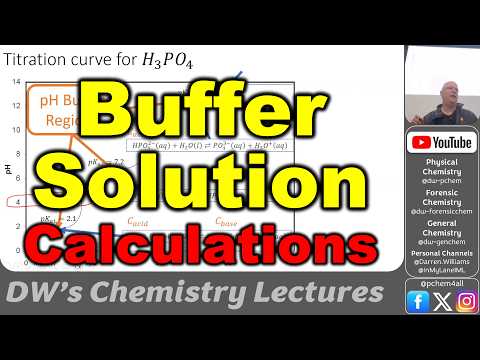 Watch on YouTube →
Overview
Buffer calculations are built from the common ion effect and the Henderson-Hasselbalch equation, pH = pKa + log([base]/[acid]). The lecture connects acid/base ratios to buffer range and capacity, then applies the ideas to titration curves, buffer selection, strong-base neutralization, ammonia, and a sodium acetate mass calculation; the final worked example contains an arithmetic inconsistency that changes its stated result.
Key takeaways
- For a weak-acid buffer, pH = pKa + log([conjugate base]/[acid]); equal concentrations give pH = pKa.
- Adding a common ion such as acetate to acetic acid suppresses further acid dissociation by shifting the equilibrium toward the undissociated acid.
- A buffer is most effective near its pKa, while buffer capacity increases with the total concentrations of the acid and conjugate base, not merely their ratio.
- The three phosphoric acid buffer regions occur near pH 2.1, 7.2, and 12.4; choosing a buffer far from its pKa puts the target in a steep, poorly buffered region.
- For a base buffer such as NH3/NH4+, use the conjugate acid pKa, found from pKa = pKw - pKb, and place base concentration over conjugate-acid concentration in the ratio.
- The final sodium acetate example states a target pH of 5.7 but calculates with a difference of -0.18, which corresponds to pH 4.57; the target instead requires a base-to-acid ratio of about 8.9.
Chapters
- For 1.0 M acetic acid and 1.0 M sodium acetate, acetate is the common ion and sodium is a spectator ion.
- The initial acetate concentration shifts the weak-acid equilibrium toward reactants, making the acid dissociate less than it would in pure acetic acid.
- Using Ka = 1.8 × 10^-5 gives [H3O+] ≈ 1.8 × 10^-5 M, pH ≈ 4.74, and pOH ≈ 9.26.
- Taking the negative logarithm of the Ka expression gives pH = pKa + log([A-]/[HA]).
- When acid and conjugate base concentrations are equal, the ratio is 1, its log is zero, and pH equals pKa.
- For an acetic acid/acetate buffer with equal concentrations, pH is about 4.74.
- With 1.0 M acetate and 0.5 M acetic acid, the ratio is 2, so log(2) raises pH by about 0.30 above pKa.
- Reversing the concentrations gives a ratio of 0.5 and lowers pH by about 0.30 below pKa.
- The examples show that changing the ratio tunes pH while keeping it near the acid's pKa.
- During phosphoric acid titration with NaOH, relatively flat portions of the curve mark buffer regions where added base causes limited pH change.
- The three approximate pKa values are 2.1, 7.2, and 12.4, corresponding to successive deprotonation steps.
- Near each pKa, an acid and its conjugate base coexist; steep endpoint regions are less suitable for buffering.
- Biological systems such as blood rely on limited pH variation because enzymes and proteins can be disrupted by pH changes.
- A buffer works best near its pKa, so phosphoric acid is a poor choice for a pH 10 buffer because its curve is steep near pH 10.
- Ammonium, with pKa about 9.25, is closer to pH 10 than phosphoric acid's buffer regions.
- For a pH 7 buffer, sulfurous acid's second pKa of 7.2 is suitable; hydrogen sulfide's pKa near 7.05 is closer numerically but poses a serious toxicity hazard.
- For sulfurous acid's second dissociation, pKa = 7.2 and target pH = 7 require [SO3^2-]/[HSO3-] = 10^-0.2 ≈ 0.631.
- Different absolute concentrations can produce the same pH if their base-to-acid ratio remains 0.631.
- The more concentrated recipe has greater buffer capacity because more acid or base must be added to change the ratio substantially.
- When mixing equal volumes of two stock solutions, each stock must be twice its desired final concentration to account for dilution.
- In the HF and NaOH example, 2.0 M OH- consumes 0.9 M HF completely in the stoichiometric step, leaving excess OH- and forming 0.9 M F-.
- The remaining OH- suppresses the reverse reaction that would reform HF; the equilibrium HF concentration is only about 10^-11 M.
- For a propanoic acid/propanoate mixture, set up the ICE table with the initial acid, conjugate base, and hydronium concentrations, and include the reaction change terms.
- Ammonia is the base and ammonium from ammonium chloride is its conjugate acid.
- Convert the base's Kb to the conjugate acid's pKa using pKa = pKw - pKb, with pKw = 14 at 25°C.
- The Henderson-Hasselbalch form uses base over conjugate acid; the example with 0.81 M NH3 and 2.1 M NH4+ gives pH about 8.84.
- An ICE-table solution is possible, but the ratio equation is shorter when both buffer components are present.
- The recipe problem starts with 100 mL of 0.5 M acetic acid and asks how much sodium acetate will produce a pH of 5.7.
- The procedure is to find pKa, solve Henderson-Hasselbalch for the required base-to-acid ratio, convert the required base concentration to moles using volume, then convert moles to mass using molar mass.
- The transcript's arithmetic is inconsistent: pH 5.7 and pKa about 4.75 require a ratio near 8.9, not 0.66; for 0.050 mol acetic acid this is about 0.446 mol, or 36.6 g of anhydrous sodium acetate.
- The spoken result of 2.7 g corresponds to roughly 0.033 mol and would not produce the stated target pH under the given assumptions.
Transcript excerpt
0:00 So, today we're going to be talking about buffer solutions. It doesn't have anything to do with buffering like in a computer, but how we buffer acid-base chemistry. Okay? And so, we're going to do the calculations associated with that. Um this is also called the common ion effect. So, let's focus on that for a little bit. We've been doing lots of ice tables with acid-base chemistry, but there's something interesting about this one. This one is different than the previous ones. And notice that when we talked about general um ice table calculations before we got to acid-base, they were pretty complicated. We had water to the sixth power or some other compound of the fourth power and so on. Acid-base is super easy cuz we don't have anything really to the second, third, or fourth power. We do protons one at a time, and so all of our coefficients are
0:47 essentially one. And this makes it even easier. It's called the common ion effect. So, what is this idea of common ion? Look at this. I've got a a solution that is acetic acid and sodium acetate. So, in this reaction, this is the acetic acid, and this is the sodium acetate. So, this is the the conjugate base. And it's it's already in solution. So, notice there's already some here. It's not a zero. So, all the ones last time we did, there was a zero molar here. Okay? And so, whenever we're in the problem, we see a
1:34 concentration of the acid and a concentration of the base or the conjugate base or even a any other kind of common ion. Like maybe we have a pH of uh of acetic acid in HCl. So, now we're talking about we know something about this column. We've already got a
This is the start of the transcript. Save this video free for the whole transcript, searchable and time-coded.
Related notes
Summary, takeaways, and chapters were generated by AI from the video's transcript and may contain errors. The video belongs to its creator, DWs General Chemistry Videos.