The Nernst Equation and Electrochemistry 1412 2026 L31
Overview
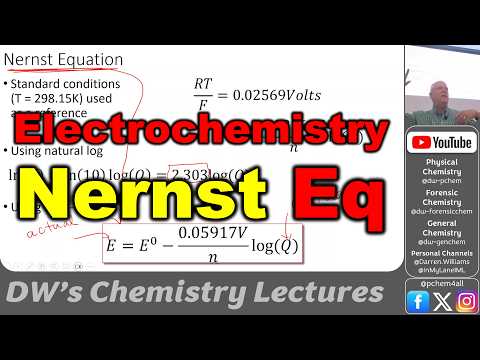
Galvanic-cell voltage changes with concentration according to the Nernst equation, E = E° − (RT/nF) ln Q, which reduces at 25 °C to a form using 0.05917 V and base-10 logarithms. Worked examples connect reaction quotients to battery discharge, cell notation, concentration-cell voltages, Faraday’s constant, and electrolysis of molten magnesium chloride.
Key takeaways
- At 25 °C, the Nernst equation can be written E = E° − (0.05917 V/n) log Q; when Q = 1, the correction is zero and E equals E°.
- Increasing product concentrations raises Q and reduces galvanic-cell voltage, while increasing reactant concentrations lowers Q and increases voltage.
- The electron count n comes from the balanced redox reaction: the aluminum-manganese example transfers six electrons, so its Nernst correction is divided by 6.
- Standard reduction potentials are intensive quantities: reverse a half-reaction by changing the sign of its potential, but never multiply the potential when scaling the reaction.
- A concentration cell produces voltage from unequal ion concentrations even with identical metal electrodes; a 1,000-fold concentration difference in the example gives 0.087 V.
- Electrolysis reverses the energy flow of a galvanic cell: molten MgCl₂ electrolysis uses an external battery to produce liquid magnesium at the cathode and chlorine gas at the anode.
Chapters
- Standard cell conditions use 1 M dissolved species and 1 bar gases, giving Q = 1.
- At Q = 1, ln Q = 0, so actual cell potential equals standard potential, E°.
- Faraday’s constant is 96,485 C/mol, relating electrical charge to moles of electrons.
- The Nernst equation is E = E° − (RT/nF) ln Q; at 25 °C, RT/F is 0.02569 V.
- Using base-10 logarithms at 25 °C gives the correction term 0.05917/n times log Q.
- Adding products raises Q and lowers cell voltage, while adding reactants lowers Q and raises voltage.
- At equilibrium, Q reaches K and the actual cell voltage falls to zero.
- In the aluminum-manganese reaction, Al(s) changes from oxidation state 0 to +3, so aluminum is oxidized and is the reducing agent.
- Mn²⁺ gains electrons to form Mn(s), so manganese ions are reduced and are the oxidizing agent.
- The balanced reaction transfers six electrons, so n = 6 in the Nernst equation.
- For [Al³⁺] = 0.001 M and [Mn²⁺] = 2 M, the product-poor, reactant-rich mixture gives a small voltage increase above E° = 0.48 V.
- Cell notation places the anode and oxidation half-reaction on the left, and the cathode and reduction half-reaction on the right.
- Vertical bars mark phase boundaries, including metal-solution interfaces and the salt bridge junction.
- Copper-silver and magnesium-aluminum cells use reactive metal electrodes, while platinum can provide a conductive, inert surface for reactions involving dissolved species.
- An inert platinum electrode conducts electrons without itself becoming a reactant.
- In the copper-silver example, Cu(s) is oxidized to Cu²⁺ and Ag⁺ is reduced to Ag(s).
- In the magnesium-aluminum example, Mg(s) loses electrons and Al³⁺ gains them.
- For chlorate becoming perchlorate, chlorine rises from +5 in ClO₃⁻ to +7 in ClO₄⁻, identifying chlorate as the species oxidized.
- Oxidation-state changes identify the full reacting species even when an inert electrode such as platinum appears in the notation.
- The oxidation half-reaction converts I⁻ to I₂, while acidic permanganate is reduced to manganese species.
- Reduction-potential tables list half-reactions as reductions, so the iodine half-reaction must be reversed and its potential sign changed for oxidation.
- Balancing the half-reactions cancels ten electrons; multiplying a half-reaction does not multiply its potential.
- The calculated standard cell potential is 0.97 V, and permanganate acts as the oxidizing agent.
- A worked aluminum-copper calculation uses Q = [Al³⁺]²/[Cu²⁺]³ = 0.73 and n = 6 to find a nonstandard potential near +2.02 V.
- A concentration cell can generate voltage even when both electrodes use the same metal, because different ion concentrations make E°cell = 0 but Q ≠ 1.
- For a metal sulfate solution at 0.0015 M on one side and 1.5 M on the other, the concentration ratio is 1,000 to 1.
- The concentration-cell calculation gives 0.087 V; the concentrated-side electrode is positive as metal ions plate out there.
- A joule equals a coulomb-volt, an ampere equals a coulomb per second, and a watt equals a joule per second.
- Faraday’s constant connects one mole of electrons to 96,485 C.
- The example converts 820 mA and elapsed time into charge, then divides by Faraday’s constant to find moles of electrons transferred.
- An external battery drives electrolysis in molten MgCl₂ using inert graphite electrodes.
- At the cathode, Mg²⁺ gains electrons to form liquid magnesium, which can collect and drain from the electrode.
- At the anode, chloride ions lose electrons and produce chlorine gas.
- The process illustrates how electrical energy can extract saleable magnesium and chlorine from a mined salt.
Transcript excerpt
0:01 today. today we're going to focus on really using the galvanic cell to make real batteries and look at the voltages that come out when you don't have normal conditions or or standard conditions. So, we're going to look at the dependence upon concentration. So far, all of the cells that we've made with the anode and the cathode and the reduction and oxidation reactions and so on have been at standard conditions. And so you can look up the voltage in the tables and just use it as is and get the voltage for that cell. So, that would be the little E zero. The zero indicates one molar concentrations, one bar pressures if it's a gas. Okay. So, let's let's move this around. Okay. Let me just make sure my mic is
0:49 working before I record a whole class. Yeah. Okay, it's going. Okay. And so yeah, then I talked about last time, don't let Batman slap you in the face by multiplying those potentials. Okay. So so we're we've covered oxidation reduction chemistry. We balanced redox reactions. Last time we did the galvanic cells and their voltages. This one is focused on the Nernst equation and non-standard voltages. So, that's today's lecture. And then there's actually I I I put down like six lectures for this whole topic, but they really really really only need five. Okay. So, Friday we're going to finish up electrochemistry and we're going to switch to nuclear chemistry on Monday. Okay. So, I know in the schedule it shows like two more lectures in electrochemistry. We're just going to do
1:35 one more. So, so next lecture will be on on actual batteries and on corrosion and electroplating. Okay. So, you can see where you're like your your costume jewelry and things like that, how we
This is the start of the transcript. Save this video free for the whole transcript, searchable and time-coded.
In this course
Related notes
Summary, takeaways, and chapters were generated by AI from the video's transcript and may contain errors. The video belongs to its creator, DWs General Chemistry Videos.