Radiochemistry and Nuclear Transformations 2026 1412 L34
Overview
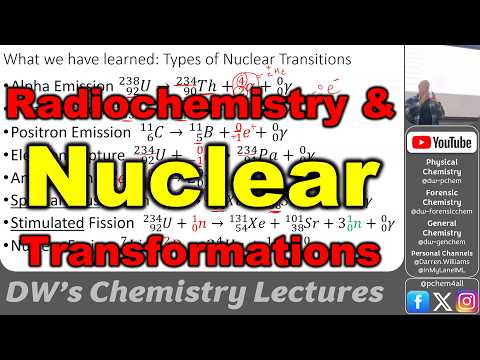
Radiochemistry explains how isotope notation tracks protons and neutrons, and how nuclear changes can turn one element into another while conserving nucleon number and charge. The lecture connects the history of atomic models, from J. J. Thomson and Ernest Rutherford to particle accelerators, with alpha and beta decay, positron emission, electron capture, fission, fusion, and practical radiation demonstrations.
Key takeaways
- An isotope's element is determined by its proton count, while its isotope identity depends on its neutron count; for example, carbon-14 has 6 protons and 8 neutrons.
- Nuclear equations conserve total proton number and nucleon number even when the element symbols change, as uranium-238 alpha decay forms thorium-234 and helium-4.
- Alpha decay moves an element two positions left on the periodic table, while beta-minus decay moves it one position right; positron emission and electron capture move it one position left.
- Technetium-99m and carbon-11 demonstrate how radioactive isotopes can serve as medical tracers, with gamma-ray detection enabling heart scans and PET imaging.
- Radiation hazards depend on both radiation type and exposure route: paper stops external alpha particles, but ingested alpha emitters can cause substantial internal damage.
- Fission reactors generate heat through neutron-driven chain reactions, and control rods regulate power by absorbing neutrons.
Chapters
- The atomic number gives the proton count and determines the element; the mass number is the total number of protons and neutrons.
- Find neutrons by subtracting atomic number from mass number: chlorine-35 has 17 protons and 18 neutrons.
- Isotopes such as carbon-12, carbon-13, and carbon-14 share six protons but have different neutron counts.
- A chart of nuclides maps isotopes by proton and neutron counts and distinguishes stable nuclei from radioactive ones.
- Carbon-14 has a half-life of about 5,700 years; the lecture uses roughly 10 half-lives as a practical detection horizon.
- A cloud chamber makes charged particles visible when they leave trails of droplets in supersaturated ethanol vapor.
- Henri Becquerel's uranium salts exposed photographic plates, while Wilhelm Röntgen's experiments established X-rays as a separate discovery.
- J. J. Thomson used cathode-ray deflection to determine the electron's charge-to-mass ratio and helped establish the CRT technology later used in televisions.
- Robert Millikan's oil-drop experiment measured the elementary charge as about 1.6 × 10⁻¹⁹ coulombs.
- Combining Millikan's charge with Thomson's ratio gave the electron's mass and established that atoms contain charged particles.
- Thomson's plum-pudding model pictured electrons embedded in diffuse positive charge.
- Ernest Rutherford's alpha particles mostly passed through gold foil, but rare large deflections revealed that positive charge is concentrated in a tiny nucleus.
- Rutherford proposed a strong nuclear force to account for the positive charges packed together in the nucleus.
- Particle accelerators use electric fields to accelerate charged particles and magnetic fields to steer them; collisions reveal products through their detector tracks.
- The lecture compares accelerator scales, including Fermilab's rings and CERN's Large Hadron Collider, whose tunnel is about 27 kilometers around.
- Technetium, atomic number 43, has no stable isotopes, unlike most elements found in the middle of the periodic table.
- Technetium-99m is used in medical imaging, including scans that show blood flow in the heart's arteries.
- A Geiger-Müller counter detects radioactive events; the lecture recounts a heart-stress-test patient whose recent technetium injection raised the meter reading.
- Many elements heavier than lead have radioactive isotopes because very large nuclei are often unstable.
- An alpha particle is a helium-4 nucleus; alpha decay lowers the parent atomic number by 2 and its mass number by 4.
- Uranium-238 alpha decay produces thorium-234, illustrating how nuclear equations balance proton number and nucleon number rather than element symbols.
- Beta-minus decay converts a neutron into a proton, moving the daughter element one place right on the periodic table without changing mass number.
- Positron emission lowers atomic number by 1; carbon-11 can be used in glucose tracers for PET imaging because positrons annihilate with electrons and produce detectable gamma rays.
- In electron capture, a nucleus absorbs an inner electron and a proton converts into a neutron, reducing atomic number by 1 while leaving mass number unchanged.
- The lecture illustrates electron capture with uranium changing from atomic number 92 to protactinium at 91.
- When a positron meets an electron, their mass converts into energy and produces gamma rays traveling in opposite directions.
- PET scanners use pairs of detectors registering simultaneous gamma-ray events to distinguish tracer signals from background radiation.
- Spontaneous fission splits a heavy nucleus into two lighter nuclei and may release neutrons and gamma rays.
- A uranium-234 fission example balances as xenon-131, strontium-101, and two neutrons, conserving both total nucleons and proton count.
- In a reactor, released neutrons can trigger additional fissions; control rods absorb neutrons to regulate the chain reaction and heat output.
- Fusion combines light nuclei: the lecture describes lithium and deuterium producing helium nuclei and a neutron under extreme compression.
- A Geiger-Müller tube clicks when radiation triggers an electrical pulse; background readings in the demonstration were about 13 to 14 events per minute.
- The lecture demonstrates uranium glass and an orange Fiestaware plate as examples of consumer objects containing radioactive material.
- Americium-241 in ionization smoke detectors emits alpha particles, which travel only a short distance in air and are stopped by paper or skin.
- Beta particles pass through paper more readily than alpha particles; alpha emitters pose greater danger if radioactive material is ingested.
- Vitrification encases radioactive waste in glass, reducing its solubility and limiting its dispersal.
Transcript excerpt
0:01 Okay. So, we're gonna we're going to really switch gears today. Uh get into radio chemistry and uh this is in this is in a freshman text. You can see it's like chapter I don't know 22 or 23 or something like that. Um and and not everybody covers it. I mean some people cover like the inorganic chemist. They like to cover uh uh coordination chemistry or whatever for the last you know thing. Other people will pick maybe an environmental chapter or something. There's a bunch of things in that Gen Cam book. I know that y'all may want the money if you did buy the book, but keep that book. I mean, it's so good in terms of what it covers that the Gen Cam book is just a wonderful reference you can always go back to. There's so much in it that we haven't covered in the Gen Cam 1 and two. But one of the chapters is this
0:48 radiochemistry chapter. So, you know, whenever we balance the the chemical equations, what's the very first thing we tell you in in Chem 1? Like you look at what do you look at on the left and right side of the equation in order to balance it? >> Oxygen. >> Well, oxygens. But but even more generally, what do you look at? >> Coefficients. >> Yeah, coefficients. And what do you want to make sure balances on both sides? That's an easy question. Yeah. The number and types of elements, right? So, you don't have a nitrogen on the left and no nitrogen on the right. You got to figure out a way to get the same number and types of elements on the left and right. Not today because the elements start changing into
1:37 other elements.
This is the start of the transcript. Save this video free for the whole transcript, searchable and time-coded.
In this course
Related notes
Summary, takeaways, and chapters were generated by AI from the video's transcript and may contain errors. The video belongs to its creator, DWs General Chemistry Videos.