The Insane Real Engineering of the Nazi Enigma Machine
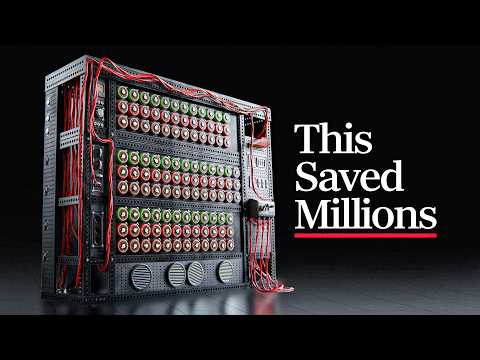 Watch on YouTube →
Overview
The Enigma’s rotating rotors, plugboard, and daily keys created an enormous search space, but German procedural mistakes and a fundamental machine flaw gave codebreakers exploitable openings. Marian Rejewski’s Polish work, Alan Turing’s Bombe, and Gordon Welchman’s diagonal board enabled Bletchley Park to read German traffic, with Enigma intelligence helping Allied operations and potentially shortening the war by up to two years.
Key takeaways
- Enigma changed its substitution with every keypress because the rightmost rotor advanced each time, while the other rotors turned at their turnover positions.
- Germany’s repeated encryption of three-letter message keys created a mathematical weakness that Marian Rejewski exploited to reconstruct military rotor wiring without capturing a military Enigma.
- German operators weakened their own security by choosing predictable indicators and moving rotors only slightly from daily settings, creating the cillies and Herivel tip.
- Enigma could never encrypt a letter as itself, a reflector-driven flaw that helped Alan Turing identify valid cribs and build logical tests for candidate settings.
- Turing’s Bombe tested rotor settings in parallel, and Gordon Welchman’s diagonal board cut false stops by over 90%, turning a promising method into a usable codebreaking system.
- Enigma intelligence informed Allied decisions from the Battle of Britain to the U-boat campaign, and historical estimates suggest its breaking shortened World War II by up to two years.
Chapters
- A message decrypts only when the receiving Enigma matches the sender’s settings, including rotor positions and wiring configuration.
- German operators changed network settings daily, forcing Allied codebreakers to solve a fresh configuration to read each day’s traffic.
- By 1939, German forces sent hundreds of encrypted messages daily, making timely decryption an urgent intelligence problem.
- Arthur Scherbius patented Enigma in 1918 as a commercial encryption machine; Germany’s military later modified it with different rotor wiring and a plugboard.
- Current passed through three wired rotors, a reflector, and back through the rotors; each keypress advanced the rightmost rotor and changed the substitution.
- The commercial machine offered over 100,000 arrangements from rotor order and starting positions; German ring settings and plugboard swaps expanded the key space dramatically.
- Daily key sheets specified shared settings so operators on the same network could encrypt and decrypt messages.
- British intelligence established its main wartime codebreaking operation at Bletchley Park, recruiting academics and Royal Navy Wrens while imposing strict secrecy.
- The initial team intercepted radio traffic, searched messages for patterns, and tested candidate settings on Enigma machines.
- By July 1939, the British lacked the military rotor wiring needed to reproduce German encryption, leaving them unable to solve the settings problem from scratch.
- A German cipher-office employee supplied French intelligence with Enigma procedures, sample messages, and key sheets; France shared the material with Poland.
- Marian Rejewski used permutation theory and a flaw in the repeated encryption of three-letter message keys to reconstruct military Enigma’s rotor wiring by 1933.
- Polish codebreakers built replica machines and could read German military traffic by the mid-1930s.
- In 1939, Germany expanded to five rotors and ten plugboard swaps, increasing the key space to over 100 sextillion; Poland shared its knowledge and Bomba device with Britain and France.
- German operators chose predictable indicators, called cillies, such as girlfriend names or abbreviations like CIL for Cilla.
- John Herivel noticed that many operators moved their rotors only a few positions from the daily settings, creating clusters in message starting letters.
- The Herivel tip used those clusters to infer daily ring settings, reducing the settings that codebreakers needed to test.
- A demonstration message was solved by combining a guessed plaintext indicator, the Herivel tip, rotor-order testing, and plugboard guesses; real traffic usually offered less convenient clues.
- Alan Turing used predictable messages, including daily weather reports, to propose cribs, or likely plaintext aligned against ciphertext.
- Enigma’s reflector ensured that no letter could encrypt as itself, letting codebreakers reject crib alignments containing a matching letter.
- Turing represented letter relationships across rotor positions as loops; a correct setting should preserve those loops, while incorrect settings usually broke them.
- His electrical test reduced plugboard possibilities through contradictions: if a proposed setting implied one letter was connected to multiple letters, that setting could be rejected.
- With engineer Harold Keen, Turing built the Bombe, a machine using 36 Enigma-like units to test candidate settings in parallel.
- The first prototype arrived in March 1940 and could scan 17,576 right-rotor positions in about 13 minutes for a given rotor order.
- A Bombe stop indicated a possible solution, not a guaranteed one; operators had to check candidates for plugboard contradictions and false positives.
- Gordon Welchman’s diagonal board linked reciprocal plugboard possibilities, eliminating over 90% of false stops in many cases and making the Bombe practical.
- By the end of 1941, Britain had 16 Bombes operating and routinely deciphered German Army and Luftwaffe traffic.
- Enigma intelligence helped British commanders assess German strength during the Battle of Britain and revealed shortages of fuel and supplies before the Second Battle of El Alamein in 1942.
- The German Navy added a fourth rotor, forcing Turing’s team to develop new statistical methods and obtain captured key sheets and cribs; British forces also used mine-clearing operations to generate plaintext clues.
- By 1943, British and American efforts had mastered U-boat Enigma; historians estimate that breaking Enigma shortened the war by up to two years.
- Sir Dermot Turing cautions against defining Alan Turing only by his persecution and death, noting his ambitious computing work between 1945 and 1950.
- Before the Normandy landings, Allied leaders needed to verify that deception about the Pas-de-Calais had misled Germany.
- Hitler did not use Enigma for his own communications; another machine had an estimated key space of 10^170 and remained classified for decades.
- One wartime Naval Enigma message remains undeciphered, underscoring that some encrypted traffic still resists analysis.
Transcript excerpt
0:00 This is the Enigma, the encryption machine used by the Nazis in World War two. I see that there is a sigil from the Nazi Party on this one, so it must be the real thing. Yes. This was actually used by the Germans in World War II. Someone actually asked me the other day, did Hitler use this machine? And I said, I don't know, but Benedict Cumberbatch and Keira Knightley did. Woah, no way! Could we try encrypting a word? Yeah. - I have just a word for us. You'd never guess what it is. - So that's our plaintext. That is our plaintext. So we need to press the keys. And look at the lamps that light up, which will give us our ciphertext. So the first one is V. We have a J. Okay. Then an E. - F - Then an R. We have an M. That is an L.
0:49 Now for someone to decrypt this message they need to type this text into another Enigma machine. But not just any enigma. Their machine has to be set up in the exact same way as the one that encrypted the message. So we need to turn these rotors back to the initial setting. That means adjusting a series of rotors and wires to exactly one of trillions of possible combinations. If you get it right.... Finally, the L gives us: - Veritasium It worked. Yeah. The message appears, but if just a single setting is out of place, well, then the encryption remains unbroken. I can see how decrypting such a thing would get very complicated very quickly. This is exactly what the Nazis relied on. Hitler had come into power in Germany and the Nazi Party had taken over. Today we rule Germany.
1:37 Tomorrow the world.
This is the start of the transcript. Save this video free for the whole transcript, searchable and time-coded.
Related notes
Summary, takeaways, and chapters were generated by AI from the video's transcript and may contain errors. The video belongs to its creator, Veritasium.