Solubility Product Constant Calculations L25 1412 2026
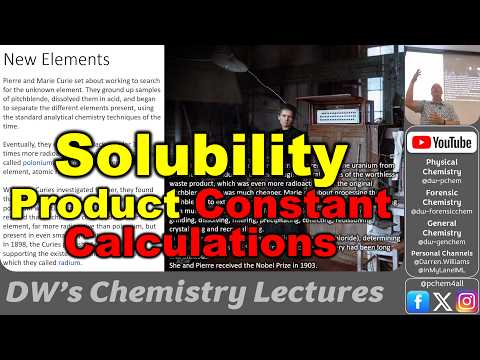 Watch on YouTube →
Overview
The lecture develops solubility-product calculations from equilibrium principles, showing how precipitation, chelation, pH, and common ions change how much of a sparingly soluble salt remains dissolved. Worked examples cover AgCl, silver carbonate, and iron(III) hydroxide, while qualitative-analysis flowcharts and Marie Curie's work illustrate how selective precipitation is used to separate and identify metals.
Key takeaways
- For AgCl at 25 °C, Ksp = 1.77 × 10⁻¹⁰ and the 1:1 dissolution stoichiometry gives a molar solubility of approximately 1.33 × 10⁻⁵ M.
- A Ksp value alone does not rank solubility across salts with different ion ratios; stoichiometric coefficients change both the powers and numerical factors in the Ksp expression.
- A common ion suppresses dissolution: adding OH⁻ to Fe(OH)₃ or fluoride to a fluoride-containing equilibrium shifts the system toward the solid.
- For salts that release basic anions such as CO₃²⁻, acidic conditions can increase solubility by consuming the anion, while basic conditions can reduce solubility.
- Chelation keeps metal ions such as Ag⁺ or Pb²⁺ in solution by binding them, which can oppose precipitation-based purification and is also used in heavy-metal treatment.
- Convert between molarity and g/L only after completing the Ksp calculation, using the compound’s molar mass; to infer Ksp from measured solubility, convert the reported mass concentration to molarity first.
Chapters
- Soluble sugar is a non-electrolyte, while NaCl dissociates into ions and sparingly soluble AgCl remains mostly solid in water.
- Temperature and pH can change solubility; adding acid can dissolve metal hydroxide precipitates by consuming OH⁻.
- Ammonia binds dissolved Ag⁺ through chelation, reducing its availability to recombine with Cl⁻ and shifting AgCl dissolution toward solution.
- Chelating agents such as citric acid can keep toxic metals like lead dissolved, affecting both wastewater treatment and biological metal removal.
- In the Lewis definition, electron-pair acceptors are acids and electron-pair donors are bases; Ag⁺ accepts lone-pair interactions from ammonia.
- The BH₃ and NH₃ example shows boron accepting nitrogen’s lone pair to complete boron’s octet without transferring a proton.
- For precipitation, compare the reaction quotient Q with Ksp: Q < Ksp permits more solid to dissolve, Q = Ksp is saturation, and Q > Ksp favors precipitation.
- A pH gradient can produce a metal hydroxide precipitate where acid and base concentrations meet.
- Adding HCl precipitates the chloride group, including AgCl, Hg₂Cl₂, and PbCl₂; centrifugation separates the solids from the remaining solution.
- Thioacetamide releases H₂S in solution as a safer alternative to directly bubbling toxic H₂S, precipitating sulfides of metals such as copper, cadmium, and arsenic.
- Basic ammonium sulfide separates additional metal groups, including Al, Fe, and Cr hydroxides and sulfides of Zn, Ni, Co, and Mn.
- Phosphate precipitation removes another group, leaving highly soluble Group 1 cations such as Na⁺, Li⁺, and K⁺ for further identification.
- Qualitative analysis identifies what is present, while quantitative analysis determines how much; a historical laboratory exercise combined precipitation tests with a lithium flame test.
- An 1898 edition of Sherwood’s qualitative-analysis text contains a metal-separation flowchart similar to modern schemes.
- Marie Curie used repeated chemical separations on pitchblende residues and radiation measurements to track and concentrate radioactive materials.
- The lecture connects precipitation chemistry to the identification of polonium and radium, noting that similar chemical behavior can cause radium to accompany barium in sulfate precipitates.
- For AgCl(s) ⇌ Ag⁺ + Cl⁻, an ICE table gives equal equilibrium concentrations, [Ag⁺] = [Cl⁻] = x.
- Using Ksp = 1.77 × 10⁻¹⁰ at 25 °C gives x = √Ksp, approximately 1.33 × 10⁻⁵ M.
- Pure solids are omitted from the Ksp expression; some solid must remain for the dissolved ions to reach saturated equilibrium.
- Ksp depends on temperature, so a tabulated value such as the 25 °C value applies only at that temperature.
- For a 1:1 salt MA, dissolution produces x of each ion and Ksp = x², so molar solubility is √Ksp.
- For salts producing three or more ions, stoichiometric coefficients change the Ksp expression; for example, an MA₂ salt gives Ksp = 4x³.
- Ksp values can rank solubility directly only within compounds that share the same dissolution stoichiometry.
- For a 1:3 salt M₃A, the expression includes (3x)³x = 27x⁴, so its Ksp cannot be compared directly with that of a 1:1 salt.
- For Ag₂CO₃(s) ⇌ 2Ag⁺ + CO₃²⁻, the equilibrium concentrations are 2x and x, giving Ksp = (2x)²x = 4x³.
- Calculate x by taking the cube root of Ksp/4; the lecture demonstrates entering scientific notation and a root operation on a TI-30 calculator.
- For a salt producing three metal ions and one anion, the expression includes (3x)³x and therefore a factor of 27 before solving for the fourth root.
- Always use the stoichiometric multiple of x when calculating an ion concentration; x represents formula-unit molar solubility, not necessarily each ion’s concentration.
- In pure water, dissolving Fe(OH)₃ produces three OH⁻ per dissolved formula unit, so hydroxide concentration must be calculated from the stoichiometry.
- For a solution at pH 10, pOH = 4 and [OH⁻] = 1.0 × 10⁻⁴ M before accounting for additional dissolution.
- The pre-existing OH⁻ is a common ion that shifts Fe(OH)₃ dissolution toward the solid and sharply suppresses dissolved iron.
- The worked comparison gives iron solubility of about 2.3 × 10⁻⁶ M in pure water versus roughly 4.87 × 10⁻⁹ M at pH 10, illustrating a reduction of about three orders of magnitude.
- Ksp calculations use molar concentrations; convert the resulting molar solubility to g/L by multiplying by the compound’s molar mass.
- For silver carbonate, the lecture converts the calculated molarity to mass concentration using the molar mass supplied in the homework system.
- When solubility is given as 0.51 g/L, convert it to mol/L first, substitute the result into the stoichiometric Ksp expression, and solve for Ksp.
- Spectroscopy can measure very low dissolved concentrations, providing experimental data for calculating solubility products.
- Adding a common ion such as fluoride from NaF lowers the solubility of a sparingly soluble salt compared with its solubility in pure water.
- A salt that releases carbonate can become more soluble in acidic conditions because acid consumes carbonate-derived basic species; basic conditions suppress dissolution.
- Ba(OH)₂ solubility is also pH-sensitive because OH⁻ is a product, whereas KCl solubility is not substantially affected by pH because K⁺ and Cl⁻ do not participate in acid–base reactions.
- Selective precipitation and common-ion control are used to reduce dissolved metal concentrations in wastewater; the lecture closes by previewing pH and liquid–liquid extraction applications in forensic drug separation.
Transcript excerpt
0:01 Okay, so today we're talking about non-electrolytes, the solubility of insoluble things. And so I had to come up with something that would So this little guy's dissolving, so he must be an electrolyte. You know, you know, they you put a you know, sugar Well, sugar's not an electrolyte, but it's soluble in water. But you put sodium chloride in water and it just gets ripped apart by the water. Okay? But you put silver chloride or lead chloride in water and the party's over and they're still there. So So we're talking about solubility equilibrium calculations today. And so we can affect solubility in many ways. I mean, temperature makes things more soluble for at least solids. Um we can change pH. And so at the end of today's lecture, we're going to talk about solubility and then we're going to add pH in there because if something
0:48 produces a basic ion or anion, um then pH is going to be important. And then same thing too, if you have a precipitate, like a hydroxide precipitate cuz it's not very soluble in water, but you put that in acid, it's going to make it more soluble cuz it's going to chew up the hydroxide and then that iron or metal doesn't have any hydroxide to precipitate with. So we're basically using Le Chatelier's principle. So these are some factors that that affect solubility. Um you know, you put this strong electrolyte uh in water and it'll dissolve. But but also sometimes, like in this case, this is silver chloride. And silver chloride is not soluble in water. But if you have something in solution that will hold on to one of
1:36 those, like the chloride or or the um silver, then it will again, Le Chatelier's principle will push that
This is the start of the transcript. Save this video free for the whole transcript, searchable and time-coded.
Related notes
Summary, takeaways, and chapters were generated by AI from the video's transcript and may contain errors. The video belongs to its creator, DWs General Chemistry Videos.