SlowDown jjPHY203 FA25
Overview
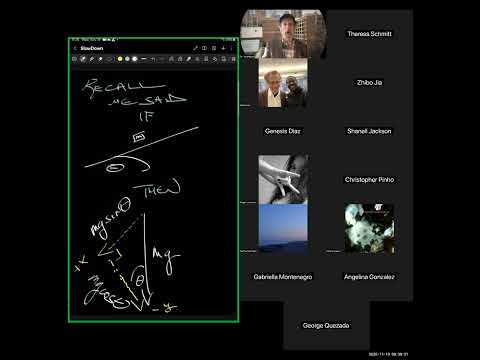
Dr. Yaverbaum uses Lab 5’s rough-incline experiment to explain why an object can take less time to slide up a ramp than to return down it. Rotating the axes along and perpendicular to the ramp gives gravity components mg sinθ and mg cosθ; with friction, the acceleration magnitudes are g(sinθ + μ cosθ) uphill and g(sinθ - μ cosθ) downhill, so the object loses speed faster going up than it regains it coming down.
Key takeaways
- For a ramp angle θ measured from the horizontal, gravity resolves into mg sinθ along the ramp and mg cosθ perpendicular to it; the zero-angle limiting case verifies the assignment.
- On the uphill trip, gravity and kinetic friction both point downhill, giving a deceleration magnitude g(sinθ + μ cosθ).
- On the downhill trip, gravity and friction oppose each other, giving an acceleration magnitude g(sinθ - μ cosθ), which is smaller than the uphill deceleration under the same conditions.
- An object can take less time while slowing down because it loses speed rapidly on the uphill leg, then regains speed more slowly over the same distance downhill.
- Rotating the coordinate axes along and perpendicular to the ramp makes the perpendicular acceleration zero and yields N = mg cosθ for this specific setup.
Chapters
- Dr. Yaverbaum checks that students have not yet submitted their Lab 5 reports and offers to clarify the analysis.
- The class is continuing from Monday’s work on choosing coordinates and resolving gravity on an inclined plane.
- The central question is why an object takes less time to slide up a rough ramp than to return down.
- Dr. Yaverbaum presents aligning the x-axis with the expected acceleration as a strategic choice, not a required law of physics.
- Choosing axes along and perpendicular to the ramp simplifies the force equations by putting the motion along one axis.
- The method illustrates the Galileo principle: physics models are chosen to make complicated situations easier to analyze.
- For a ramp angled θ above the horizontal, the component of gravity along the plane is mg sinθ.
- The component perpendicular to the plane is mg cosθ, directed into the surface.
- Dr. Yaverbaum connects the component choice to opposite and adjacent sides of the force triangle.
- Dr. Yaverbaum uses sin(0°) = 0 and cos(0°) = 1 as anchors for deciding which trigonometric function belongs to each component.
- At θ = 0°, a horizontal surface has no gravity-driven acceleration along it, so the along-ramp component must vanish.
- As θ increases toward 90°, the along-ramp component should increase, matching the behavior of sinθ.
- A limiting-case check tests a mathematical choice against an extreme situation whose physics is already clear.
- With no friction and θ = 0°, the block should have zero acceleration along the surface; mg sinθ gives that result.
- At θ = 90°, sinθ = 1, so the along-plane acceleration becomes g, as expected for free fall.
- Without friction, the acceleration down the ramp is a = g sinθ.
- At 30°, sinθ = 0.5, giving half of g; at 45°, sinθ is about 0.707; at 60°, it is about 0.866.
- The examples show that acceleration rises nonlinearly with angle because sine describes the curved relationship.
- For an object moving uphill, gravity’s mg sinθ component points down the ramp, as does friction.
- The normal force points away from the ramp and balances the perpendicular component mg cosθ.
- Dr. Yaverbaum treats the lab object’s rolling details as small and uses the sliding-friction model for the main analysis.
- The component free-body diagram leads to applying Fnet = ma independently along each axis.
- On the y-axis, N - mg cosθ = maᵧ; because the object stays on the ramp, aᵧ = 0.
- Therefore, in this setup, N = mg cosθ, a result for this situation rather than a universal rule for normal force.
- Dr. Yaverbaum solves the perpendicular-axis equation first because its normal force is needed to calculate friction.
- For the uphill trip, gravity and friction both point down the ramp, so their magnitudes add in the net force.
- Using fₖ = μN and N = mg cosθ gives a downhill acceleration magnitude g(sinθ + μ cosθ) while the object is moving uphill.
- The friction model used is fₖ = μN, where μ represents the roughness coefficient and N is the normal force.
- Substituting N = mg cosθ makes the friction contribution μmg cosθ.
- The mass cancels from the along-ramp equation, so the resulting acceleration depends on g, θ, and μ rather than the object’s mass.
- While the object moves uphill, both gravity and friction act downhill and therefore combine to slow it.
- Dr. Yaverbaum illustrates the addition with example contributions of 5 and 4 acceleration units, giving a net magnitude of 9 uphill.
- A larger deceleration means the object reaches zero speed sooner, which completes its uphill leg.
- On the return trip, gravity points downhill while friction points uphill, so the along-ramp equation becomes mg sinθ - μmg cosθ = ma.
- The downhill acceleration magnitude is g(sinθ - μ cosθ), smaller than the uphill deceleration magnitude when the same friction model applies.
- In the example with gravity contributing 5 units and friction 4, the downhill net acceleration is 1 unit rather than 9.
- The uphill object is slowing down, but its acceleration magnitude is large because gravity and friction work together.
- The downhill object speeds up, but at a lower rate because friction opposes gravity.
- Dr. Yaverbaum emphasizes that velocity describes motion while acceleration describes how velocity changes; confusing low speed with slowing down obscures the result.
- The uphill journey ends when speed reaches zero, while the downhill journey ends after the object covers the same ramp distance back to the bottom.
- Because the object loses speed faster uphill than it regains speed downhill, its average speed is greater on the uphill leg.
- For equal distances, the higher average uphill speed means t_up < t_down; friction’s reversal between trips creates the difference.
Transcript excerpt
0:07 Okay. Okay. Who do we have? All right. All right. There's Gabriella. >> Good morning with the to already the triple right there. And good morning Jocelyn with the and both people being very early. I know. Thank you for waiting. Um and good morning Sydney. And good morning Nadine. Oh, we are rocking and rolling already. Um, and good morning Effie with even my 11-year-old son knows about Effy's. Um, I don't know if anyway. Good morning, Melanie. Good morning, Chenade. Good morning, Muhammad. Good morning, me somehow. I hope you got Oh, Muhammad, you were at the thing yesterday. Okay, good. All right, we're go. Yes, I'm going to Oh, and there's more people coming. And also, wait, I shouldn't get personal right
0:56 now. Wait, who did I just So, good morning. I'm in the chat. I'm in the chat. Good morning, Melanie for the double. Good morning, Nadine for the triple or Melanie for the triple. Good morning, Chenade for the double. Good morning, Lun Lunar. Oh, where's Lunar? Okay. Yes. Good morning, Lunar. Thank you. Good morning, Effie, for the double. Good morning, Teresa. Good morning, Muhammad, for the triple if you count me as part of that. Good morning, Sydney. For with the with the emphasis um with the enthusiasm except but where is Sydney? Oh. Oh yeah, of course. For the triple. For the triple Sydney. Yes. Um good morning Joshua. Good morning Chanel. How do I see Chanel? But I don't Oh, there's more. Sorry. Sorry. Okay. Okay.
1:42 Okay. Good morning Jibo. Good morning Angel for the double. Good morning, Christopher, for the double triple for the the triple G. Good morning, Genesis. Good and good morning. Where's J? Okay. And good morning, Norma. Awesome for the double. Thank you. All right. And and
This is the start of the transcript. Save this video free for the whole transcript, searchable and time-coded.
In this course
Related notes
Summary, takeaways, and chapters were generated by AI from the video's transcript and may contain errors. The video belongs to its creator, Dr. Yaverbaum.