WorkAsAPathIntegral PartA jjPHY203 FA26
Overview
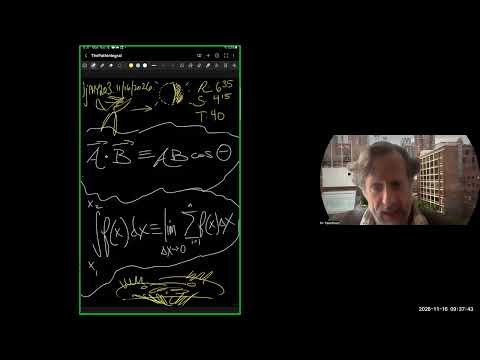
The lecture develops the mathematical foundation for work and energy: work over a small displacement is approximated by force times displacement, while net work changes a system’s kinetic energy, defined as one-half mass times speed squared. It also introduces the key puzzle for the next step: force and displacement are vectors, but work is a scalar, so their multiplication must account for alignment and can yield positive or negative work.
Key takeaways
- Work over a sufficiently small displacement is approximately force times displacement when the force’s magnitude and direction remain nearly constant.
- The net work done on a system equals its change in kinetic energy, where kinetic energy is 1/2 mv² and is measured in joules.
- Positive work adds kinetic energy to a system, while negative work removes it; the sign records the relationship between force and displacement rather than a spatial direction.
- Work is the transfer process, while energy is the transferable quantity; kinetic energy represents the capacity to do work through motion.
- Since force and displacement are vectors but work is a scalar, their multiplication must account for alignment, setting up the dot product.
Chapters
- Yaverbaum apologizes for grading delays, including Newton’s laws homework and the first work assignment, and says submitted work has not been forgotten.
- For Physics 204, in-person sections are expected to have in-person exams, while the fully remote section will probably use an open-world exam like Physics 203.
- Yaverbaum rules out remote webcam-proctored exams but cautions students not to choose a section based on a format that is not yet confirmed.
- At 9:29, the lecture shifts from course logistics to work and energy concepts rather than solving a particular homework problem.
- Students are encouraged to submit a first homework attempt on time, then use lecture and recitation ideas to revise and improve it.
- The goal is to generalize the prior lesson’s definition of work over a small displacement beyond its specialized conditions.
- For a small but finite displacement, work is approximately force multiplied by displacement; the approximation is suitable when force does not change magnitude or direction over that interval.
- When force points along or directly against displacement, 1 joule of work corresponds to 1 newton acting through 1 meter.
- The net work on a system equals its change in kinetic energy, written as the change in one-half mass times speed squared.
- Positive work transfers kinetic energy to a system, while negative work removes kinetic energy from it.
- Kinetic energy is defined as 1/2 mv², and its units reduce to joules; the lecture presents this combination as emerging from the work calculation rather than being self-evident.
- Yaverbaum distinguishes work as the transfer or transaction from energy as the quantity transferred, comparing energy to value that can move between forms like money, tuition, or goods.
- Kinetic energy describes the ability to do work by virtue of motion: greater mass or speed means greater capacity to move another object through an interaction.
- In response to Ibrahim’s question, the lecture confirms that work and energy are scalars, with no spatial direction even in three dimensions.
- Work can still be positive or negative, like temperature above or below zero; its sign indicates the result of combining force and displacement directions, not an eastward or westward direction.
- Because force and displacement are vectors, multiplying them to obtain scalar work motivates the dot product and its role in measuring alignment.
- An internet interruption begins around 26:49, and the lecture ends while Yaverbaum is checking whether the class can still hear and see the session.
Transcript excerpt
0:07 Good morning. Good morning. Good morning. Good morning, Edberto. Good morning, Alexi. Good morning, Zamin. Who? Okay. Good morning, Adena. Good morning, Kimberly. Good morning, Ashley. Good morning, Danilo. Good. Good morning. Okay. Um, good morning. Okay. Good morning, Abby, Adriana, Alexa, Den, Daniela, Jaylen, David, Martina, Sata,
0:58 Yanelli. Good. I love the chat. Good Madison. Good morning Jezel Italies. Nia Sebastian. Wh here we go. Nicole. Okay. And D. and Diana and Ibrahim and Dalin and Jaden and Daryl. Okay, in chat chat chat. Good morning, Martina, Kimberly,
1:45 Yanelli, Edberto, Adina, Abby, Daniela, Ashley, Alexa, Madison, Danilo, Abraham, Diana, Sebastian, David, Alexi, direct chat person, and Jaden. Okay, let's do this. Oh, wait. Okay, okay, okay. Let's do this. Let's do this. Um, I owe you a bunch of stuff. I apologize. I have it. It is not personal to you but yes if you have turned in actually I owe you two I don't know how this already happened well midterm yes you are totally ahead of me I owe you a Newton's laws many of you I owe you a Newton's laws homework and I owe you a all of you a the first work homework so my apologies please uh bear with me they
2:34 are not lost nor forgotten okay and Evelyn Jules Jaden Dalen Diana Daniela, good morning. Okay, so let's just keep going with the material though, unless there's qu more people. Okay, and good morning, Ruby Summer. Okay, hold on. Hold on. Oh, oh, wait. I'm looking. Oh, oh, oh. Okay, that's a question. I mean, that's a good question. Um wait and let me just let me get so so question about 204 next semester. Oh, which I gather means registration is happening. You might want to tell me. Yeah, I'm glad if registration's
This is the start of the transcript. Save this video free for the whole transcript, searchable and time-coded.
In this course
Related notes
Summary, takeaways, and chapters were generated by AI from the video's transcript and may contain errors. The video belongs to its creator, Dr. Yaverbaum.