Whymgsintheta Afternoon jjP203 FA23
Overview
The lesson explains how to analyze a marble traveling up and down a rough incline, connecting rolling resistance to the lab’s finding that the marble takes longer to descend than to ascend. It compares tilted and horizontal-vertical coordinate systems, showing how resolving gravity into components and aligning the x-axis with expected acceleration simplifies Newton’s second-law equations, while both coordinate choices yield the same result.
Key takeaways
- For a ramp angle θ, gravity resolves into mg sin θ parallel to the incline and mg cos θ perpendicular to it; checking θ = 0° identifies which component must vanish.
- With ramp-aligned axes, the perpendicular acceleration is zero, so N = mg cos θ and friction can be written as μmg cos θ.
- For the same friction coefficient μ, the uphill deceleration magnitude is g(sin θ + μ cos θ), while the downhill acceleration magnitude is g(sin θ − μ cos θ).
- The marble takes longer to descend because friction opposes motion on both legs, reducing its downhill acceleration while increasing its uphill deceleration.
- Horizontal-vertical axes are valid, but they require resolving both the normal force and acceleration; ramp-aligned axes reduce the algebra by aligning one axis with the motion’s expected acceleration.
- Rolling resistance is not identical to ideal static or kinetic friction: deformation at the marble-ramp contact creates measurable resistance that the lab models using a coefficient times the normal force.
Chapters
- The class checks that Lab Five formal reports are due Wednesday, even though students have no school that day.
- Dr. Yaverbaum invites questions about the lab before reviewing its free-body diagrams and comparing coordinate systems.
- The central lab task is to explain the marble’s unequal travel times using force components and Newton’s second law.
- A student asks about the lab equation for the coefficient of rolling resistance, written as rolling friction force divided by normal force.
- The class distinguishes that expression from the general friction relation, coefficient times normal force.
- The rolling-resistance equation describes how the lab represents friction from a rolling marble.
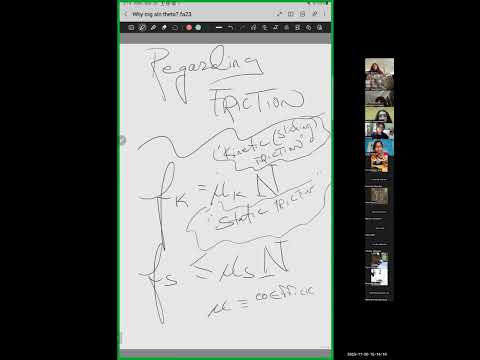
- The general model is friction force = μN, where μ is dimensionless and N is the normal force measured in newtons.
- A larger μ means rougher surfaces and more friction for the same normal force; the lesson gives rubber-on-rubber as a high-friction example.
- The relation makes friction proportional to how strongly the surfaces press together.
- A block sliding on a ramp experiences kinetic friction, while a rolling wheel ideally replaces sliding contact with static friction.
- A real marble and ramp deform slightly at their contact point, so rolling does not eliminate all friction.
- The lab treats this small rolling resistance with a coefficient so friction can still be modeled as a coefficient times the normal force.
- The lab’s surprising result is that a marble takes less time to travel up the ramp than to return down it.
- Friction opposes the marble’s motion on both legs, so gravity and friction combine differently for the uphill and downhill trips.
- The report should use free-body diagrams and Fnet = ma to explain why the marble loses speed uphill more rapidly than it gains speed downhill.
- A free-body diagram for the uphill trip includes gravity downward, the normal force perpendicular to the ramp, and friction down the ramp.
- The class compares horizontal-vertical axes with axes tilted to match the ramp.
- The recommended strategy is to align positive x with the expected acceleration, reducing the number of force and acceleration components to resolve.
- With axes aligned along and perpendicular to the ramp, gravity is not parallel to either axis and must be split into components.
- The component parallel to the ramp pulls the marble along the incline; the perpendicular component presses it into the surface.
- The decomposition is a coordinate choice, not a change to gravity’s direction or magnitude.
- The given angle θ is the ramp’s angle above the horizontal, not automatically the angle at the same-looking position in the component triangle.
- Adding a horizontal reference line reveals the complementary angles needed to locate θ in the gravity-vector triangle.
- The resulting geometry identifies the ramp-parallel component as mg sin θ and the perpendicular component as mg cos θ.
- The explanation uses the triangle-angle sum of 180° and the fact that the two acute angles in a right triangle sum to 90°.
- A student questions whether the angles might be 45°; the instructor clarifies that the drawing’s appearance does not establish equal angles.
- An exaggerated shallow-ramp sketch helps show how the original angle and its complement fit into the larger vector triangle.
- Once θ is located, the side opposite it is the ramp-parallel component mg sin θ, while the adjacent side is mg cos θ.
- The components add vectorially to reproduce the original downward gravity vector.
- In a frictionless case, the along-ramp force gives ma = mg sin θ, so the acceleration magnitude is g sin θ.
- At θ = 0°, sin θ = 0, so gravity has no component along a horizontal ramp; this identifies the along-ramp component as the sine term.
- At 30°, g sin θ is half of g; at 45° it is about 71% of g, and at 60° it is about 87% of g.
- The normal-force component mg cos θ decreases as the ramp steepens, matching the surface’s reduced support of the marble’s weight.
- On the perpendicular axis, the marble has no acceleration, so N − mg cos θ = 0 and N = mg cos θ.
- On the ramp-parallel axis, gravity and friction determine the acceleration; friction is substituted as μN.
- For the uphill trip, the equation becomes a = g(sin θ + μ cos θ) when acceleration is expressed as a positive magnitude opposing the motion.
- On the downhill trip, gravity and friction act in opposing directions, producing the corresponding magnitude a = g(sin θ − μ cos θ).
- Because the same friction coefficient applies on both legs, the uphill deceleration magnitude exceeds the downhill acceleration magnitude.
- That difference explains why the marble can travel up faster than it returns down, the result students must justify in Lab Five.
- The instructor repeats the frictionless incline problem using conventional horizontal and vertical axes, resolving the normal force instead of gravity.
- Because acceleration points along the ramp rather than either chosen axis, it must also be split into horizontal and vertical components.
- The resulting equations contain two unknowns, acceleration and normal force, and require additional algebra even before friction is included.
- Solving the horizontal-vertical equations requires eliminating the normal force and using sin²θ + cos²θ = 1.
- The calculation still yields a = g sin θ, matching the simpler ramp-aligned solution.
- The main lesson is to choose axes deliberately: aligning an axis with expected acceleration makes Fnet = ma easier to set up and solve.
Transcript excerpt
0:10 oh hello wait am I hello sorry I just uh jump started myself hello hello hello yaavi hello Michelle hello avani I don't you can wait can you am I on good afternoon mean you can hear oh and oh did I say Michelle yes okay good and does this mean you can hear me right or am I on yes thank you thank you okay all right so yes good afternoon yaavi good afternoon Malita good afternoon Amanda did I say could have oh there okay I shouldn't laugh that was a laughing with not a laughing at it was a laughing against good afternoon Marilyn how was my oh how was my oh was that
0:57 great thank you I yes that was very was thank you good afternoon hi you I said that too no I didn't and good afternoon Michelle okay yes my birthday was good thank you um uh oh there's Molita all right all right and okay all right um okay we are going to we're going to we're we are going to continue something I started last Wednesday and we're gonna finish it today and then we're
1:44 apparently gonna go off to holidays which I honestly did not real I thought we well it doesn't matter here's my question your lab Lab five slow down you hi hi Chris um good to see you double yes um you did or did not yet already turn in the formal reports for lab five slow down the the incline played but you lab five is due this Wednesday perfect as it great okay and you told me that last time I just couldn't remember okay I mean great and even though you don't have school this Wednesday correct like you're say right okay okay then even
This is the start of the transcript. Save this video free for the whole transcript, searchable and time-coded.
In this course
Related notes
Summary, takeaways, and chapters were generated by AI from the video's transcript and may contain errors. The video belongs to its creator, Dr. Yaverbaum.