Welcome jjPHY203 FA26
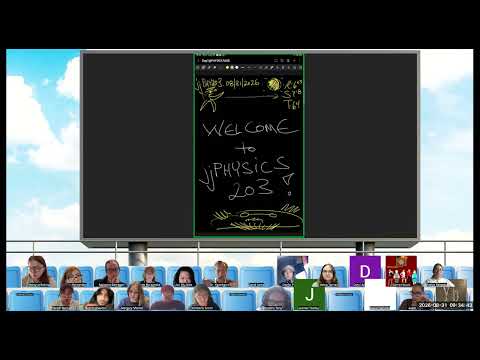 Watch on YouTube →
Overview
Dr. Yaverbaum introduces a synchronized remote Physics 203 course that meets Mondays and Wednesdays at 9:25, uses Google Classroom for assignments and class materials, and emphasizes participation, collaboration, and revision. The first homework, “Numberline,” is due Wednesday and establishes the course’s five-step problem-solving format; students submit a self-contained draft on time, then can revise it for full credit, while participation points are added to the exam average.
Key takeaways
- Google Classroom is the central hub for Physics 203 and 204, including assignments, rubrics, daily board-note PDFs, recordings, and problem-solving guides.
- A reasonable first draft submitted on time can be revised until it earns full homework credit, so students should prioritize completing an attempt by the deadline.
- Every homework and exam problem should use Dr. Yaverbaum’s five-step structure: diagram and facts, question, principles, work, and circled answer.
- Homework is open-resource, and students may consult classmates, Khan Academy, prior YouTube lectures, the recommended textbook, and AI, but submissions must reflect their own reasoning.
- The remote Physics 203 midterm and final are planned as untimed take-home assignments; the stated deadlines are October 21 and December 16 at 10:00 a.m., respectively.
- Participation points are available for actions such as speaking, using chat, showing video, and following up on answers; all non-exam points are divided by 100 before being added to the exam average.
Chapters
- Dr. Yaverbaum welcomes students to the large synchronized remote class and asks them to correct name pronunciations.
- Students can participate by speaking, using Zoom chat, or showing video; these actions can earn points but are not required.
- Dr. Yaverbaum says keeping the Zoom session interactive helps make it feel like a class.
- Dr. Yaverbaum confirms the course is Physics 203 and says 48 students are officially enrolled.
- Students should join the Google Classroom, which holds the course’s physics materials and assignments.
- The class meets synchronously every Monday and Wednesday at 9:25 in the same Zoom room.
- A PDF of the board notes will be posted in Google Classroom after every class.
- Class recordings will also be available for review, including for missed sessions or exam preparation.
- Dr. Yaverbaum says he has taught physics and related subjects since 1992 and welcomes students interrupting him with questions.
- Dr. Yaverbaum has taught at John Jay since 2012 and coordinates the physics program.
- His office is room 6105 on the fourth floor, near the Jaywalk window; Tuesday Community Hour is the official time to find him.
- Students may text his cell for concise questions or to arrange a phone call, and should identify themselves the first time they text.
- Google Classroom is the primary location for Physics 203 and 204 course work; Brightspace serves as a portal to it.
- The first quantitative assignment, “Numberline,” is due at the start of Wednesday’s class.
- A separate participation reflection is due by midnight on the first class day.
- Students may use friends, websites, Khan Academy, Dr. Yaverbaum’s prior YouTube class recordings, and the recommended textbook as homework resources.
- No textbook purchase or assigned pre-reading is required; the “Numberline” sheet defines distance, displacement, average speed, and average velocity.
- Students do not need to cite sources used for learning, but should cite any material they directly quote.
- Physics lecture and lab contribute to one course grade, and Dr. Yaverbaum coordinates lab work with instructors Brunson and Woo.
- For this remote Physics 203 course, the midterm and final are planned as take-home, open-resource, untimed assignments with no camera requirement.
- The midterm is due no later than Wednesday, October 21; the final is due at 10:00 a.m. on Wednesday, December 16.
- Homework grading emphasizes the student’s process and method, not just whether the final answers are correct.
- A reasonable, thorough first draft submitted on time can be revised and resubmitted until it earns all available points.
- Dr. Yaverbaum describes grading as developmental feedback, not a permanent penalty for initial errors.
- Students can put unresolved questions directly into a first-draft homework document to show where they need help.
- If a question remains after class discussion, students can email or text Dr. Yaverbaum; concise questions are suited to text.
- Students can also use the Zoom direct chat for private questions, and Dr. Yaverbaum will avoid naming the sender when answering relevant questions to the whole class.
- Each homework submission should be one self-sufficient document, preferably a PDF, uploaded to the assignment in Google Classroom.
- Handwritten work is acceptable; students can scan pages or combine phone photos into one document using Word or Google Docs and export it as a PDF.
- The document should restate each question in the student’s own words and include enough context for a reader to follow without the original assignment sheet.
- Students may use AI and other resources to understand a problem, but the submitted explanation must represent their own reasoning.
- Homework questions should not be copied and pasted; students should rewrite them and present their own thought process.
- A rubric evaluates whether the document is self-sufficient, individual, and clearly presented.
- Dr. Yaverbaum requires students to label five steps for each problem: diagram and fact pattern, the question, general definitions or principles, the work, and a circled final answer.
- The method makes reasoning visible and gives students a starting point when they do not know how to solve a problem.
- Rubrics award points for the steps, so the format applies even to questions that initially seem simple.
- Google Classroom contains Zoom links, class recordings, daily notes, assignment rubrics, and examples of five-step solutions.
- Students can use recordings from prior Physics 203 semesters on Dr. Yaverbaum’s YouTube channel to revisit explanations.
- The course page lists the October 21 midterm deadline and the December 16 final deadline.
- The “Numberline” assignment is due before Wednesday’s 9:25 class and should use the five-step method for every question.
- When several questions share a scenario, students can refer back to a labeled diagram instead of redrawing it, provided the document remains easy to follow.
- Students should consult the one-page five-step guide and related examples in Google Classroom before attempting the assignment.
- The first participation reflection is due by midnight and earns 5 points for briefly documenting one way the student participated.
- Students can also submit evidence of actions such as showing video, asking a question, speaking, or closing a question-and-answer exchange.
- Participation and homework points are divided by 100 and added to the exam average; Dr. Yaverbaum ends the session by offering to stay for questions.
- After the formal class ends, a student begins asking whether a question should go to Dr. Yaverbaum or directly to a lab instructor.
- Dr. Yaverbaum agrees to hear the question after stopping the recording.
Transcript excerpt
0:35 Hello. Hello. Hopefully you can hear me. Let's see. Hello. Hello. Ah, thank you. Yes, it's not required, but it's certainly desirable to show video. Thank you. Hello, Winnie. I'm gonna say hello to everybody. I'm not singling you out. Hello, Winnie if you can hear me. Hello, Danilo, if you can hear me. Hello. Hi. Thank you for saying hi back. You're gonna find all of you that this hello business and oh hello and correct me. I mean correct my pronunciation please. Martina. No. Is that right? Um is that okay? Thank you. Awesome. And you're going to find soon that any of you who even gesture or respond in any way are going to get points for that. We're going to talk about that. Hello Daryl. I'm sort of saying this random. Hello Anthony. I won't say hello to Well, this
1:23 is a very big cl. Hello David. Good to see you. A very big class obviously. Marjgery, if I'm saying it correctly. Um, tell me if I'm not. And oh, yes. Ah, Zaming, am I saying it? Yes. Okay. And hello. Thank you for the email. Yes. Awesome. Okay. Um, Ibraim, am I saying that correctly? Yes. Awesome. Okay. And I still will. It'll take me a little while. Oh, and I'm seeing things in the chat. That's great. Hello. Obviously, I can't fit everybody in this. And we will change the view on the screen. It won't be this annoy. I mean, it will change to be less annoying in Jeanju, is that your name? Is that correct? Am I saying it correctly? >> Uh, just call me by June. >> Oh, by June. Like June, is that what you said? >> Yeah. >> Great. Okay. It might take me a couple things, but thank you. Awesome. And
This is the start of the transcript. Save this video free for the whole transcript, searchable and time-coded.
Related notes
Summary, takeaways, and chapters were generated by AI from the video's transcript and may contain errors. The video belongs to its creator, Dr. Yaverbaum.