ContinuousSums jjPHY203 FA26
Overview
Yaverbaum connects the physics definition of work, the path integral of force, to the mathematical meaning of integration: a continuous sum of products that accumulates a function’s output across an interval of input. Using force and displacement as the running example, he distinguishes the integral’s definition from the Fundamental Theorem of Calculus, which makes many integrals computable by reversing differentiation, and clarifies how homework credit contributes to Physics 203 grades.
Key takeaways
- Work is the path integral of force: it accumulates the dot product of force and displacement along a path, accounting for changing force and direction.
- The definite integral from x1 to x2 represents the limit of sums of function values multiplied by finite input intervals as Δx approaches zero.
- On a force-versus-displacement graph, each rectangle’s area represents a small force-displacement contribution, and the limiting sum gives total work.
- The differential dx is not decorative notation: it identifies the infinitesimal input interval whose product with the function’s output is accumulated.
- An integral’s definition is a continuous sum of products; the Fundamental Theorem of Calculus is the separate result that often lets us evaluate it by finding an antiderivative.
- Power differs from work because power is the time derivative of energy, while work accumulates force through displacement.
Chapters
- Yaverbaum greets Physics 203 students and answers a question about Homework 6, the optional Space Relations assignment.
- Homework points count as extra credit: the total homework points divided by 100 are added to the course grade, not directly to an individual exam score.
- In Physics 203, the final grade combines exams and lab work, with the lab portion described as about 40%; homework points apply to the overall calculation.
- Students may revise substantially submitted homework through the last day of classes, but should leave the earlier draft in the portal and avoid submitting a large batch of revisions at the end.
- Yaverbaum shifts from course logistics to the work and energy problems in the recent Physics 203 homework.
- He plans to build the mathematical theory first, then start working through specific exercises in the next class.
- The concepts and mathematics matter for Physics 204 as well as for understanding work and energy in Physics 203.
- The familiar expression for work, force times displacement, is a useful approximation for a simple push over a short distance.
- That shortcut assumes the force does not change magnitude or direction during the displacement.
- It also assumes force and displacement are aligned, so their vector directions can be treated as positive or negative numbers.
- The general definition of work is the path integral of force, which accounts for force changing along a path.
- A path integral integrates a dot product with a displacement element, rather than integrating a field against time.
- For work, the relevant quantity is force dotted with displacement, so direction and changing force both matter.
- The dot product of two vectors produces a scalar by measuring how much their directions align.
- Its magnitude is the product of the two vector lengths and the cosine of the angle between them.
- For force and displacement, the cosine factor makes perpendicular force contribute no work, while aligned force contributes fully.
- Yaverbaum acknowledges that the word integral can cause anxiety, even for students who have completed calculus courses.
- The goal is conceptual: understand why an integral is needed, how to set one up, and what its result represents.
- The focus is not on advanced integration techniques such as integration by parts or trigonometric substitution.
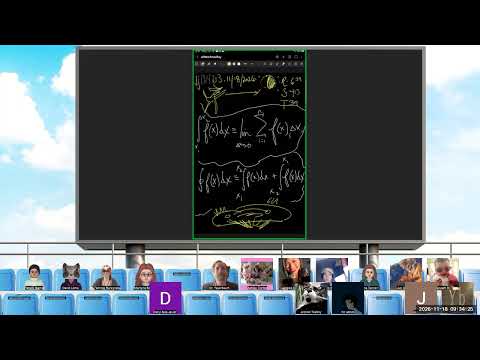
- For a function f(x), the definite integral from x1 to x2 is defined as the limit of sums of f(x) times small intervals Δx.
- The graph of f(x) can visualize the function, but it is not the function itself.
- In a physics example, x can represent displacement and f(x) can represent the force applied at each position.
- Plotting force as a function of displacement gives a graph where a rectangle’s width represents displacement and its height represents force.
- Each rectangle’s area, force times displacement, represents a small contribution to work.
- Adding rectangle areas approximates the total work done across the full displacement interval.
- If force changes continuously with position, any finite-width rectangle uses a force value that is not constant across its width.
- Making rectangles narrower improves the approximation, but finite rectangles still miss some variation in the force.
- Taking the interval width Δx toward zero leads to the limiting sum needed to describe continuously changing force.
- Yaverbaum links continuous functions to situations that can be divided into ever-smaller intervals without encountering discrete jumps.
- A continuously changing force may vary at every scale, so no finite-sized step captures its exact behavior everywhere.
- Calculus handles this infinite divisibility by considering what happens as Δx approaches zero.
- The capital sigma, Σ, denotes a discrete, countable sum whose index tracks terms such as the first, second, and third interval.
- An integral sign represents the continuous-sum limit, replacing a countable collection of finite steps with infinitely small intervals.
- Δx denotes a finite difference between positions, while dx represents the interval in the limiting integral notation.
- Yaverbaum describes an integral as a continuous sum of products between a function’s output and small increments in its input.
- In the work example, each step pairs the force acting at that position with the corresponding displacement element.
- The accumulated result captures the total effect of the function across its domain, rather than its value at just one point.
- A derivative describes what is happening locally or instantaneously, such as a car’s speed at a particular moment.
- An integral instead accumulates contributions across a finite interval, such as force acting throughout a path.
- For work, the accumulated quantity is force dotted with displacement along the path, not force considered at one instant.
- Yaverbaum connects work with energy transfer and emphasizes that the integral under discussion is taken through space.
- Power is energy transferred per unit time, or the time derivative of energy, so it focuses on a rate rather than accumulated work across a path.
- The distinction is between spatial accumulation of force for work and time-based measurement of energy transfer for power.
- The area-under-the-curve picture represents a function’s accumulated effect over an interval; it is not necessarily ordinary geometric area.
- Rules such as reversing the power rule explain how to evaluate certain integrals, but do not define what an integral means.
- Yaverbaum notes that the definite-integral definition does not guarantee that every integral is easy or even expressible in a simple closed form.
- The integral is defined as a continuous sum of products, not as an antiderivative.
- The Fundamental Theorem of Calculus establishes that reversing differentiation can evaluate an integral under appropriate conditions.
- Yaverbaum presents that connection as a theorem and a powerful calculation method, distinct from the integral’s underlying definition.
Transcript excerpt
0:21 Okay, let's get this party started. Yanelli, David, Winnie. Whoa. Okay, I Oh, wait. How did it Okay, I I withhold comment. That was actually a smile, too. I'm just saying. All right. And I still and I didn't realize my last comment was a public comment, but that's okay because I didn't realize that the WB comment was okay. Ashley, good morning. Alexi, good morning. Danilo, good morning. Also, chat, I'll get to you in a minute. We're gonna get Adena, good morning, Daryl, good morning. Hello. Wait. Oh, wait. And the smile continues. That's actually that could be a record um of duration. I mean, oh yes, I said that. Abby, good morning.
1:14 Marie, good morning. Sorry. Adriana, good morning. My pronunciation is still questionable there. Alexa, good morning. Daniela, good morning. Oh, June. Oh, also June is in a different uh a different Jason. Good morning, Mir. Good morning. Oh, and Mia, you got the I hope I think it all worked out. I mean, that's totally inside voice I just used, but Mirror, I think the whole next semester thing I think we're all on the same page. Um, yes. Okay. Good, good, good. Okay. All right. Sorry to go public there, Jules. I mean, I am not distinguishing the inside voice from the
2:01 outside voice today. Sorry, Daniela. Good morning, Diana. We're almost there. Um, and sorry, what's happening? What's happening? Wait. Sorry. Nicole, good morning. Madison, good morning. Oh, Nicole, where' Nicole go? Okay, I think we're Sebastian, good morning. Ibraim. Oh, is it Oh, sorry. Okay, I see I Jaden and Evelyn. Good morning. And Na. Oh, okay. Good morning. Good morning. And and Marjorie and Jaden if I didn't say. And Ruby Summer. Good morning.
2:49 Okay. I think Are we there? Okay. I
This is the start of the transcript. Save this video free for the whole transcript, searchable and time-coded.
In this course
Related notes
Summary, takeaways, and chapters were generated by AI from the video's transcript and may contain errors. The video belongs to its creator, Dr. Yaverbaum.