School Board Meeting - August 14, 2012
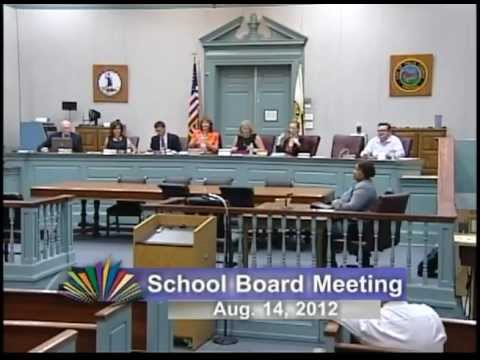 Watch on YouTube →
Overview
Falls Church City Public Schools’ August 14, 2012 board meeting focused on a major policy overhaul, especially public comment restrictions, teacher evaluation, and a series of Virginia-code-driven policy updates. The board also approved a consent agenda, discussed student parking and athletic fees, received a TJ construction update, debated the city’s $3.68 million surplus and $500,000 technology request, and adopted a new work plan centered on mobile technology, graduation outcomes, and facilities planning.
Key takeaways
- Falls Church City Public Schools’ board treated the public-comment policy as a constitutional issue, not just a procedural one, and delayed action until October after a 4-2 vote.
- The new teacher evaluation system is built around annual reviews for all teachers, twice-yearly reviews for probationary teachers, and a 40% student-performance component.
- Several policy updates were driven directly by Virginia Code changes, including child-abuse reporting, retirement language, charter-school references, and juvenile-conviction disclosure.
- The city’s $3.68 million surplus became a major political issue because the school board wanted $500,000 for critical technology, but City Council failed to pass any final allocation.
- TJ’s renovation changed daily operations immediately: the kitchen and cafeteria were demolished, and bus/car drop-off moved to Oak Street for safety.
- The board’s 2012 work plan emphasizes measurable goals in mobile technology, reading growth, special education review, ESOL best practices, a new LMS, and long-range facilities planning.
Chapters
0:00
Pledge, Agenda Adoption, and Public Comment Setup
- Meeting opens with the Pledge of Allegiance and a motion to adopt the agenda.
- Agenda discussion points include item 8.06, the technology purchasing update, as a place to address surplus funds.
- Public commenters are told each speaker gets 3 minutes and the board will not respond directly.
1:45
Shannon Royce Challenges Limits on Individual Special-Ed Cases
- Shannon Royce argues that IDEA is about the needs of an individual child, not just broad policy.
- She says her family followed the chain of command for years and still struggled to get services met.
- Royce warns that blocking individual public comments would leave families only with formal complaints, which return to the board anyway.
7:00
Barbara Mack Says the Special Education Committee Needs a Next Step
- Barbara Mack, chair of the special education committee, says parents are often advised to use the chain of command first.
- She argues the proposed public comment change removes the next escalation point for families with unmet needs.
- Mack asks the board to reconsider before moving forward without a replacement process.
8:30
Public Comment Rounds Out with Concerns About August Timing
- Allison says the proposed rule is 'outrageous' and notes she has already used private conversations and superintendent escalation.
- She worries safeguards weaken if Superintendent Dr. Jones leaves and public comment disappears.
- She objects to first reading in August, when many families are away.
10:25
Parents Argue the Board Must Hear Problems on the Record
- Dave says people do not come to the board just to chat; they come because something serious is happening.
- He argues public concerns should be on the record, on tape, and visible to the community.
- Stephanie Correio says individual cases can illuminate systemic issues and improve communication across the school system.
15:02
Dr. Jones Frames Policy Changes as First Reading, Not Final Action
- Dr. Tony Jones thanks the speakers and says first reading is not adoption.
- She promises time to edit and refine the policy before second reading.
- The board moves into consent agenda items after public comment.
16:16
Consent Agenda: Staffing, Resignations, Committees, and Meal Prices
- The consent agenda includes multiple staff appointments for 2012-2013, including teachers, aides, and paraprofessionals.
- Resignations include Jeremy Lowe at Thomas Jefferson and Elizabeth Rizzi at George Mason.
- The board also approves Mary Beth Spellman to the Family Life Education Advisory Committee and school meal/milk prices.
18:55
Teacher Evaluation Model Introduced as a Growth System
- Dr. Jones presents the new Virginia-mandated teacher evaluation system, developed with a large committee of teachers and principals.
- Every teacher will be evaluated annually; probationary teachers twice yearly.
- She emphasizes it is intended as a growth system, not a punitive 'got you' rubric.
20:40
Board Members Probe Metrics, Collaboration, and Team Performance
- Mr. Sharp says the system is a refinement of existing evaluation practices, not a complete departure.
- He asks how the division will handle periodic reporting, school-level data, and group targets by department or grade.
- Dr. Jones explains school-based planning can measure departments and schools, but teacher evaluations must remain individual under law.
25:45
Support for the New Evaluation Binder and 40% Student-Performance Weight
- Rosara Garibara praises the binder, administrator accountability, and weekly principal walkthroughs.
- She notes that 40% of the evaluation is tied to student performance and asks how that will be measured.
- Other board members say the committee included varied subjects and perspectives, which strengthens the result.
30:40
First Policy Batch: Mandatory Virginia Code Updates
- Mr. Horn walks through policy changes tied to Virginia Code, including conflict of interest, charter-school language, and graduation notification rules.
- Policies 5.12 and 6.24 are adjusted so the School Health Advisory Committee and Gifted Education Advisory Committee are no longer described as state-mandated.
- Child abuse reporting, resignation dates, home instruction, and class assignment references are also updated.
37:30
Waiving First Reading and Adopting Code-Driven Revisions
- The board waives first reading and approves second reading/adoption for a batch of policies including 2.9, 5.12, 5.44, 6.3, 6.14, 6.24, 8.6, 8.29, 8.30, 8.50, 8.62, 9.23, and 9.24.
- Mr. Sharp asks that staff be informed about policy 8.29 so they understand the new child-abuse reporting path.
- One policy, 4.11, is pulled for later revision because the board wants to fix language about per-pupil cost notification.
39:50
Public Comment Policy 2.30 Triggers a Long First Amendment Debate
- Policy 2.30 would narrow public comment to protect employees and avoid slander liability, according to board counsel.
- Several commenters and board members say the policy could suppress parental speech and is risky under the First Amendment.
- Joan Wadeska moves to table the policy until the first October meeting, and the motion passes 4-2.
58:30
Optional Policy Updates: Purchasing, Staff Evaluation, and Tutoring
- Policy 4.23 updates purchasing procedures to reflect Virginia Procurement Act changes to small-purchase and bidding thresholds.
- Policy 8.57 clarifies that paid tutoring by school employees is allowed when directed by the schools, but school facilities should not be used improperly.
- Board members press for clearer boundaries around tutoring, including whether it applies only to a teacher’s direct students.
1:06:50
Student Records, Directory Information, and Epinephrine Policy Changes
- Policy 9.8 updates directory-information language and federal FERPA-related definitions.
- Board members flag date of birth as a potential identity-theft risk if treated as directory information.
- Policy 9.38 addresses self-administration of asthma medication and auto-injectable epinephrine, and staff note training and implementation details will follow.
1:14:00
Juvenile Convictions and Evaluation Language Adjustments
- Policy 9.64 requires the division to distribute Attorney General information about juveniles convicted as adults.
- Board members question how the information will be communicated and whether it creates a cost burden.
- Mr. Castillo also asks to soften evaluation language so it improves instruction through more than just accountability.
1:19:00
Second First-Reading Policy Batch Passes With 4.11 Deferred
- The board approves first reading on 4.23, 8.33, 8.38, 8.57, 9.8, 9.38, 9.40, and 9.64, with 4.11 carried over.
- Staff explain that tweaks raised during discussion will return for second reading.
- The board asks for clearer wording on several items before final adoption.
1:21:10
Student Parking and Athletic Fees Stay in the Budget
- Dr. Jones reports elementary schools have almost no fees beyond field trips and book orders.
- George Mason has 110 parking spaces and has not historically run out, with seniors and juniors prioritized.
- The board agrees not to remove parking or athletic fees from the budget for now because funding is tight and technology needs take priority.
1:26:10
Thomas Jefferson Construction Moves to Oak Street Drop-Off
- Dr. Jones reports TJ’s kitchen is demolished, the cafeteria back wall is down, and a false wall protects the building interior.
- The car drop-off lane is moving from Seton to Oak Street because construction beams create a safety issue near the original route.
- A staff safety/security person is reassigned to help with crosswalks, entrances, and construction visibility.
1:30:00
Community Excitement Around the TJ Renovation
- Board members describe walking past TJ with children who are fascinated by bulldozers and demolition.
- The update reinforces that construction is on time and that communication with families will continue.
- The board treats the TJ project as a visible, community-facing sign of progress.
1:31:00
City Surplus Revenue: $3.68 Million and a Stalled Technology Plan
- Dr. Jones says the city ended the fiscal year with a $3.68 million surplus from broad revenue overperformance.
- The school board had asked for $500,000 of that surplus to support critical technology purchases.
- City Council rejected both the school-supported split and a one-third/one-third/one-third proposal, leaving no final allocation.
1:37:40
State Academic Results Arrive and Outperform Comparable Divisions
- Falls Church begins receiving official state results electronically and expects to outperform Virginia overall.
- Dr. Jones says the division beat 29 of 33 comparable school divisions, including Arlington and Loudoun comparisons.
- The board is still waiting for subgroup data, which is affected by Virginia’s waiver and changing targets.
1:43:00
Authorization to Hire Staff Before the September 11 Meeting
- The board authorizes Dr. Jones to hire staff as needed before names can be brought for approval on September 11, 2012.
- The motion is intended to avoid delaying classroom staffing until the next board meeting.
- The board gives unanimous approval.
1:44:10
School Board Work Plan: Mobile Tech, Cherry Street, and Facilities Strategy
- Dr. Jones presents a revised work plan reflecting board feedback, including evaluation, compensation, and superintendent goals.
- Major goals include increasing mobile technology access from a 1:7 to a 1:4 machine-to-student ratio and improving reading growth.
- The work plan also covers Cherry Street early childhood planning, a new LMS, a five-year facilities plan, and updated policy/legal workflow processes.
1:59:00
Rosara Garibara Resigns and the Board Reassigns Duties
- Garibara announces she is resigning and moving back to California for personal reasons.
- Board members praise her advocacy, bilingual perspective, teaching expertise, and focus on students and minorities.
- The board needs a new VSBA delegate and alternate, and the chair asks members to review last winter’s appointment process for a replacement.
2:13:30
Minutes Approved and Meeting Adjourned
- The board approves minutes from July 10, July 24, August 1, and August 6, 2012, with abstentions from members absent at some meetings.
- The chair reminds members about the upcoming VSBA conference in Williamsburg, November 14-16.
- The meeting adjourns after midnight, with a note that the lengthy policy debate made the evening run long.
Summary, takeaways, and chapters were generated by AI from the video's transcript and may contain errors. The video belongs to its creator, Falls Church City Public Schools.