August 25, 2026, Classroom Lecture
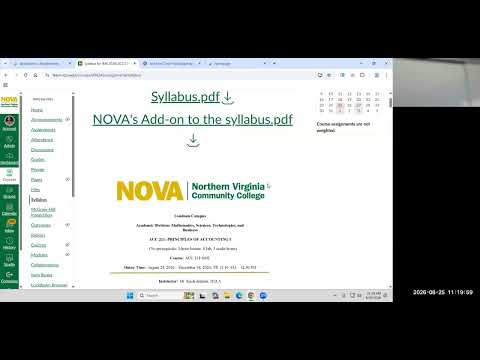 Watch on YouTube →
Overview
Dr. Kush Jenkins opens Principles of Accounting I by outlining course logistics, learning expectations, assessments, and the accounting concepts students will need for later business courses. He emphasizes sustained practice with debits and credits, responsible use of AI as a learning aid rather than a substitute for understanding, and a 1,000-point grading system with four exams, the lowest exam dropped, and substantial online and workbook assignments.
Key takeaways
- Dr. Kush Jenkins identifies debits and credits in chapter 2, alongside chapters 3 through 5, as the course’s hardest early material and is willing to give it more class time than later topics.
- The grading system totals 1,000 points, includes four exams with the lowest score dropped, and awards only 50 points for attendance and participation across roughly 30 meetings.
- AI can support accounting study, but students need to verify each step: an advanced answer is not evidence of understanding if they cannot explain a basic input such as hourly pay multiplied by hours worked.
- Online exams are expected to take place over weekends, while extended homework accommodations can push deadlines beyond the semester and delay final grades.
- Canvas may display an inaccurate course grade when extra credit or assignment calculations are involved; Jenkins says the syllabus point scale is authoritative.
- Chapter 13 consolidates ratios introduced across chapters 1 through 12, and the foundational accounting work is intended to help students interpret costs, revenue, and profit in later business courses.
Chapters
0:00
Welcome to Principles of Accounting I and Dr. Jenkins’s Technology Policy
- Dr. Kush Jenkins introduces the first-day class and says the session will cover the syllabus, course setup, and introductions.
- He describes his 2015 to 2020 work as an accountant at a technology startup, where engineers helped large companies refine phone features that encourage frequent use.
- Students may use computers on the first day, but devices should be silent or on vibrate during later classes.
6:40
Syllabus, LR 262, Office Hours, and the Accounting I to II Sequence
- The class meets in LR 262; the semester begins August 24, and the college will set the final exam date.
- Dr. Jenkins directs students to email and his public calendar for contact and office-hour information, with office hours usually after class and after his 5 p.m. class until 7 p.m.
- The course is arranged to support students who pass Accounting I and continue into Accounting II the following semester, ideally with the same instructor and schedule.
11:14
Attendance, Recorded Lectures, and the Responsibilities of a College Course
- Dr. Jenkins says students should prioritize attending class or watching its recording, which he plans to post for review.
- Missing a lecture does not extend assignment deadlines; students remain responsible for keeping up with course material and work.
- Attendance is a small part of the 1,000-point course grade, so he suggests watching the recording at home rather than coming to class exhausted and unable to participate.
17:30
Study Habits and Active Participation in Accounting
- Dr. Jenkins recommends setting aside two to three hours before class and another two to three hours afterward for study.
- Students should read the textbook, attempt problems from scratch, and bring questions that arose during preparation.
- He encourages students to connect accounting topics to personal experiences, participate in class discussions, and seek help from peers, study groups, and the professor.
20:50
Using AI to Learn Accounting Without Skipping the Fundamentals
- Dr. Jenkins supports appropriate AI use and says he is developing an AI-based project for Accounting II.
- He warns that AI-generated solutions can hide gaps in basic knowledge, such as producing a tax answer when a student cannot explain the employee’s pay calculation.
- Students should use AI outputs as prompts to ask how an answer was derived and why it is correct; exams are timed, individual, and use different questions.
26:59
Accommodations, Online Exams, and Extended Homework Deadlines
- Students should submit accommodation documentation, including requests for extra exam time.
- Unless the college changes the arrangement, exams will be taken online over weekends rather than in the classroom.
- An extended homework deadline can fall after the semester ends; for example, Jenkins explains that a January 10 deadline could prevent a grade from being finalized by the December 14 course end.
30:50
Weather Cancellations and Navigating a 200-Level College Course
- Students should monitor college announcements for weather-related changes; Jenkins says he will cancel class when conditions make travel unsafe.
- He notes that students commuting from farther west may face greater travel risks and that late-afternoon storms especially affect his 5 p.m. class.
- Because Accounting I is treated as a 200-level course, he expects students to know campus basics such as Canvas, the classroom location, tutoring, and campus services.
34:53
Course Schedule: Four Exams and the Early Challenge of Debits and Credits
- The tentative sequence covers chapters 1 to 3 before Exam 1, chapters 4 to 7 before the midterm, chapters 8 to 10 before Exam 3, and chapters 11 to 13 before Exam 4.
- Jenkins identifies chapters 2 through 5 as the book’s hardest stretch, with debits and credits introduced in chapter 2.
- He plans to spend extra class time where students need it, especially on debits and credits, even if that means compressing later topics such as petty cash.
40:30
The 1,000-Point Grade: Quizzes, Homework, Workbooks, and Exams
- The course uses points, with 13 chapter quizzes worth four points each and 13 homework assignments worth four points each.
- Students also have 13 SmartBook assignments and a target of 10 workbook assignments; Jenkins may assign more or fewer workbook exercises based on class needs.
- There are four exams, and the lowest exam score is dropped, including an exam missed or taken poorly.
- Attendance and participation contribute 50 points across about 30 class meetings, making each session worth less than two points.
45:00
Why the Syllabus, Not Canvas, Determines the Final Grade
- Jenkins advises students to track total points rather than rely on Canvas’s displayed grade, which can miscalculate extra credit or other assignments.
- He gives the example of Canvas showing 89 percent when a student’s 920 points correspond to a higher grade under the syllabus scale.
- The syllabus is the governing document for grade calculation, so students should use its point totals when discussing a grade.
51:00
Assignment Deadlines, Academic Integrity, and Classroom Technology
- Students should treat an assignment’s due date as the final submission date, not as a suggested day to begin the work.
- Jenkins identifies exams as the main academic-honor-code risk and discourages cheating, especially because exam questions differ among students.
- Disruptive personal device use can cost 10 points per incident; Jenkins says a phone interruption from his own device earns the class 10 points.
- Handwritten notes are welcome, while digital note-taking requires prior discussion with Jenkins.
57:00
Study Guides, PowerPoint Slides, and Accessible Course Materials
- Jenkins confirms that students will receive a study guide, which he says is harder than the exam rather than a direct preview of exam questions.
- PowerPoint slides are available through the course files and McGraw Hill Connect student resources.
- Students who need accessible materials can request the more ADA-friendly versions on Connect; Jenkins says his workbook design considers font, lettering, paper feel, and retention.
1:03:00
Flexible Pacing, Ratios, and the Bridge to Accounting II
- Chapter coverage depends on student understanding and class interaction; Jenkins says some groups finish chapter 5 by late September while others need longer.
- He prioritizes foundational debits and credits because later finance and economics courses use measures such as total cost, total revenue, and profit.
- Chapter 13 reviews ratios introduced in chapters 1 through 12, while chapter 14 begins Accounting II and is described as easier than chapter 1.
1:09:00
Chapter 1 Preview and First-Day Closing
- Jenkins confirms that the next class will begin chapter 1 and reminds students of the scheduled meeting time and location.
- He explains that he closes each class by telling students he loves them, connecting the practice to his start in teaching in 2007 after the Virginia Tech shooting.
- He says his experience on a SWAT team informs his commitment to protecting students in an emergency.
Summary, takeaways, and chapters were generated by AI from the video's transcript and may contain errors. The video belongs to its creator, Dr. Kush Jenkins.