Padrão Sanitário
Overview
Veterinarian Nic de Souza Oliveira explains how environmental conditions, microbial status, and sanitary barriers affect laboratory-animal welfare and the reliability of research. She covers environmental targets such as 20 to 26 °C, a 12:12 light-dark cycle, and 15 to 25 air changes per hour, then describes rodent health monitoring using FELASA 2014 guidance, diagnostic tests, and clinical checks.
Key takeaways
- Environmental control is part of experimental control: temperature around 20 to 26 °C, a 12:12 light-dark cycle, appropriate humidity, and suitable ventilation can prevent physiological and behavioral changes that confound results.
- Ammonia can be more concentrated inside a cage than in the room; it is produced by bacterial breakdown of urine and feces and can damage respiratory health or trigger stress signs such as porphyrin staining.
- Sanitary categories describe different microbiological conditions: axenic animals lack microbiota, defined-flora animals carry deliberately selected organisms, SPF animals exclude specified pathogens, and conventional animals have an undefined microbiota.
- Sanitary barriers protect both directions: autoclaves, filtered ventilated racks, disinfectants, facility workflows, and PPE limit pathogen entry while also reducing the spread of agents out of the animal facility.
- Health-monitoring schedules should match colony risk and test reliability; the examples given are six-month testing for conventional animals, three-month testing for SPF colonies, and checks as often as every 15 days for germ-free colonies.
- Daily observation adds information that laboratory tests may miss: coat and eye condition, behavior, weight, dental alignment, skin lesions, and respiratory signs can reveal welfare problems that could affect study outcomes.
Chapters
- Laboratory animals respond to physical, chemical, and microbiological conditions in both the macroenvironment outside the cage and microenvironment inside it.
- Changes in temperature, lighting, noise, or cage conditions can alter animal physiology and behavior, affecting experimental outcomes.
- Controlling environmental variation supports animal welfare, reduces variability, and makes results more reproducible.
- Animal rooms should be monitored daily and kept around 20 to 26 °C, with daily temperature fluctuations avoided.
- A 12-hour light and 12-hour dark schedule helps control physiology and behavior; intense light can damage the retinas of albino rats.
- Most laboratory animals tolerate relative humidity around 40 to 55%; levels near 30% or above 70% can cause problems.
- Ventilation removes heat, moisture, carbon dioxide, and metabolic byproducts that accumulate around caged animals.
- Bacteria acting on urine and feces produce ammonia, which can harm the respiratory system and inhibit liver enzymes.
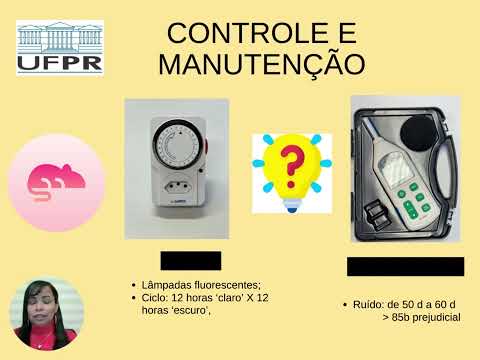
- Rats and mice are highly sensitive to sound; noise above about 85 dB can cause stress and may increase cannibalism in mouse colonies.
- A timer maintains the recommended 12:12 light-dark cycle; its clock should be checked after a power outage, especially where there is no generator.
- A decibel meter measures room noise, while a thermohygrometer records temperature and relative humidity.
- The cited guidance recommends approximately 15 to 25 air changes per hour in animal rooms to help maintain air quality.
- Ringtail is a constriction and scaling of the tail associated with low environmental humidity, often below 20%, and may be worsened by excessive heat.
- Young and recently weaned rats are particularly susceptible; severe cases can involve necrosis and inflammation.
- Diagnosis combines visible tail lesions with the housing history, especially evidence of persistently low humidity.
- Sanitary status describes an animal’s relationship with its microbiota, including viruses, bacteria, fungi, and parasites.
- Classification reflects both the microorganisms present and the effectiveness of barriers that prevent unwanted agents entering or leaving the facility.
- Gnotobiotic colonies use the most restrictive protections, SPF colonies occupy an intermediate level, and conventional colonies generally have fewer barriers.
- Gnotobiotic animals have a known, defined microbiota and are maintained under rigorous sanitary conditions, often in ventilated racks or isolators.
- Germ-free, or axenic, animals lack an associated microbiota and are maintained in isolators.
- Defined-flora animals are deliberately inoculated with selected organisms: monoxenic animals receive one type, dixenic two types, and polyxenic several types.
- Specific pathogen-free, or SPF, animals are free of designated disease-causing agents and are housed behind sanitary barriers.
- Monitored animals have a less fully characterized microbiota but are screened for selected pathogens; their barriers are generally less stringent than SPF systems.
- Conventional animals have an undefined microbiota and are typically maintained with routine hygiene, cleaning, and disinfection rather than strict pathogen-exclusion barriers.
- A sanitary barrier is a combination of physical, chemical, architectural, and procedural measures that limits pathogen entry and spread.
- A double-door autoclave separates dirty and clean areas while sterilizing suitable supplies, including cages, water-bottle components, bedding, some feed, and uniforms.
- Ventilated racks create protected cage-level environments with filtered incoming and outgoing air, reducing cross-contamination and exposure for staff.
- Other controls include sodium hypochlorite disinfection, facility traffic flow, cleaning procedures, and personal protective equipment.
- Routine animal-health monitoring combines daily visual inspection with laboratory tests and, when needed, palpation or necropsy.
- FELASA’s 2014 recommendations help plan which agents, animals, and tissues to sample, as well as the sampling frequency.
- Monitoring panels should reflect colony status and include relevant viruses, bacteria, ectoparasites, and endoparasites.
- Examples discussed include adenovirus, Mycoplasma pulmonis, and Syphacia; Syphacia infection may be inapparent but can cause poor growth and a rough coat under adverse conditions.
- Histopathology can identify tissue damage: salmonellosis may cause an enlarged spleen, mesenteric lymph-node edema, necrotizing splenitis, and hepatitis.
- Parasitological sampling can include perianal tape tests, skin or hair examination for mites and lice, intestinal scrapings, and fecal flotation for cysts and eggs.
- Heavy Syphacia burdens can occasionally cause rectal prolapse and perianal irritation.
- Bacteriological samples may come from animals, cages, feed, or water; Mycoplasma pulmonis can cause chronic respiratory disease and lung lesions in rodents.
- The lecture gives example testing intervals of every six months for conventional colonies and every three months for SPF colonies.
- Germ-free colonies may require checks as often as every 15 days to confirm the absence of microorganisms.
- Sentinel animals can be placed with a colony and tested periodically, with three-month testing offered as an example.
- Sampling plans should account for agent importance, test reliability, colony type, barrier equipment, and the introduction of new animals.
- A healthy coat should be even and glossy, while healthy eyes should look bright and moist; daily checks also assess weight, temperature, ears, and possible tumors.
- Changes in posture, isolation, pain behavior, abdominal size, nasal discharge, or bleeding can signal a health or welfare problem.
- Red-brown staining around a rat’s eyes or forepaws may be chromodacryorrhea, caused by porphyrin rather than blood.
- Porphyrin staining can indicate stress, including stress associated with excessive cage ammonia.
- Overgrown incisors can cause malocclusion, difficulty eating, weight loss, and dehydration; pellet feed helps wear teeth through regular chewing.
- Corynebacterium bovis can cause scaly, thickened skin, while environmental stressors such as high ammonia can worsen signs of Mycoplasma pulmonis infection.
- Barbering is social or stress-related hair removal, often affecting the nasal, orbital, and dorsal cervical areas; the skin usually remains intact, unlike ulcerative dermatitis.
- Ulcerative dermatitis is multifactorial and can progress to painful skin ulcers, with C57BL/6 mice noted as especially susceptible.
- Knowing sanitary status helps reduce animal numbers and repeat experiments while improving the reliability and reproducibility of research results.
Transcript excerpt
0:01 Olá sejam todas e todos muito bem-vindos a mais uma nova edição do curso de treinamento em manipulação na experimentação animal mais uma vez meu nome é nic de Souza Oliveira atualmente sou médica veterinária do Complexo biotério da UFPR da Universidade Federal do Paraná o assunto que iremos abordar hoje será padrão sanitário em animais de laboratório quais os tópicos que iremos estudar hoje os fatores relacionados ao meio ambiente né em que esse animal é criado em que o animal de laboratório é criado ou mantido a classificação dos animais de laboratório quanto ao estatus
0:51 sanitário barreira sanitária os métodos de avaliação em relação ao padrão sanitário e os dados com a saúde do animal quando realizamos pesquisas em animais nós devemos levar em consideração todos esses fatores aqui que estão ilustrados na figura né o porquê né e a fim de qu a fim de tentar minimizar ao máximo né a variabilidade e obtermos resultados reproduzíveis o animal de de laboratório em si ele responde a diversos fatores né Tais quais fatores seriam ess seriam esses né esses fatores
1:40 aqui que estão ilustrados eh nesta figura ele responde a diversos fatores físicos né quais seriam esses fatores físicos como exemplo iluminação eh ruído qualquer alteração né em um desses fatores o animal vai tentar responder para tentar ali eh estabilizar é a sua homeostase né ele responde também aos fatores químicos um exemplo bastante importante seria o nível de amônia né dentro da da gaiola mais à frente nós vamos ver mais um pouquinho como que como que seria né Essa amônia dentro da gaiola como que ela é produzida ele responde também aos fatores microbiológicos e
2:30 que existem né dentro e fora desse ambiente eem quando nós falamos em ambiente de animais de laboratório nós podemos falar né Nós
This is the start of the transcript. Save this video free for the whole transcript, searchable and time-coded.
Related notes
Summary, takeaways, and chapters were generated by AI from the video's transcript and may contain errors. The video belongs to its creator, Bruno Martynhak.