Peixes - Espécies mais utilizadas
Overview
Bruno Martynhak surveys commonly used fish models, including zebrafish, lambari, tilapia, catfish, goldfish, and trout, then explains how species-specific housing and handling affect experimental welfare. He compares MS-222, benzocaine, and eugenol for sedation, and outlines CONCEA guidance for fish euthanasia, including two-stage procedures, size-dependent physical methods, and restrictions on electrical methods.
Key takeaways
- Fish housing must be adapted to each species, including stocking density, water hardness, alkalinity, temperature, light, and feeding; wild-caught fish may need a gradual transition from natural food to commercial feed.
- Removing fish from water is a substantial stressor, and handling can damage skin, scales, and mucus-producing cells, so sedation and efficient procedures can reduce welfare risks.
- MS-222, benzocaine, and eugenol are common fish anesthetics, but effective concentrations vary with species, body size, stress, and procedure; for example, adult tilapia may require 100 to 200 ppm MS-222 while fry may require 60 to 70 ppm.
- CONCEA guidance favors a two-stage euthanasia approach when feasible: induce anesthesia until loss of equilibrium, then use a suitable method to cause brain death.
- Freezing is restricted by life stage and size: it may be used for small fish, while medium and large fish are limited to embryos, larvae, or post-larvae up to about 200 mg.
- Electrical euthanasia methods have specific welfare constraints: electrocution is discouraged due to possible fractures and muscle damage, and the described alternating-current procedure requires prior unconsciousness.
Chapters
- Examples include lambari, zebrafish (Paulistinha), traíra, tilapia, yellow catfish, goldfish, and trout.
- Trout and salmonids are used in experimental research worldwide, while tilapia and zebrafish are more familiar models in Brazil.
- The discussion focuses on housing, handling, anesthesia, and euthanasia of experimental fish.
- Appropriate stocking density depends on species, since some fish tolerate more individuals per tank than others.
- Water hardness, alkalinity, metabolites, and temperature must be adjusted to the needs of the species being studied.
- Light and feeding routines also require species-specific planning; hatchery-raised fish are usually accustomed to commercial feed.
- Wild-caught fish may need their natural food at first, followed by a gradual transition to prepared feed.
- Removing fish from water for measurements or procedures is a significant stressor, even when handling lasts only about a minute.
- Physical handling can damage skin, remove scales, and injure mucus-producing cells, undermining fish health and welfare.
- Planning procedures to minimize the time fish spend out of water helps reduce stress and the risk of injury.
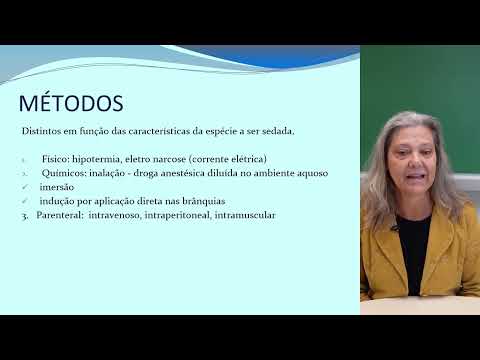
- Physical options include hypothermia and electrical methods; electrical approaches are generally associated with larger fish.
- For small laboratory fish, anesthetics are commonly dissolved in water and administered by immersion.
- Loss of balance is a practical sign that an immersed fish has reached anesthesia.
- Gill application and parenteral routes, including intravenous, intraperitoneal, and intramuscular injection, may be used for larger fish but involve more logistical demands.
- MS-222, or tricaine, is water-soluble and anesthetizes fish by blocking sodium channels.
- The concentration can differ between induction and maintenance, depending on how long and deeply the fish must be anesthetized.
- Examples include roughly 20 to 85 ppm for common carp, 100 to 200 ppm for adult tilapia, and 60 to 70 ppm for tilapia fry.
- Species, body size, stress, and operculum behavior affect uptake and onset; excessive concentrations can kill fish.
- Benzocaine blocks sodium channels but is insoluble in water, so it must first be dissolved in acetone or ethanol.
- A commonly used range for many experimental fish is 50 to 100 mg/L, adjusted for species, size, and stress.
- Fish may close their opercula in response to the anesthetic, slowing respiration and delaying anesthesia.
- Martynhak recommends checking published protocols and testing the chosen concentration for the specific procedure.
- Eugenol is the active anesthetic associated with clove oil and is presented as a relatively inexpensive option for fish.
- The transcript describes its action in terms of GABA agonism and glutamate antagonism, reducing pain perception.
- Clove oil contains approximately 70 to 90 percent eugenol, and concentrations should be adapted to the fish species and procedure.
- Martynhak recommends eugenol when a study does not require a different anesthetic for a specific experimental reason.
- CONCEA guidance emphasizes differences in metabolism, anatomy, respiratory physiology, and tolerance to cerebral hypoxia.
- Fish species vary substantially, so euthanasia procedures should be chosen and adjusted for the animals being used.
- Recognizing death can be difficult in fish, making method reliability and clear verification of death important.
- When possible, guidance recommends first anesthetizing the fish until it loses equilibrium, then applying a physical or chemical method that causes brain death.
- A chemical approach may use a sufficiently high concentration of the same anesthetic used for sedation.
- Physical alternatives include concussion or damage to the spinal cord, with speed and precision prioritized to minimize suffering.
- A physical method without prior anesthesia may be acceptable when anesthesia would interfere with experimental data or prolong extreme distress, but the reason should be justified.
- Immersion in liquid nitrogen may be accepted for small fish, including some small ornamental species, because death can occur rapidly.
- For medium and large species, freezing is limited to embryos, larvae, and post-larvae up to about 200 mg.
- For fish above that size threshold, the guidance favors methods such as concussion or decapitation rather than relying on freezing.
- A blow to the cranium can be used with restrictions, and requires a clear justification for choosing it over other methods.
- Electrocution is discouraged because it may cause spinal fractures and muscle damage.
- Alternating current can produce cardiac fibrillation followed by cerebral hypoxia, but loss of consciousness may take up to 30 seconds.
- For that reason, the described electrocution procedure is only acceptable after the fish has already been rendered unconscious by another method.
- Electroimmobilization must be followed by electrocution, exsanguination, or another method that reliably ensures death.
- Water-dissolved anesthetics are practical for fish and amphibians and can anesthetize or euthanize multiple animals in one solution.
- MS-222 is typically administered by immersion for small fish; for large fish, concentrated solution may be applied directly to the gills.
- Benzocaine immersion protocols also depend on concentration and exposure time, with roughly 10 minutes mentioned as an example rather than a universal rule.
- The choice between light sedation, deep anesthesia, and euthanasia should guide species-specific literature searches and preliminary dose testing.
- Brazilian CONCEA rules discussed here do not yet cover invertebrate groups, while some international jurisdictions treat mollusks and crustaceans as sentient.
- Researchers using these animals should check the requirements of target journals, which may require formal reporting of handling and welfare methods.
- Martynhak closes by urging researchers to keep up with evidence and standards for invertebrate welfare, alongside the established care requirements for vertebrates.
Transcript excerpt
0:00 Olá então estamos aqui hoje para conversar sobre a segunda parte né do da questão que envolve a utilização de peixes enquanto o modelos experimentais e então dando continuidade à nossa conversa anterior eu coloquei aqui nesse slide umas espécies mais comumente utilizadas na experimentação né uma liberdade de tirar o óculos então eu coloquei né o lambari o Paulistinha traíraste tilápia bagre Amarelo cara peixe dourado e truta né ainda coloquei ali entre
0:51 parentes o salmonidios de maneira geral Então essas são as espécies que normalmente a gente mais vê né no como utilizadas como modelo experimental né isso considerando né a produção mundial né então por exemplo truta é uma espécie que aqui no Brasil ou não é tão comum quem trabalha com truta né os intruta como modelo experimental já tilápia né o Paulistinha e as demais espécies colocadas aí são é mais mais comuns né para nós bom então hoje a gente vai falar sobre
1:39 umas questões mais específicas a respeito da otimização desses animais acomodação deles né e outras questões relacionadas a utilização então de peixes na experimentação animal bom então começo falando sobre a acomodação desses animais né então acomodação ela envolve o espaço né a qualidade da água a luminosidade a alimentação né e tudo isso acaba sendo essas características Quais que espécie específicas né então o espaço Por exemplo ele se traduz nada em cidade né de animais que nós vamos utilizar e essa
2:29 densidade né Essa característica Então ela Depende das necessidades da espécie né então tem espécies que suportam uma densidade maior né E tem espécies que não que precisam estar acomodadas uma densidade né menor Ou seja no número menor de indivíduos por um espaço x né a qualidade da água ela é essencial né e de novo né como nós temos uma
This is the start of the transcript. Save this video free for the whole transcript, searchable and time-coded.
Related notes
Summary, takeaways, and chapters were generated by AI from the video's transcript and may contain errors. The video belongs to its creator, Bruno Martynhak.