Normas de Utilização do Biotério - parte 3
Overview
Júlia, a laboratory technician at the Federal University of Paraná (UFPR) animal facility, explains the practical rules for requesting, collecting, housing, handling, and monitoring research animals. She details the 10-day minimum for animal requests, cage capacity limits, maintenance schedules, room-use restrictions, reporting procedures, and researchers’ ethical and operational responsibilities.
Key takeaways
- Submit animal requests at least 10 days before collection and use the four-digit CEUA certificate number; requests must be separated by species, strain, sex, and age cohort.
- Maximum cage loads are 15 mice in a large cage, 5 mice in a small cage, and 4 rats in a large cage; overcrowding is prohibited.
- Researchers must inspect their own animals at least once daily, even though facility staff monitor rooms at least three times per day.
- Maintenance rooms are restricted to animal housing and cage changes; even weighing must take place in a designated, appropriately booked procedure room.
- Return dirty cages by noon or clean and return them the same day; overnight storage can cause mold and lead to a formal notice.
- Keep cage cards and contact details current, respond to facility notices on time, and promptly address missing water or feed, escapes, and animal welfare concerns.
Chapters
- Júlia, a biologist and laboratory technician at UFPR, organizes the guidance around animal collection, housing, daily care, noncompliance, access, PPE, and ethics.
- The procedures begin after a professor has requested animals through the facility’s demand-planning process and the animals are ready for collection.
- The project’s responsible researcher must complete the online animal-request form, including CEUA details, species, strain, sex, age, quantity, collection date, and pickup person.
- Requests must be submitted at least 10 days before collection so staff can verify allocations and prepare the animals.
- Researchers should specify housing location, required borrowed supplies, whether facility staff may maintain the cages, environmental enrichment, and the expected experiment end date.
- Enter the four-digit CEUA certificate number, not the ethics application’s process number, so staff can locate the approved project.
- Only researchers listed on the relevant CEUA project may collect its animals; requests must be separated by species, strain, sex, and age cohort.
- Technicians deduct requested animals from the monthly demand plan and CEUA allocation, while veterinarians update the facility’s inventory spreadsheet.
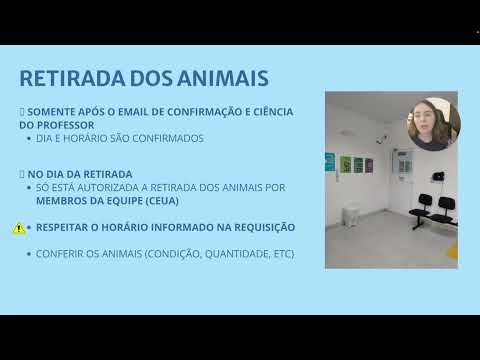
- Facility staff email the researcher and copy the professor with collection details; the professor must acknowledge the message before animals are released.
- Only project-team members may collect animals, and researchers should arrive at the confirmed time because staff may remove food and water shortly before pickup.
- At handoff, count the animals and check each box for the requested quantity and visible problems, such as injuries or abnormal sounds.
- Request facility equipment at least 10 days ahead, sign the loan form, and label laboratory-owned supplies left in shared facility space.
- Large mouse cages hold up to 15 mice, small mouse cages up to 5, and rat cages up to 4 animals.
- Males and females, and different strains, remain in separate cages except where approved breeding arrangements apply.
- Isolation is permitted only when specified in the project and approved by the animal ethics committee; cage overcrowding is never allowed.
- Consult the supervisor or facility technicians before redistributing animals, because compatibility can vary by species and strain.
- Researchers may carry a small number of cages by hand or use a department or laboratory cart; UFPR facility carts are reserved for staff.
- Protect animals from prolonged exposure to rain or strong sun, and use the facility elevator for upper-floor transport when possible.
- Do not leave animals unattended in the elevator; if animals are housed in an external laboratory, the researcher assumes all maintenance duties.
- External animal rooms must meet animal-facility standards, including air conditioning, ventilation, and timed lighting.
- Shared maintenance rooms separate rats from mice and generally use a 12-hour light cycle, with lights on from 07:00 to 19:00.
- Request special rooms months ahead for inverted light cycles, breeding programs, or transgenic animals, because space is limited.
- Maintenance rooms are only for housing animals and changing cages; weighing, surgery, euthanasia, and other procedures belong in designated procedure rooms.
- Reserve procedure rooms on the calendar posted at the door, recording both start and end times and selecting a room appropriate to the task.
- Staff monitor rooms daily at least three times, change rat and mouse cages on Mondays and Thursdays, and provide environmental enrichment on change days.
- Rats receive water replenishment on Mondays, Wednesdays, and Fridays; mice generally receive it once weekly.
- Diabetic rats require daily cage and water changes, while leaking bottles trigger immediate replacement regardless of the normal schedule.
- Large mouse cages with fewer than 8 animals and small cages with fewer than 3 may be changed weekly rather than twice weekly.
- Perform cage changes only on designated tables or wall-mounted benches, then disinfect the surface with the cleaning supplies provided in the room.
- Facility staff monitor room temperature, humidity, ventilation, lighting timers, noise, leaks, cage condition, and animals’ general appearance.
- Each researcher must inspect their own animals at least once daily, animal by animal, and watch for pain or injury using rodent facial-expression scales.
- The facility’s weekend staff also carry out routine monitoring, but this does not replace the researcher’s daily welfare checks.
- If the researcher does not authorize staff maintenance, the researcher is responsible for cage changes, water, feed, enrichment, and cleaning bottles and spouts.
- Maintenance is handled either entirely by facility staff or entirely by the researcher; arrange the schedule with the experimentation team rather than dividing tasks.
- Shared feed is available, or researchers can request a recorded feed package; avoid overfilling because excess feed can develop mold in humid conditions.
- Facility enrichment includes varied items such as paper rolls, feed-filled paper balls, wood-shaving balls, and tied fabric caps.
- Use unmarked cages for external housing; internal rat cages have a green identifier, while internal mouse cages have a brown identifier.
- Take only the number of clean cages needed that day; stockpiling reduces supplies for other researchers.
- Return used cages by 12:00 so the experimentation technicians can handle them during their morning cleaning period.
- If a cage cannot be returned by noon, the researcher must clean it and return it that same day; storing dirty cages overnight risks mold and may trigger a formal notice.
- Place infectious waste in the clearly marked infectious-waste bins, not in ordinary rubbish bins.
- Seal animal carcasses in an infectious-waste bag, place them in one of the facility freezers, and log the researcher’s name and carcass count.
- The facility contacts researchers using the phone number on the cage card; failure to respond by the specified deadline can be recorded as an occurrence and repeated occurrences may jeopardize project approval.
- If an animal escapes, staff isolate it and trace its cage using current animal counts; the researcher must confirm and return it promptly to limit isolation stress.
- Procedures are prohibited in shared maintenance rooms because animal stress can affect other experiments; strong perfumes and headphones are also prohibited because they can disturb animals or distract researchers.
- Facility entry requires a personal, non-transferable access card and current animal-handling training; external visitors, pets, and children are not permitted without an authorized justification.
- Wear a lab coat in animal rooms and use gloves and a mask when handling animals; researchers must bring their own PPE because the facility’s supplies are for staff.
- Júlia emphasizes responsible use of feed and bedding, clear communication with technicians, respect for other researchers’ experiments, and humane treatment of animals.
Transcript excerpt
0:07 Opa, aqui. Eh, bom, pessoal, deixa eu me apresentar, né? Meu nome é Júlia, eu sou bióloga, sou técnica de laboratório, trabalho no biotério da Universidade Federal do Paraná e eu vou falar um pouquinho com vocês sobre o manejo e o uso do dos animais no biotério. Então, desde a parte da retirada, parte da experimentação e parte de boas práticas. Ai, meu Deus. aqui, eh, eu separei o conteúdo em blocos, né, para para ficar mais fácil a nossa compreensão. Então, começando pela retirada e responsabilidade inicial, parte de alojamento e organização experimental, parte de manejo e rotina diária do biotério, eh não conformidades e erros graves e o acesso ao biotério, EPI e
0:56 responsabilidade ética. Então, começando pela parte de retirada e responsabilidade inicial, eh, eu acredito que vocês estejam vendo essa aula logo depois da aula da laí, que é a ordem que a gente se organizou. Então, aqui a gente tá partindo a partir do momento que o professor responsável, né, pelo experimento, ele já solicitou os animais naquela planilha de previsão. Então, a Laí falou sobre isso, né, que pede com três meses de antecedência e tudo mais. Então aqui partindo do do momento que o que o professor já pediu os animais e eles já foram eh produzidos, já foram reproduzidos ali e estão disponíveis paraa retirada, [roncando] eh então a gente parte daqui, né? O pesquisador ele vai agendar a retirada dos animais no biotério, né?
1:44 Não é só chegar lá e pegar os animais, tem todo um passo a passo que a gente segue. Então esse agendamento, né? Deixa eu tirar essa bolinha daqui que tá na frente. Eh, esse agendamento ele é feito pelo site do Biotério. É, nessa aba aqui o Biotério, né? Então, entrando no site, descendo lá para baixo, a gente tem essa
This is the start of the transcript. Save this video free for the whole transcript, searchable and time-coded.
Related notes
Summary, takeaways, and chapters were generated by AI from the video's transcript and may contain errors. The video belongs to its creator, Márcia Shimada.