Normas de Utilização do Biotério - Parte 1
Overview
Natália explains how the UFPR animal facility supports ethical, scientifically reliable animal research, covering its production, maintenance, and experimental-use functions, as well as the Three Rs: replacement, reduction, and refinement. She describes the facility’s two-building layout and regulatory framework, then profiles Wistar rats and the Swiss, C57, and BALB/c mouse lines, emphasizing how welfare, species biology, and genetic traits affect experimental design.
Key takeaways
- Animal welfare and scientific reliability are linked: pain and distress can alter physiology and behavior, increase data variability, reduce reproducibility, and make results unpublishable.
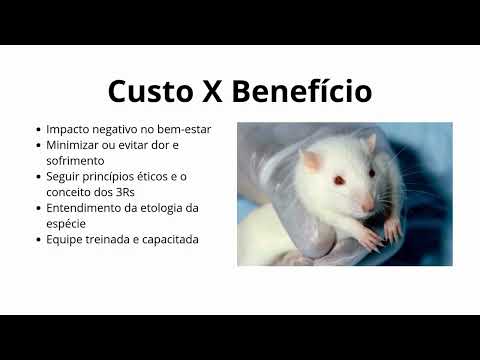
- Ethical animal research requires weighing expected scientific benefits against potential suffering and applying the Three Rs: replacement, reduction, and refinement.
- UFPR’s animal facility separates production from experimentation and includes 14 production rooms, 16 experimental rooms, a quarantine room, and a dedicated clean-area building.
- UFPR produces Wistar rats and Swiss, C57, and BALB/c mice; heterogeneous lines offer genetic variation, while inbred BALB/c and C57 mice are genetically similar.
- The Wistar rat’s sex and age affect expected body weight: at eight weeks males average 250 g and females 200 g, while by ten weeks males may reach about 400 g.
- The facility’s CIAEP accreditation is a legal institutional requirement for producing, maintaining, or using vertebrate animals in scientific or teaching activities.
Chapters
- A biotério is a controlled, regulated facility for producing, maintaining, or using animals in teaching and scientific research.
- Production facilities breed animals, maintenance facilities house animals before protocols, and utilization facilities conduct teaching or research procedures.
- Animal welfare includes physical health, species-typical behavior, and mental experience; trained staff should recognize physical and behavioral changes early.
- Projects should weigh animal suffering against expected benefits and apply replacement, reduction, and refinement while minimizing pain and distress.
- The UFPR complex is a multiuser facility at the Centro Politécnico, primarily producing and supplying rodents while also housing experimental animals and providing technical guidance and supplies.
- Its production building includes 14 animal rooms; the experimental area has 16 rooms and a quarantine room, and houses rats, mice, and fish.
- A separate clean-area building has four rat and mouse maintenance rooms, a procedure room, and a soiled area for washing and material flow.
- The facility operates under the Lei Arouca and CONCEA guidance, holds the required CIAEP institutional accreditation, and belongs to REBIOTEC.
- UFPR produces Wistar rats, Rattus norvegicus, and three mouse lines, Swiss, C57, and BALB/c; each research protocol requires an appropriately selected animal model.
- Wistar rats weigh about 45 to 50 g at weaning around 21 days; at eight weeks males average 250 g and females 200 g, while ten-week males can reach about 400 g.
- Wistar rats are social, nocturnal, curious, and genetically heterogeneous, a trait useful for studies that require variation among individuals.
- Adult mice typically weigh 25 to 40 g; Swiss mice are heterogeneous and albino, while BALB/c and C57 mice are inbred, with white and black coats respectively.
Transcript excerpt
0:00 Oi, eu sou a Natália, eu sou técnica de laboratório do biotério e eu vou apresentar a primeira parte da aula de normas de utilização do biotério da UFPR. Nessa apresentação, nós vamos tratar da estrutura do biotério, das espécies produzidas e dos princípios éticos e científicos que fundamentam o uso de animais. Antes de qualquer coisa, é importante a gente entender o que é de fato um biotério. Um biotério é uma instalação animal. Isso significa que é um espaço estruturado especificamente para produzir, manter ou utilizar animais em atividades de ensino e pesquisa científica. Mas não é apenas um local onde os animais ficam. Ele precisa ser adequado para garantir o bem-estar da espécie utilizada. Então, quando a gente fala em biotério,
0:47 a gente tá falando de um ambiente controlado, planejado e regulamentado, que existe para garantir tanto a qualidade científica quanto o cuidado ético com os animais. Então, entendendo o que é um biotério, a gente precisa compreender que ele não é um espaço único e homogêneo. Ele pode ter diferentes finalidades. Por isso, existem três tipos de biotério. O biotério de produção é onde ocorre a reprodução e a criação dos animais, em um ambiente preparado para garantir condições adequadas de desenvolvimento. O biotério de manutenção é onde os animais permanecem durante o crescimento ou aguardam até serem destinados a um protocolo experimental. E, por último, nós temos o biotério de utilização, que é onde os procedimentos
1:35 de ensino ou pesquisa são realizados. E, independente da finalidade da instalação, existe um elemento que deve estar presente em todas elas. Esse elemento é o bem-estar animal. Quando falamos em bem-estar animal, a gente tá falando de um conceito que evoluiu ao longo do tempo. Antes, o foco principal era garantir o manejo adequado e o controle de
This is the start of the transcript. Save this video free for the whole transcript, searchable and time-coded.
Related notes
Summary, takeaways, and chapters were generated by AI from the video's transcript and may contain errors. The video belongs to its creator, Márcia Shimada.