Non-endpoint Titration Equilibrium Calculations L24 1412 2026
 Watch on YouTube →
Overview
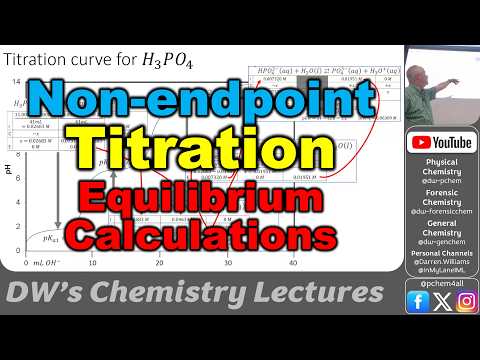
Non-endpoint titration calculations follow a two-stage method: use stoichiometry to determine which reactants remain, then choose the appropriate equilibrium calculation for the resulting solution. Worked examples cover triprotic phosphoric acid, monoprotic weak acids, sulfate, aniline, Henderson-Hasselbalch calculations, and the special information provided by equivalence; the lecture also introduces an approximately $3,000 auto titrator that can automate titration and pH-curve measurement.
Key takeaways
- For a non-endpoint titration, complete the strong acid or strong base stoichiometry first; the species left over determine whether the next step is excess-reagent pH, Henderson-Hasselbalch, or salt hydrolysis.
- Polyprotic acids must be handled one proton at a time because each deprotonation has its own pKa; products and excess hydroxide from one step become reactants for the next.
- Always use the combined solution volume when converting post-mixing millimoles to molarity, although the shared volume cancels in a Henderson-Hasselbalch concentration ratio.
- At equivalence, equal stoichiometric amounts of acid and base are consumed, which can reveal an unknown titrant volume; the resulting conjugate acid or base still requires an equilibrium calculation to find pH.
- For a weak base buffer, convert pKb to pKa with pKa + pKb = 14 before applying the pH-form Henderson-Hasselbalch equation.
- Auto titrators can automate reagent delivery and pH-curve measurement, but accurate interpretation still depends on knowing the underlying stoichiometry and equilibrium chemistry.
Chapters
- Auto titrators use reagent pumps and a pH probe to add titrant in small increments, sometimes down to microliters, and record the titration curve and equivalence point.
- A unit costing about $3,000 may be worthwhile in a busy industrial or water-quality lab if it frees staff from hours of manual titration.
- Automation does not replace understanding titration stoichiometry, equilibrium, or pH calculations.
- Every non-endpoint calculation begins with stoichiometry: react the strong acid or base with the sample and identify the limiting reactant.
- Use the remaining species to choose an equilibrium calculation, because polyprotic acids have distinct proton-removal steps and pKa values.
- A triprotic acid may require up to three sequential limiting-reactant calculations before the final equilibrium calculation.
- The example mixes 11 mL of 0.1 M phosphoric acid with 30 mL of 0.1 M hydroxide, giving 1.1 mmol acid and 3.0 mmol base in 41 mL total volume.
- The first two proton-transfer steps consume 1.1 mmol of hydroxide each; the third consumes the remaining 0.8 mmol, leaving 0.3 mmol hydrogen phosphate and forming 0.8 mmol phosphate.
- Convert millimoles to molarity using the combined 41 mL volume before applying equilibrium expressions; a zero in the stoichiometry table represents an approximation, not a true zero concentration.
- The final phosphate/hydrogen-phosphate pair is checked with Henderson-Hasselbalch using pKa 12.4, yielding pH 12.8.
- After the limiting-reactant table, excess hydroxide means calculate pOH and then pH; excess weak acid with its conjugate base means use Henderson-Hasselbalch.
- If stoichiometry leaves only a conjugate acid or base, react that species with water and solve a new equilibrium problem.
- For a base and its conjugate acid, convert pKb to pKa with pKa + pKb = 14 before using a pH-form Henderson-Hasselbalch equation.
- In the propionic acid example, 116.3 mL of acid is titrated with 254 mL of 0.24 M KOH; stoichiometry leaves 9.65 mmol OH⁻ and 51 mmol conjugate base.
- For excess strong hydroxide, divide the remaining millimoles by the combined volume, calculate pOH, and subtract it from 14 to obtain pH.
- In the benzoic acid example, 25 mL of KOH leaves 80 mmol HA and about 21 mmol A⁻, so the solution is a buffer and Henderson-Hasselbalch gives pH 3.63.
- When both Henderson-Hasselbalch terms use concentrations from the same mixed solution, the shared total-volume denominator cancels, allowing a ratio of millimoles.
- For the sulfuric acid and sodium hydroxide example, stoichiometry leaves sulfate as the relevant product after the acid and base are consumed.
- The sulfate concentration is calculated from the total volume as approximately 0.02 M, then sulfate is treated as a base reacting with water to form HSO₄⁻ and OH⁻.
- Convert the conjugate acid pKa to pKb using pKa + pKb = 14; the example uses pKb 12.1 and estimates hydroxide with the weak-base approximation.
- Taking the negative logarithm of hydroxide and converting pOH to pH gives an approximate pH of 7.1.
- Aniline reacts with strong acid to form its conjugate acid, BH⁺; chloride is a spectator ion and does not need to appear in the pH-active equilibrium table.
- The example leaves excess aniline alongside BH⁺, creating a buffer rather than a solution controlled by excess strong acid.
- Use the given pKb of 9.13 to obtain pKa = 14 − 9.13, then apply the base-buffer form of Henderson-Hasselbalch to calculate pH 5.15.
- Writing units and simplifying millimole ratios can reduce calculator input and help prevent algebra and parentheses errors.
- The phrase “at equivalence” means the initial aniline and HBr amounts are equal and both are consumed in the 1:1 reaction.
- The known aniline amount determines the millimoles of HBr; dividing by the 0.74 mmol/mL HBr concentration gives a titrant volume of about 111.33 mL.
- Adding the 111.33 mL to the 150 mL aniline sample gives about 261.33 mL total volume, needed to calculate the BH⁺ concentration.
- Treat BH⁺ as a weak acid in water; using pKa 4.87 and the small-change approximation yields an estimated pH of 2.68.
- At equivalence, known and unknown reactants have reacted in stoichiometric proportions, allowing the amount or volume of an unknown titrant to be recovered.
- A dimensional-analysis “train track” conversion can replace an ICE-style stoichiometry table when equivalence guarantees a one-to-one amount relationship.
- Away from equivalence, use a stoichiometry table to determine the excess reactant and products before calculating equilibrium concentrations and pH.
- The combined-volume correction remains essential whenever concentrations are needed after mixing two solutions.
Transcript excerpt
0:00 Okay, welcome, welcome. Made it to hump day. Halfway through. Okay, so uh I mean, my chemistry degree was just like yours. And I went through quant, and I titrated a whole bunch of things, and we did the little tedious 1 mil at a time, and mapped out the pH. I did exactly what you did. And then I went to um my first well, grad school, and then my first university teaching, I was teaching analytical, quant, and instrumental analysis. Burettes and all of that. And then I left academia for industry, and I get to industry, and I'm in the lab, and I'm talking to the technicians, and there's this little device sitting on the table, and I said, "What is that?" And they said, "That's an auto titrator." I said, "What?"
0:47 >> [laughter] >> And so, this thing has little pumps inside. You got little reagent tubes, and so on. There's all these little little tubes that go into your beaker, and it'll titrate for you, and give you the titration curve, and the equivalence point, and it's measuring it all electrochemically, or with a little pH probe, and goes very slowly, you know, a tenth of a mil at a time, or maybe even microliters at a time. You get really accurate results. And I didn't even know these things existed. So, I wanted to be sure to show you, this is how titrations are done. I mean, they still use burettes in in industry, but you know, if they if it's going to take you several hours to build your reagents, and do all of that stuff, um and they add up the amount of time you do on titrations, this thing is around $3,000, which sounds expensive, but in terms of
1:36 time, it's not that expensive. And so,
This is the start of the transcript. Save this video free for the whole transcript, searchable and time-coded.
Related notes
Summary, takeaways, and chapters were generated by AI from the video's transcript and may contain errors. The video belongs to its creator, DWs General Chemistry Videos.