Math 30 - Day 2 - Domain and Range
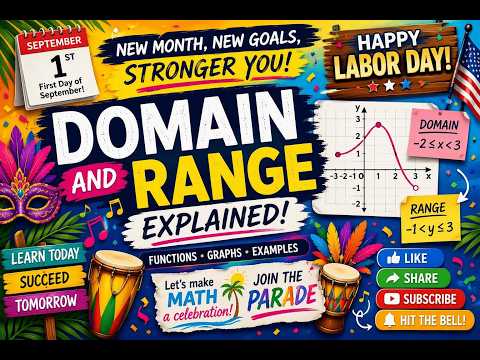
Overview
Christopher Lee teaches how to determine whether relations are functions and one-to-one functions, then introduces common toolkit-function graphs and methods for finding domains. The lesson develops interval, inequality, and set-builder notation, with practical domain checks for denominators and even roots, including worked examples such as (x + 1)/(2 - x) and sqrt(7 - x).
Key takeaways
- A relation is a function when each input has exactly one output; multiple inputs may share an output, but that prevents the function from being one-to-one.
- The vertical line test checks whether a graph is a function, while the horizontal line test checks whether an already-valid function is one-to-one.
- For real-valued formulas, domain restrictions come chiefly from denominators that cannot equal zero and even-root radicands that must be nonnegative.
- Interval notation uses brackets for included finite endpoints and parentheses for excluded endpoints; infinity always takes a parenthesis.
- A domain is the set of permitted inputs and a range is the set of resulting outputs; they can be entirely different sets, such as positive inputs and negative outputs.
Chapters
- A function is one-to-one when each output corresponds to exactly one input, in addition to each input having exactly one output.
- A stock price of $1,000 on five dates illustrates a function that is not one-to-one because multiple inputs share an output.
- A mapping where Q and R both point to N is still a function, but it is not one-to-one.
- A mapping where one input Q points to two outputs is not a function; a one-to-one mapping gives each input and output a unique partner.
- The circle-area rule is A = πr², so each permitted radius produces one area.
- For physical circles, radius is nonnegative; on that domain, different radii give different areas, making the area function one-to-one.
- A bank account number can serve as input to a function that returns its balance.
- A balance cannot generally determine a unique account number because several accounts can have the same balance, so the reverse relationship is not one-to-one.
- If each percentage score maps to one letter grade, letter grade is a function of percentage score.
- The mapping is not one-to-one because a range of percentages can receive the same letter grade, such as multiple scores earning an A.
- Graphs conventionally place input x on the horizontal axis and output y on the vertical axis, with y = f(x).
- The example marks f(0) = 2 at (0, 2) and f(6) = 1 at (6, 1), points that lie on the function's curve.
- A graph represents a function only if every vertical line intersects it at most once, since each x must have only one y.
- A circle or other closed oval fails the test because some vertical lines cross the graph twice.
- To test a graph, check whether any vertical line would intersect its curve more than once; if so, it is not a function.
- Lee emphasizes the distinction: vertical lines test whether a graph is a function, while horizontal lines will test whether it is one-to-one.
- After confirming a graph is a function, draw horizontal lines across it to test whether it is one-to-one.
- If any horizontal line intersects the graph more than once, different inputs share an output and the function is not one-to-one.
- A constant function has the form f(x) = c, where c is fixed; for example, y = 2 graphs as a horizontal line.
- Every input x produces the same output, so y = 5 remains at 5 for all real x.
- The identity function is y = x, a diagonal line through the origin.
- Its outputs match its inputs: x = 1 gives y = 1, x = 3 gives y = 3, and x = -2 gives y = -2.
- The absolute value function y = |x| measures distance from zero, so inputs 3 and -5 produce outputs 3 and 5.
- The quadratic function y = x² forms a U-shaped graph; for example, -3 maps to 9 and 2 maps to 4.
- The cubic function y = x³ preserves the sign of its input, so -2 maps to -8 while 2 maps to 8; its graph falls left and rises right.
- The reciprocal function y = 1/x is undefined at x = 0 and has branches in the first and third quadrants.
- The reciprocal-squared function y = 1/x² is positive for nonzero x; substituting x = -2 gives y = 1/4.
- The square-root function y = √x begins at (0, 0) and requires x ≥ 0 over the real numbers; the cube-root function maps 8 to 2 and also accepts negative inputs.
- A domain must respect both real-world meaning, such as ticket quantities, and mathematical rules.
- For real-valued functions, exclude inputs that cause division by zero or require an even root of a negative number.
- Use square brackets when an endpoint is included and parentheses when it is excluded or the interval extends to infinity.
- For a spending amount greater than $0 and no more than $100, write (0, 100], excluding zero while including $100.
- For a function given as ordered pairs, the domain is the set of first coordinates; Lee uses pairs such as (2, 10) and (6, 40), giving domain {2, 3, 4, 5, 6}.
- For an equation, identify possible inputs, remove values that violate restrictions, and express the result in interval notation when appropriate.
- A polynomial such as a quadratic has domain (-∞, ∞) because every real x can be substituted without causing an invalid operation.
- For a rational expression, check for zero denominators; for an even-root expression such as √x, require the radicand to be nonnegative.
- For f(x) = (x + 1)/(2 - x), set the denominator equal to zero: 2 - x = 0, so x = 2 is excluded.
- The domain is (-∞, 2) ∪ (2, ∞), all real numbers except the value that makes the denominator zero.
- For f(x) = √(7 - x), require 7 - x ≥ 0; solving gives x ≤ 7.
- The domain is (-∞, 7], with a bracket at 7 because the square root of zero is defined.
- A function's domain and range do not have to overlap; one example described is a rule with positive inputs and negative outputs.
- Set-builder notation describes a set by a condition, such as {x | 10 ≤ x < 30}, read as all x such that the inequalities hold.
- Number-line shading, inequalities, set-builder notation, and interval notation can encode the same set in different forms.
- For example, 5 < h ≤ 10 corresponds to {h | 5 < h ≤ 10} and (5, 10], with an open endpoint at 5 and a closed endpoint at 10.
- The union symbol ∪ combines values belonging to either set; for finite sets {2, 3, 5} and {4, 6}, the union is {2, 3, 4, 5, 6}.
- The condition |x| ≥ 3 becomes (-∞, -3] ∪ [3, ∞), capturing both negative and positive values whose distance from zero is at least 3.
- A shaded number line from 1 through 3, including both endpoints, together with values greater than 5 is written [1, 3] ∪ (5, ∞).
- The same set can be expressed as 1 ≤ x ≤ 3 or x > 5, or in set-builder notation using the conditions joined by union.
Transcript excerpt
0:00 Start this up. Okay. Right here. All right. Does anybody have any questions? We all good? Nothing from yesterday or or Monday? Whichever one came first. All right. So, let's answer your question. I'm sorry I didn't learn your name yet. But you asked me about one one. So let's So now we're going to get into that. All right. Determining whether a function is one one. All right. So some functions have a given output value that corresponds to two or more input values. Right? So for example, in
0:50 the stock chart shown in the figure at the beginning of this chapter, right? the stock price was $1,000 on five different dates, meaning that there were five different input values that all resulted in the same output value of $1,000. However, some functions have only one input value for each output value as well as having only one output value, right, for each input. We call these functions onetoone functions. All right, an example, right? Um, consider a school that uses letter grades and decimal equivalents, right? As in this table right here, right? So, on the left you have your letter grades, ABC, C, D, and on the right you have your grade
1:36 point averages, 4.0, 3.0, 2.0, 1.0, right? Let's just assume that that's the only thing you can get, right? There's no such thing as 2.2, right? For example, right? The grading system represents a onetoone function because each letter um input yields one particular grade point average output and each grade point average corresponds to one input letter. To visualize this concept, right, we're going to look at two simple functions sketch in the future um figures, right? Um we'll talk about that in a minute, but real quick, you guys get the idea of onetoone.
This is the start of the transcript. Save this video free for the whole transcript, searchable and time-coded.
In this course
Related notes
Summary, takeaways, and chapters were generated by AI from the video's transcript and may contain errors. The video belongs to its creator, Christopher Lee.