Math 30 - Day 18 - Rational Functions
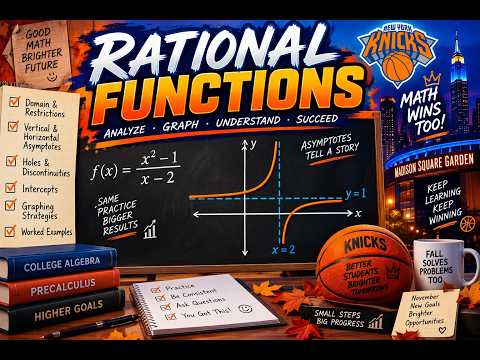
Overview
Christopher Lee reviews rational-root candidates and transformations of the reciprocal-squared function, then develops a step-by-step method for finding rational-function domains, vertical asymptotes, and removable discontinuities. Examples show how factoring and canceling common factors distinguish vertical asymptotes from holes, including a final function with asymptotes at x = 0 and x = 1 and a hole at x = 5.
Key takeaways
- For a rational function, factor the numerator and denominator before classifying restricted inputs: uncanceled denominator factors produce vertical asymptotes, while fully canceled common factors produce holes.
- A denominator zero is always excluded from the original function's domain, even when its factor cancels during simplification.
- If a denominator factor has greater multiplicity than the matching numerator factor, cancellation leaves a denominator factor behind, so the input remains a vertical asymptote.
- For (x² - 25)/(x³ - 6x² + 5x), canceling x - 5 gives vertical asymptotes at x = 0 and x = 1 and a hole at x = 5.
- Testing Rational Root Theorem candidates can rule out rational roots among those candidates, but it cannot by itself establish that a polynomial has no irrational real roots.
- The graph of 1/(x - 3)² - 4 has vertical asymptote x = 3 and horizontal asymptote y = -4, with both branches rising toward positive infinity near x = 3.
Chapters
- For 2x⁴ - 5x³ + x² - 4, Lee lists candidate rational zeros from factors of 4 over factors of 2, including ±1, ±1/2, ±2, and ±4.
- He uses a calculator table with a 0.5 step to test candidates and finds that none of the listed values produce zero.
- The class notes that complex zeros may exist; testing rational candidates alone does not establish that a polynomial has no irrational real zeros.
- The reciprocal-squared toolkit function is 1/x²; shifting it right 3 and down 4 gives 1/(x - 3)² - 4.
- The shift moves the vertical asymptote from x = 0 to x = 3 and the horizontal asymptote from y = 0 to y = -4.
- As x approaches 3 from either side, the function rises toward positive infinity; as x approaches either infinity, it approaches -4.
- Lee defines a rational function as f(x) = p(x)/q(x), where p and q are polynomials and q(x) cannot equal zero.
- He connects rational functions to applied problems involving rates and concentrations.
- For a horizontal asymptote, he previews comparing the leading coefficients when numerator and denominator have matching degrees.
- The domain includes every real input except values that make the denominator equal zero.
- The three-step procedure is to set the denominator to zero, solve for x, and exclude those solutions from the domain.
- A vertical asymptote marks an undefined input, though a denominator restriction can also correspond to a hole.
- For a denominator that is zero at x = -3 and x = 3, the domain is written as (-∞, -3) ∪ (-3, 3) ∪ (3, ∞).
- The graph example identifies a vertical asymptote at x = 3 and a removable discontinuity, or hole, at x = -3.
- Lee emphasizes that excluded values are not included in interval notation, so the endpoints use parentheses rather than brackets.
- For a denominator containing (x - 1)(x - 5), setting each factor to zero gives the excluded inputs x = 1 and x = 5.
- The domain is (-∞, 1) ∪ (1, 5) ∪ (5, ∞), excluding both values that cause division by zero.
- Lee distinguishes domain, the allowed x-values, from range, the resulting y-values.
- Lee's method begins by factoring the numerator and denominator, then identifying the original denominator's restrictions.
- After canceling common factors, zeros of the remaining denominator factors give vertical asymptotes.
- A restricted input associated with a canceled common factor instead gives a removable discontinuity, or hole.
- In a worked example, Lee factors the denominator and finds zeros at x = 1 and x = -2.
- Because the numerator has no matching factors to cancel, both restricted values remain vertical asymptotes rather than holes.
- He contrasts asymptote behavior, where the graph approaches a vertical line, with a hole, where a point is missing from an otherwise continuing graph.
- For (x² - 1)/(x² - 2x - 3), factoring gives (x + 1)(x - 1)/((x + 1)(x - 3)).
- Canceling x + 1 leaves (x - 1)/(x - 3): x = -1 is a hole, while x = 3 is a vertical asymptote.
- A graphing calculator may not display the hole; checking the table can reveal that the original function is undefined at the canceled-factor input.
- A common factor in the numerator and denominator produces a hole when cancellation removes that factor from the denominator entirely.
- If the denominator has a higher multiplicity, such as (x + 2)² below and only (x + 2) above, one denominator factor remains after cancellation.
- That remaining factor makes x = -2 a vertical asymptote rather than a removable hole.
- For (x - 2)/(x² - 4), factoring the denominator gives (x - 2)(x + 2).
- Canceling x - 2 leaves 1/(x + 2), so x = -2 is a vertical asymptote and x = 2 is a hole.
- The original denominator supplies both restricted inputs; cancellation distinguishes which one becomes the hole.
- The practice function is (x² - 25)/(x³ - 6x² + 5x).
- Factoring the denominator as x(x - 1)(x - 5) and the numerator as (x - 5)(x + 5) reveals a common factor to cancel.
- Lee asks students to classify the denominator's zeros as vertical asymptotes or a removable discontinuity.
- After canceling x - 5, the function simplifies to (x + 5)/(x(x - 1)).
- The remaining denominator zeros give vertical asymptotes at x = 0 and x = 1; the canceled factor gives a hole at x = 5.
- Lee notes that the calculator graph may not show the hole and announces the exam for the following Wednesday.
Transcript excerpt
0:03 All right. So once again, we're just finding the possible zeros right here. So let's look at what we're going to have, right? So we're going to have let's start with our negatives. -1 over 1 right? We're going to have a negative 1 over 2 then we're going to have a -2 over 1 a negative 2 over 2 -4 over 1 and -4 over 2. That's for our negatives. For our positives now, right? We'll have positive 1 over 1 positive 1 over 2 positive 2 over 1
0:50 positive 2 over 2 positive 4 over 1 and positive 4 over 2. Did I leave anything out? Good. Let's simplify this down a little bit. Right? So like -1 over 1, we know that's just -1, right? What else do we have? We have -1/2 -2 over 1, that's just -2 -2 over 2, you know that's just -1. I have that already. -4 -4 over 2 is just -1/2 right? I have that Excuse me, -2, excuse me. Sorry about that. I already have that. Let's go to the positives. 1 over 1 is 1 and I have 1/2
1:40 2 over 1 is 2 2 over 2 is 1. I have that already. 4 over 1 is 4 and the 4 over 2 is 1/2, right? So these are my possible zeros. Right? And then recap, our next step that we spoke about, right? I want to see which ones are possible zeros. So, let me get my calculator. Bear with me one second. Oh man, I got ads for days over here.
2:41 Yeah, I think we should start this new thing, right? Anytime they show us an ad, we don't buy their product no more. Call it reverse advertising, I don't know. Okay. All right, so let's test this out.
This is the start of the transcript. Save this video free for the whole transcript, searchable and time-coded.
In this course
Related notes
Summary, takeaways, and chapters were generated by AI from the video's transcript and may contain errors. The video belongs to its creator, Christopher Lee.