Math 30 - Day 1 - Functions and Function Notation
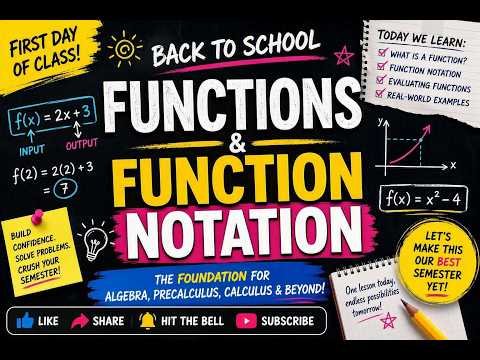
Overview
Christopher Lee introduces functions by connecting ordered pairs, domains, and ranges to the rule that every input must have exactly one output. He then shows how to read and write function notation, test relations in examples and tables, evaluate functions from formulas, tables, and graphs, and distinguish evaluating an input from solving for inputs that produce a given output.
Key takeaways
- A relation is a function if and only if every input has exactly one output; multiple inputs may share the same output without violating the definition.
- Reversing input and output can change whether a relation is a function: a coffee item can determine one price, while a shared price such as $1.99 can correspond to multiple items.
- Function notation f(x) means apply the rule f to input x, not multiply f by x; in f(a + b), calculate a + b before applying the rule.
- Evaluating asks for the output at a specified input, while solving asks for all inputs that produce a specified output; h(p) = 3 for h(p) = p² + 2p has solutions -3 and 1.
- A circle relation x² + y² = 1 is not y as a function of x because solving gives two branches, y = ±√(1 - x²); the cube-root relation y = ∛(x/8) is single-valued.
- Functions can be represented by formulas, tables, or graphs: reading f(2) from the example graph gives 1, while solving f(x) = 4 gives two inputs, -1 and 3.
Chapters
- A relation is a set of ordered pairs; the first components form the domain, or inputs, and the second components form the range, or outputs.
- For the pairs (1,2), (2,4), (3,6), (4,8), and (5,10), the domain is 1 through 5 and the range is 2 through 10.
- A relation is a function when each domain value is associated with exactly one range value.
- In mapping diagrams, P to M, Q to N, and R to N is a function, even though Q and R share output N.
- P to X, Q to Y, and R to Z is also a function because each input has one output.
- A diagram where Q points to both X and Y is not a function: one input cannot produce multiple outputs.
- To test a relation, identify its inputs and outputs, then check whether every input has exactly one output.
- For a menu, price is a function of the item when each menu item has one listed price.
- Reversing the relation can change the result: if two items cost $1.99, an item is not a function of price because one price maps to multiple items.
- A percentage grade determines a GPA under a grading scale, so GPA can be a function of percentage grade.
- The reverse relation need not be a function: multiple percentages, such as 55 and 56, can correspond to the same 0.0 GPA.
- In a list of five ranked baseball players, each player's name maps to one rank, and each rank maps to one player.
- The notation y = f(x) names the function f, identifies x as its input, and identifies f(x) as its output.
- For height as a function of age, the relationship can be written h = f(a), where age is the input and height is the output.
- Parentheses in f(x) indicate a function input, not multiplication; f(a + b) means add a and b before using the result as the input.
- The number of days is a function of the month, written d = f(m), with the month as input and the day count as output.
- For a non-leap year, f(March) = 31 and f(February) = 28.
- Function inputs do not have to be numbers: they can be month names, people, or labels for geometric objects.
- If n = f(y) represents the number of police officers in a town in year y, then f(2005) = 300 means the town had 300 officers in 2005.
- The weight of a pig in pounds as a function of age in days can be represented as weight = f(days).
- Christopher Lee distinguishes the function rule from its output, recommending notation such as y = f(x) in math even when applied fields may write y = y(x).
- A table pairs inputs and outputs; a month-number table can use 1 for January and list each month's day count.
- In a table of children's ages and heights, age 5 paired with both 40 inches and 42 inches means the table is not a function.
- To test a table, check each input for a single associated output; repeated outputs are allowed, but a repeated input paired with different outputs is not.
- A table with inputs 2, 5, and 8 paired with outputs 1, 3, and 6 is a function because each input has one output.
- Inputs -3, 0, and 4 paired with outputs 5, 1, and 5 still form a function: two inputs may share output 5.
- Inputs 1, 5, and 5 paired with outputs 0, 2, and 4 do not form a function because input 5 has two outputs.
- To evaluate a formula, substitute the requested input for the variable and calculate the resulting output.
- For f(x) = 5 - 3x², evaluation follows the rule: square the input, multiply by 3, then subtract from 5.
- Every valid function input produces exactly one output, while solving for inputs that yield an output can produce several solutions.
- For f(x) = x² + 3x - 4, substitution gives f(2) = 4 + 6 - 4 = 6 and f(a) = a² + 3a - 4.
- Substituting a + h gives f(a + h) = (a + h)² + 3(a + h) - 4.
- Expanding f(a + h), subtracting f(a), and dividing by h simplifies [f(a + h) - f(a)]/h to 2a + h + 3.
- For h(p) = p² + 2p, evaluating at p = 4 gives h(4) = 16 + 8 = 24.
- For g(m) = √(m - 4), g(5) = √1 = 1; the positive square root is used unless the equation requires both roots.
- Solving h(p) = 3 yields p² + 2p - 3 = 0, which factors as (p + 3)(p - 1) = 0, giving p = -3 or p = 1.
- To express an equation as an output function, isolate the output variable so the other side depends only on the input.
- Starting with 2n + 6p = 12 and solving for p gives p = -n/3 + 2.
- The same algebraic methods apply: subtract 2n from both sides, then divide both sides by 6.
- From x² + y² = 1, solving for y gives y = ±√(1 - x²).
- For most allowed x-values, the plus-minus result gives two y-values, so the circle does not define y as a function of x.
- The result is an important function check: a valid input cannot correspond to multiple outputs.
- From x - 8y³ = 0, rearranging gives y³ = x/8.
- Taking the cube root yields y = ∛(x/8) = ∛x/2, with no plus-minus sign.
- Because each x produces one real cube-root output, this relation does define y as a function of x.
- The equation x = y + 2ʸ can determine a unique y for each x even though y cannot be isolated in a simple explicit algebraic formula.
- Such a relationship is described as an implicit function: mathematical procedures can determine y to a desired accuracy.
- A pet-memory table represents pet type as input and memory duration as output, including a goldfish estimate of 3 months, or 2,160 hours.
- To evaluate a table-defined function, find the input and read its paired output; for example, g(3) = 7.
- To solve g(n) = 6, find every row where the output is 6; the example has inputs n = 2 and n = 4.
- A table can show repeated output values, so solving for an input requires checking every occurrence of the requested output.
- To evaluate f(2), locate x = 2 on the graph and read the corresponding y-coordinate; the example gives f(2) = 1.
- To solve f(x) = 4, locate y = 4 and read all matching x-coordinates; the graph gives x = -1 and x = 3.
- The final graph example similarly finds the x-values associated with an output of 1, showing how a horizontal level can intersect a graph at multiple inputs.
Transcript excerpt
0:00 Y'all gonna really like it. Promise y'all that. >> Yeah, every day. >> I will send it to y'all every single day. All right. So, let's let's look at what we getting into, right? Let's bridge the gap between 28 and 30 real quick. All right. So, we're going to do that by talking about determining whether a relation represents a function. All right. So check this out. A relation is a set of ordered pairs, right? The set of the first components of each ordered pair is called the domain, right? And the set of the second components of each ordered pair is called the range, right? So set a little differently. Think of it
0:47 as like x and y, right? x is domain, y is range. Same kind of idea, right? So consider the following set of ordered pairs. The first numbers in each pair are the first five natural numbers. Right? So natural numbers, you remember those are the numbers that we grew up with when we were kids, right? One, two, three, four, right? We ain't know nothing about zero yet, right? I know I have two toys that was on on the floor and my my little cousin just came in and one of them toys is missing. That's all I know, right? [laughter] All right. So consider the following set of ordered pairs. The first number numbers in each pair are the first five natural numbers. The second number in each pair is twice that of the first. So you have one twice of one is two. You
1:38 have two twice of two is four etc. Right? So this is our set that we have here. Right? So the domain is all of the x values, right, in each one of those ordered pairs. So 1 2 3 4 5. That's your
This is the start of the transcript. Save this video free for the whole transcript, searchable and time-coded.
In this course
Related notes
Summary, takeaways, and chapters were generated by AI from the video's transcript and may contain errors. The video belongs to its creator, Christopher Lee.