Math 30 - Day 12 - Graphing Quadratic Functions
Overview
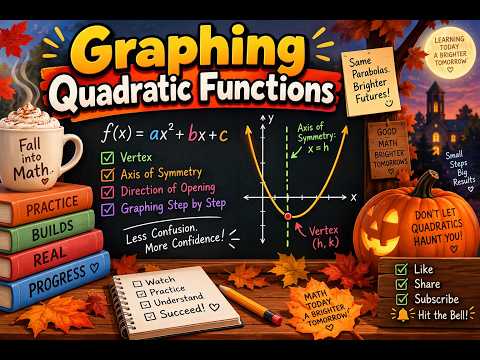
Christopher Lee teaches how to analyze quadratic functions by finding vertices, rewriting equations in vertex form, determining domains and ranges, and locating intercepts. He applies vertex optimization to an 80-foot garden fence and begins a newspaper revenue model, while the revenue calculation is left unfinished for the next class.
Key takeaways
- For f(x) = ax² + bx + c, the vertex is found with h = -b/(2a) and k = f(h); the sign of a determines whether k is a minimum or maximum.
- A quadratic has domain (-∞, ∞), while its range is [k, ∞) when a > 0 and (-∞, k] when a < 0.
- With 80 feet of fencing for three sides, A(W) = -2W² + 80W reaches its maximum of 800 square feet at W = 20 feet, leaving L = 40 feet.
- The newspaper data imply subscriber demand S(p) = -2,500p + 159,000, where p is the quarterly price in dollars; revenue requires multiplying p by S(p).
- For f(x) = 3x² + 5x - 2, the y-intercept is (0, -2) and the x-intercepts are (1/3, 0) and (-2, 0); set x = 0 for the y-intercept and f(x) = 0 for the x-intercepts.
Chapters
- Christopher Lee checks for homework questions before continuing the quadratic-functions lesson.
- He notes that practice helps the procedures become familiar and recommends using class time to prepare for the exam.
- Some materials attached to class announcements can be printed and used during the exam.
- For a quadratic in general form, identify coefficients a, b, and c.
- Find the vertex's x-coordinate with h = -b/(2a), which is also the axis of symmetry.
- Substitute h into the original function to find k = f(h), giving the vertex (h, k).
- For f(x) = 2x² - 6x + 7, the coefficients are a = 2, b = -6, and c = 7.
- Using h = -b/(2a) gives h = 6/4 = 3/2.
- Substituting x = 3/2 into the function gives k = 5/2, so the vertex is (3/2, 5/2).
- Vertex form is y = a(x - h)² + k; the known vertex supplies h = 3/2 and k = 5/2.
- Using the original point f(0) = 7 determines the leading coefficient without substituting fractional vertex coordinates.
- The completed result is y = 2(x - 3/2)² + 5/2; Christopher corrects an arithmetic mistake during the derivation.
- The next function is G(x) = 13 + x² - 6x, which is first reordered as x² - 6x + 13.
- The task asks for both general form and vertex form, using the vertex and an additional point to identify the coefficient.
- Students work through the problem before Christopher checks the calculation.
- For G(x), h = -(-6)/(2·1) = 3.
- Evaluating G(3) gives 9 - 18 + 13 = 4, so the vertex is (3, 4).
- Since G(0) = 13, substitution into vertex form confirms a = 1 and yields y = (x - 3)² + 4.
- Every real x-value can be used as input to a quadratic, so its domain is all real numbers.
- The vertex is either the minimum or maximum, restricting the function's y-values.
- An upward-opening parabola has range y ≥ k; a downward-opening parabola has range y ≤ k, where k is the vertex's y-coordinate.
- State the domain of a quadratic as all real numbers.
- Check the sign of a: positive means the parabola opens upward and has a minimum, while negative means it opens downward and has a maximum.
- Use the vertex value k as the range boundary, including it: [k, ∞) for a minimum or (-∞, k] for a maximum.
- The exercise uses f(x) = -5x² + 9x - 1; its negative leading coefficient means the parabola opens downward.
- The axis of symmetry is x = -9/(-10) = 9/10.
- Evaluating at x = 9/10 gives the maximum value 61/20, so the range is (-∞, 61/20].
- A second domain-and-range exercise is answered with domain (-∞, ∞) and range [8/11, ∞).
- The upward-opening graph has a minimum at its vertex, so the range includes the minimum and extends upward without bound.
- Christopher contrasts this with the downward case, whose range extends from negative infinity through the included maximum.
- For an upward-opening example, the minimum output is 1 and occurs at x = 2.
- For a downward-opening example, the maximum output is 4 and occurs at x = -3.
- The sign of a indicates the orientation: positive opens upward and negative opens downward.
- A backyard farmer has 80 feet of wire for three sides of a rectangle, using an existing backyard fence as the fourth side.
- The two perpendicular sides are labeled W and the third fenced side L, giving 2W + L = 80.
- The area formula A = LW will become a quadratic after expressing L in terms of W.
- Solving the fencing constraint gives L = 80 - 2W.
- Substitution into A = LW produces A(W) = (80 - 2W)W = -2W² + 80W.
- Because the coefficient -2 is negative, the area parabola opens downward and its vertex gives the maximum.
- The vertex formula gives W = -80/(2·-2) = 20 feet.
- The maximum area is A(20) = 80·20 - 2·20² = 800 square feet.
- Using 800 = L·20 gives L = 40 feet, so the garden dimensions are 20 feet by 40 feet.
- Christopher outlines a three-step method for quadratic revenue problems: construct the revenue equation, find its vertex, and interpret the vertex's y-value as maximum revenue.
- He introduces a newspaper subscription example in which price affects demand.
- The worked example continues with a linear demand relationship before revenue is maximized.
- At a quarterly price of $30, the newspaper has 84,000 subscribers; at $32, it expects to lose 5,000 and have 79,000.
- Treating price as x and subscriber count as y gives slope (84,000 - 79,000)/(30 - 32) = -2,500 subscribers per dollar.
- Using the point (30, 84,000) gives the demand model S(p) = -2,500p + 159,000.
- The y-intercept is found by evaluating the function at x = 0.
- The x-intercepts occur where the output is zero, so set f(x) = 0 and solve.
- A parabola may have no real x-intercepts, one where it touches the axis, or two where it crosses; algebra may also produce imaginary roots.
- For f(x) = 3x² + 5x - 2, evaluating f(0) gives the y-intercept (0, -2).
- Factoring gives (3x - 1)(x + 2) = 0, producing x-intercepts (1/3, 0) and (-2, 0).
- Christopher notes that the quadratic formula and completing the square also work when factoring is not practical.
- The newspaper example is left unfinished, with Christopher planning to continue it on Monday.
- The next step for maximizing revenue is to multiply price by the subscriber-count model, then find the vertex of that quadratic.
- Christopher says upcoming homework will be posted Sunday and is not on the exam.
Transcript excerpt
0:03 All right, how about like the work with the class, homework? Anybody have any questions about that? We good? All right. You got time. You got time. So so do your homework in class. I feel like after you after you do it a couple of times, it just kind of gels with you a little bit. I'm feeling you. I know.
0:53 I got you. I mean just get it in when you can, you know. Maybe you can. That's the best way to prepare for the exam, you know. So no no questions at all. Everybody good? Yeah, that's fine. I have several comments. You'll see. It's not going to be that bad. Yeah. You'll be good. Don't worry.
1:45 Maybe like 30, 20 30. Yeah. Y'all have the whole class period though, so y'all have time. Yeah. Yeah. Yeah. The ones that that are attached in the um announcements, y'all can print them out and use them on the exam. All right, let's pick up where we left off then since there's no questions, all right? I give you all a little couple of notes real quick. So, this is a little how-to. So, given a quadratic function in general form, in general form, say you want to find the vertex of the parabola, right? This how you do it. Step one, identify what is A, B, and C. Step two, find H, all right? So, H is
2:35 the X coordinate of the vertex, all right? And you find that once again by substituting A and the B into H is equal to -B/2A, that formula, all right? After you get whatever H is, right? Take that that number and plug it back into the original equation that was given before, right? So, and then when we do that,
This is the start of the transcript. Save this video free for the whole transcript, searchable and time-coded.
In this course
Related notes
Summary, takeaways, and chapters were generated by AI from the video's transcript and may contain errors. The video belongs to its creator, Christopher Lee.