Métodos Alternativos
Overview
The lesson explains how alternative methods apply the 3Rs, covering complete or partial animal replacement, reduction, and refinement, alongside their scientific uses and limitations. It maps Brazil’s framework, including Lei Arouca, CONCEA, RENAMA, BraCVAM, and teaching restrictions, then shows practical alternatives such as simulators, cell assays, organotypic tests, predictive systems, and organ-on-a-chip technology; CONCEA had recognized 41 research methods across four resolutions.
Key takeaways
- An alternative method is not limited to full replacement: under the 3Rs it can also reduce animal numbers or refine procedures to reduce pain and distress.
- Under Brazil’s framework, CONCEA recognizes research methods, BraCVAM organizes or reviews validation, and RENAMA laboratories may carry out validation studies.
- CONCEA RN 53 restricts teaching use to activities that develop specified psychomotor skills and competencies; demonstrations without those learning objectives require alternatives.
- Teaching alternatives in CONCEA’s SICA repository are shared voluntarily and do not undergo the same validation pathway as research methods.
- Organ-on-a-chip systems use microfluidic, connected cell cultures to model organ interactions and may support kinetic studies that simpler in vitro methods cannot.
- The lesson reports 41 CONCEA-recognized research methods across four resolutions and a five-year transition period for mandatory replacement after recognition.
Chapters
- Alternative methods can replace animals, reduce the number used, or refine procedures to lessen pain and distress, and these outcomes can reinforce one another.
- Replacement can be direct, using the same biological substrate in vitro, or indirect, inferring an effect from a related phenomenon.
- Replacement can also be total, such as HPLC replacing mouse insulin-potency tests, or partial, such as using bovine corneas recovered after slaughter.
- Lei Arouca, Law 11,794/2008, created CONCEA and assigned it responsibility for monitoring alternative techniques in teaching and research.
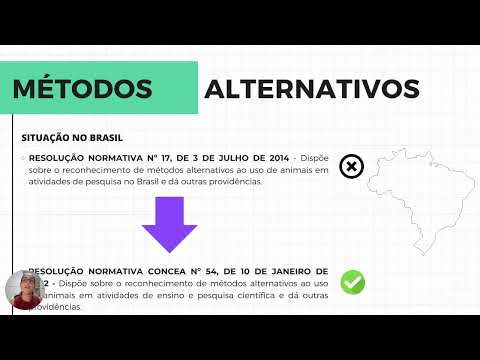
- RN 17 set a five-year deadline for mandatory use after CONCEA recognition; RN 54 replaced it in 2022 while retaining its core function.
- RENAMA connects laboratories that develop or use alternative methods, while BraCVAM organizes validation studies and recommends recognized methods to CONCEA.
- Validation can begin with a new study coordinated through BraCVAM and RENAMA, recognition of an internationally validated method, or review of a laboratory’s existing study.
- In vitro methods can reduce animal-facility costs and space needs and avoid environmental confounders such as noise, temperature, light cycles, and humidity.
- A key limitation is the lack of whole-organism interaction; implementation can also require upfront spending on commercial kits.
- Reproductive toxicity, learning, pain assessment, metabolism, kinetics, and chronic toxicity still often require animal models because adequate substitutes are unavailable.
- Lei Arouca defines research to include basic and applied science, technology development, and production or quality control of drugs, foods, immunobiologicals, and instruments.
- Animal use in education is restricted to higher education and technical secondary education in biomedical fields, so classroom dissections in general schools are not permitted.
- CONCEA RN 53 prohibits demonstrative or observational teaching procedures that do not develop defined psychomotor skills or competencies.
- Clinical teaching using an animal that needs treatment differs from using a healthy animal solely to demonstrate a drug effect.
- First ask whether the practical class euthanizes a vertebrate; if so, the decision tree directs the user to its final decision point.
- If the animal remains alive, ask whether the procedure causes distress or compromises welfare; a no answer means the activity falls outside this restriction.
- If welfare is compromised, ask whether the class develops both specified psychomotor skills and competencies; if not, animal use is prohibited and an alternative is needed.
- Videos can demonstrate animal handling, surgery, clinical signs, drug administration, blood collection, and experimental procedures without exposing an animal to the demonstration.
- Pharmacology and physiology software can simulate drug effects on the nervous and cardiovascular systems; veterinary simulators model procedures such as childbirth care and emergency treatment.
- Cadavers support anatomy and surgical-skills teaching while preserving anatomical detail, provided their source meets ethical requirements.
- CONCEA’s SICA-submitted repository shares voluntary teaching alternatives, but these are not subjected to the same pre-validation and validation process as research methods.
- A leather-fabric rat model supports restraint practice and intraperitoneal or subcutaneous injections; its submission includes construction steps and production cost.
- A boiled-egg-shell model lets trainees practice craniotomy, dura removal, and microelectrode implantation before working with animals.
- Other examples include a synthetic model for canine and feline cystocentesis and a virtual complete-blood-count simulation.
- Cell-line assays can assess cytotoxicity or inflammatory-mediator release, including tests that measure cytokines instead of observing fever in rabbits.
- The Limulus amebocyte lysate test detects endotoxins through gelation or color change, indicating contamination without inducing a response in an animal.
- Organotypic tests use isolated organs or tissue components, such as bovine or chicken corneas, to replace rabbit eye-irritation tests.
- Corneal injury can be measured by opacity and permeability, providing defined endpoints for assessing a substance’s effects.
- Predictive systems estimate chemical toxicity and must be built from experimental data; they can be formal systems without being computational.
- An organ-on-a-chip uses a three-dimensional, multichannel microfluidic system with cell cultures to imitate organ physiology and interactions.
- Because connected cell cultures can model interactions across tissues, organ-on-a-chip systems may support kinetic studies that simpler in vitro models cannot.
- Brazil had recognized 41 research methods: 17 under RN 18/2014, seven under RN 31/2016, one under a 2019 resolution, and 16 under RN 54/2022.
- A resolution’s preamble states its purpose, while its articles identify the recognized methods and organize them by endpoint, such as skin irritation or corrosion.
- OECD guideline codes identify the detailed test protocols; the resolution itself does not contain every procedural detail.
- The resolutions specify that internationally validated and regulatorily accepted methods become mandatory replacements within five years of recognition.
- Recognized endpoints include skin and eye irritation or corrosion, phototoxicity, skin absorption and sensitization, acute and reproductive toxicity, genotoxicity, and endocrine effects.
- The lesson closes by urging researchers to check existing methods before planning animal studies and to share useful alternatives with other institutions.
- Practicing on models before animal procedures can refine technique, reduce surgical errors and losses, and decrease the number of animals needed.
Transcript excerpt
0:01 Olá pessoalo que todos vocês estejam bem e preparados para nosso último encontro dessa vez para conversar sobre métodos alternativos a parte de definições importância e também vários exemplos como eu já mencionei para vocês nas últimas aulas o meu nomea olivea eu sou médica veterinária do complexo biotério aqui do setor de ciências biológicas da UFPR Então bora começar pessoal o que são métodos alternativos são procedimentos que podem substituir completamente o uso de animais e experimentos podem reduzir o número de animais necessários e também diminuir a dor ou desconforto sofrido
0:49 por esses percebam que nada mais é do que o nosso princípio dos trrs certo e apesar de terem definições muito Claras o con conito de substituição redução e refinamento de uma metodologia muitas vezes podem se sobrepor uns aos outros em uma espécie de sinergismo isso significa dizer que em alguns casos o refinamento da metodologia pode contribuir para uma redução do número de animais por exemplo outras vezes nós podemos conseguir substituir determinados ensaios que deveriam ser feitos em animais nas primeiras etapas ali do desenvolvimento de um medicamento mas entretanto em uma fase mais Av mais avançada utilizarmos os animais apenas Para comprovar a
1:38 ausência de toxicidade por exemplo isso também é considerado aí uma técnica né um um uma metodologia de método alternativo digamos assim eh então nós podemos encontrar aí métodos alternativos que apresentam funções variadas e graus variados dentro da sua aplicabilidade ok a substituição pessoal que é o nosso replacement ele pode ser dividido em quatro categorias Lembrando que essa é uma divisão didática Ok se trata aí de formas diferentes de nós conseguirmos compreender como essa substituição é feita então a gente pode dizer que ela é uma substituição direta ou indireta nos referindo à origem do substrato ou do fenômeno estudado e nós
This is the start of the transcript. Save this video free for the whole transcript, searchable and time-coded.
Related notes
Summary, takeaways, and chapters were generated by AI from the video's transcript and may contain errors. The video belongs to its creator, Bruno Martynhak.