Lecture 20 - Exam 2 Review
Overview
Professor Rosen reviews a 105-point Python exam covering material through Chapter 10, plus dictionaries and introductory functions from Chapters 11 and 12. The session works through practical problems involving slices, file processing, functions, list mutation, digit and letter counting, and Monte Carlo simulations, emphasizing that correct, working code matters more than efficiency.
Key takeaways
- Python slices solve common list and string tasks compactly: `s[-3:]` selects the last three characters, `items[:len(items)//2]` returns the first half, and `L[::-1]` creates a reversed copy.
- When scanning a CSV file for extrema, keep both the best value and its associated date, and convert split text fields to numbers before comparing them.
- To inspect positions ahead in a string, iterate over indexes and restrict the range; a `c?t` search must stop before the final two characters to avoid an out-of-range access.
- A dictionary-based frequency counter has two stages: build counts for each key, then scan those counts to identify the most frequent letter or word.
- Monte Carlo simulations need a model that preserves the real probabilities: two six-sided dice produce 36 equally likely pairs, not 12 equally likely sums.
- For the exam's programming questions, Professor Rosen prioritizes code that works over efficiency, so both built-in solutions and explicit loops can earn credit.
Chapters
- The exam is worth 105 points and includes a reference page with reminders such as file-reading commands.
- Students may use a cheat sheet, and the material runs through Chapter 10 with selected content from Chapters 11 and 12.
- Prioritize iteration, conditionals, dictionaries, functions, and review of slices; turtle graphics are excluded.
- Use double quotes around a string such as Howl's Moving Castle when its text contains an apostrophe.
- Lists use sequential integer indexes, while dictionaries associate values with keys that need not be sequential.
- The slice `L[::-1]` produces a reversed copy, and `s[-3:]` selects a string's last three characters.
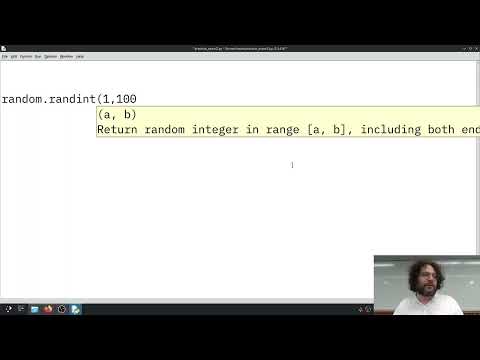
- Use `random.choice` or `random.randint` for a fair coin; simulate 55% heads by choosing among 55 heads and 45 tails or using a 1-to-100 draw.
- The example file has comma-separated date, high-temperature, and low-temperature fields, without requiring a header.
- Read the file with `open` and iterate over its lines, then use `line.split(',')` to extract fields.
- Track the maximum high, minimum low, their associated dates, and a running total of high temperatures.
- Initialize extrema with suitably wide bounds, such as -1000 for a maximum and 1000 for a minimum, rather than assuming temperatures are positive.
- Convert the high and low fields to numbers before comparing them; update the corresponding date whenever a new extreme is found.
- Add each high temperature to a running total, then divide by the number of lines to calculate the average.
- The same pattern applies to other file tasks, such as totaling receipt items other than cheeseburgers or comparing racers' lap times.
- A file header is unnecessary when the problem statement already explains the field order; integers or floats both work for temperature values.
- Check whether `word[:2] == 'un'` to determine whether a word starts with the prefix.
- If it starts with `un`, return `word[2:]`; otherwise, return `'un' + word`.
- Examples include `unable` becoming `able`, `able` becoming `unable`, and `necessary` becoming `unnecessary`.
- Use examples to understand the rule, not as hard-coded cases; any correct implementation is acceptable.
- One approach initializes the largest and smallest values from `numbers[0]`, then updates them while iterating through the list.
- Return the difference as `biggest - smallest` after processing all elements.
- The concise alternative is `max(numbers) - min(numbers)`, which is valid when built-in functions are allowed.
- Swapping the endpoints is different from reversing the entire list: `[1, 2, 3, 4, 5]` becomes `[5, 2, 3, 4, 1]`.
- Save `numbers[0]` in a temporary variable before replacing it, or its original value will be lost.
- Assign the last element to index `0`, then put the saved first element at index `-1`.
- Compute the midpoint with `len(items) // 2` and return `items[:midpoint]`.
- For a five-item list, integer division gives a midpoint of 2, so the slice returns the smaller half.
- The same expression handles even lengths, such as returning the first three items from a six-item list.
- The `has_wildcat` function returns `True` when a string contains `c`, any middle character, and then `t`.
- Iterate over indexes so the code can compare `word[index]` with `word[index + 2]`; the middle character is unrestricted.
- A loop through the entire string can cause an index error when a `c` appears near the end.
- Use a range ending at `len(word) - 2` to ensure two later positions are available.
- Initialize a total to zero and inspect each character in the input string.
- Use `character.isdigit()` to recognize digits, then convert each matching character with `int()` before adding it.
- The examples `AA1BC2D3` and `AA11B33` produce totals of 6 and 8; a string such as `chocolate` produces 0.
- A string-based solution can convert the integer with `str(num)` and reuse the digit-scanning approach.
- For arithmetic extraction, take the last digit with `num % 10`, add it to the total, and remove it with integer division by 10.
- Handle negative input by making the number positive first, or by using an absolute-value operation.
- Professor Rosen emphasizes that either correct method earns credit; efficiency is not the exam's main criterion.
- Rolling two six-sided dice is not equivalent to choosing uniformly from 1 through 12: two-dice sums form a bell-shaped distribution.
- A `roll` function can generate two values with `random.randint(1, 6)` and return whether they match.
- A `turn` function counts consecutive doubles, allowing another roll after each double and capping the result at three.
- Of the 36 possible ordered dice outcomes, 6 are doubles, so a single roll has a 1-in-6 chance of doubles.
- Run the turn simulation 10,000 times and record whether each turn contains zero, one, two, or three doubles.
- Store counts in a four-element list, using the turn's returned value as the list index, then increment that entry.
- Divide each count by the number of trials to produce outcome proportions; the demonstrated results are approximately 82% with no doubles and 14% with one double.
- A separate set of four counters is another workable approach when list indexing feels less clear.
- Build a dictionary by iterating through the text and checking whether each letter is already a key.
- Set a newly seen letter's count to 1; otherwise, increment its existing count.
- Scan the completed dictionary to track the highest count and the letter associated with it.
- The same first step can solve a simpler exam variant that asks only for counts, or can be adapted to count words separated by spaces.
- Although each three-flip sequence has probability 1 in 8, a game that continues until either player's sequence appears does not give every chosen pattern an equal chance to win.
- Simulate flips by appending `random.choice` results to a string and checking whether its last three characters match either target sequence.
- The strategy is to choose a second sequence that exploits overlap with the first, making the first player's pattern difficult to complete.
- A Monte Carlo estimate comes from repeating the game many times and dividing the number of wins by the trial count.
Transcript excerpt
0:00 recording now. All right. So, I'm just going to dive right in. Today is um our practice for our exam or I'm going to go over the practice exam for us um or or most of it, I should say. Once again, it will be out of 105 points. And this back page will have um will have again kind of hints like or notes that you may have forgotten. Uh examples of this is like um the the proper commands to read lines or just read a file or open up a file file. >> Yes. >> Can we also make a cheat sheet again? >> Yes, you are enable. Yeah, you do get a cheat sheet again. I'll I'll put I'll
0:47 send that out as an email. Yes. >> So, I'm sorry. I think two of you thought you were talking at once. So, you in the back first and then I'll get you. >> Excellent question. I have no idea. Um, so, uh, runstone.academy. Log in. Let's check what chapters it is. And then you had your question about Monday. That's right. The exams start on Tuesday the 3. >> So you So yeah, Monday gets the it gets the extra week because they're on the end of it. Um, all right. So all the way through chapter
1:35 10 with a bit of chapter 11 and 12. Chapter 11 for the dictionaries and then chapter 12 for um the that first taste of functions where you learn how to write functions and return from functions. >> So up through chapter 12 I I can't tell you it's like from like chapter 7 through chapter 12. We don't go over tur we aren't going to do turtles but like at the same time like it's good to review things like the slices so you
This is the start of the transcript. Save this video free for the whole transcript, searchable and time-coded.
In this course
Related notes
Summary, takeaways, and chapters were generated by AI from the video's transcript and may contain errors. The video belongs to its creator, Professor Rosen.