CIS 1051 - Introduction to Class
Overview
CIS 1051 introduces computer science as the study of algorithms and problem-solving, using Python to turn ordered, unambiguous steps into programs. The course also surveys milestones from Ada Lovelace and Alan Turing to ENIAC and the World Wide Web, then explains how to succeed through regular practice, assignment demos, a month-long final project, and responsible AI use.
Key takeaways
- Computer science is presented as the study of algorithms: precise procedures that solve problems in finite time and can be evaluated for correctness and efficiency.
- Ada Lovelace’s program for Bernoulli numbers and her account of the Analytical Engine’s ability to manipulate symbols support her reputation as an early programmer.
- Learning Python requires deliberate practice and debugging; CIS 1051 expects roughly 8 to 12 hours of work outside class each week.
- Lab credit depends on both submitting work through Canvas and demonstrating that it runs; labs lose 5 points per late day, up to a 50% penalty.
- The final project gives students a month to explore a chosen computing topic, allows groups of up to three, and can earn the best projects a final-exam waiver.
- AI may help with debugging questions, but it cannot complete assignments; the course checks individual skill through paper exams.
Chapters
- Computer science is framed as the study of algorithms, or how to automate problem-solving, rather than the study of computers themselves.
- Algorithms are evaluated for correctness and efficiency, and computer science also asks what problems can or cannot be automated.
- The field includes areas such as security, software engineering, networking, machine learning, and computational biology.
- Python prioritizes readability over execution speed, while libraries written in other languages can handle performance-critical tasks.
- COBOL, Pascal, and Fortran persist in legacy systems, while C remains widely used and Rust is part of ongoing efforts to replace some C code.
- Computer science connects to medicine, astronomy, finance, psychology, and education; data science combines statistical analysis with computational tools.
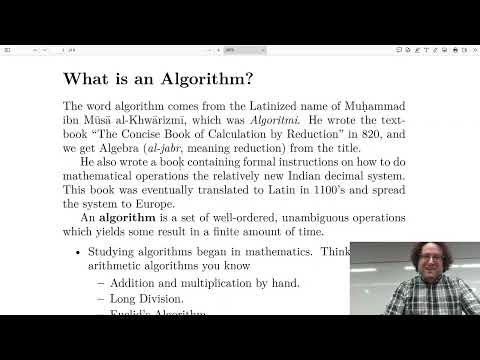
- The word algorithm derives from the Latinized name of Persian mathematician Muhammad ibn Musa al-Khwarizmi.
- An algorithm is a set of well-ordered, unambiguous operations that produces a result in finite time.
- Long division, addition, and baking recipes illustrate algorithms; programmers translate such procedures into programs that automate tasks.
- Information can be represented with 0s and 1s, physically encoded through states such as high and low voltage.
- Alan Turing’s machine model uses a tape and simple operations, including moving left or right, writing a bit, and erasing.
- Programs combine sequence, conditional branching, and iteration, concepts taught through statements such as if/else and loops.
- Early calculating devices included the abacus, while 18th- and 19th-century inventors explored representing numbers with gears.
- Charles Babbage designed the Analytical Engine, a proposed machine that would take instructions from punched cards.
- Ada Lovelace published a program for calculating Bernoulli numbers and described how the machine could manipulate symbols beyond numbers.
- At Bletchley Park, Alan Turing and colleagues used the Bombe to help decipher German Enigma messages.
- Repeated message formats and sign-offs such as “Heil Hitler” gave codebreakers known patterns to exploit; Allied intelligence Ultra was credited with shortening the war.
- ENIAC was an early electronic computer, and a moth found in a Mark II relay became a famous literal example behind the term computer bug.
- Rear Admiral Grace Hopper helped develop programming ideas and is associated with the moth incident.
- Computers shrank from room-sized machines to personal computers, and Tim Berners-Lee proposed the World Wide Web as a system of linked documents.
- Learning to program involves repeated trial and error, including tracking down small syntax mistakes such as misplaced quotation marks.
- Beginners are encouraged to treat errors as a normal part of learning and to build debugging skill instead of outsourcing fundamentals to AI.
- The course uses a flipped format: students complete readings or videos before class, with class time focused on programming problems.
- Labs and homework require both an online submission and a demonstration; work that is never demoed can receive a zero.
- The free Runestone textbook course is titled “Fall 2026 Rosen,” and students should register with their Temple student email for gradebook matching.
- Plagiarism is actively investigated, and exams are completed on paper rather than with AI.
- The four-credit course calls for roughly 8 to 12 hours of work outside class each week, with regular practice compared to learning music or art.
- Lab 4 and Lab 5 must be submitted and demoed by week 8, and the Hurricane Trapper Lab 7 must be completed by week 11 to avoid falling too far behind.
- Runestone is free, and supplementary resources include Al Sweigart’s Automate the Boring Stuff and Think Python, both available online.
- Professor Rosen offers help in CIRC 349, while free peer tutoring is available in CIRC 358.
- Attendance is not formally taken, but students are expected to attend lectures and labs; anyone who misses class should watch the recordings.
- Students who are sick should stay home, email about missed exams as early as possible, and arrange makeups rather than spreading illness.
- Students dealing with stress or other difficulties are encouraged to seek help early; disability accommodations go through DRS.
- A usable computer is necessary, and Temple offers laptop kiosks, computer labs, and potentially loaner laptops for students with device problems.
- Grade cutoffs are not curved against students; A-level work generally begins near 90, with the A-minus boundary often around 88.5.
- Runestone accounts for 15% of the grade: 10% for solo reading exercises and 5% for in-class exercises.
- Assigned exercises are only a subset of the textbook’s full exercise bank, and students can use the assignments page to find the required problems.
- If a textbook exercise remains unsolved after 15 minutes, students should stop and ask for help rather than letting a low-stakes task become a time sink.
- Labs are the course’s main homework assignments, introduced during dedicated lab time with support from teaching assistants and classmates.
- Lab deadlines are firm, with a penalty of 5 points per day late capped at 50%; lateness is measured from the online submission time, not the demo.
- Students normally have two weeks after a due date to demo a lab, and extensions can be considered when circumstances warrant.
- Submitting through Canvas creates an electronic record, while an early demo gives time to correct mistakes.
- The final project replaces regular homework during the last month and lets students explore a programming topic, language, or platform of their choice.
- Projects may be completed individually or in groups of up to three, with the group-size limit enforced.
- Students complete brainstorming, a pre-proposal, a proposal meeting, a progress report, and a final submission with a short video presentation.
- Projects must be hosted on GitHub, and students can coordinate with another instructor or research adviser to apply one project to two courses.
- A project earns an A when it demonstrates learning; especially strong projects can earn the chance to skip the final exam.
- The final project is due on the last Monday of the semester, with a strict late penalty of 0.1% per minute unless an extension was approved.
- Three midterms are scheduled; the lowest score is dropped, leaving two exams worth 15% each, while the final exam is worth 20%.
- AI use follows the same boundary as collaboration with another student: debugging help is allowed, but having AI do the assignment is not.
Transcript excerpt
0:01 Okay. So, I'm going to try something a bit different this uh this semester. Uh normally I go over the syllabus first and then go over a bit of computer history, but considering that people that I don't want to wait for for people to trickle in to go over the syllabus, um I want and I want to make sure I have plenty of time to cover everything. I think I'm just going to go over the history first and then I'll go over the syllabus for this class. So um welcome to 1051 which is intro to programming in Python or intro to problem solving in Python. I am professor Rosen. I will go into more detail about who I am and what I do uh when I go over the syllabus but suffice to say I am the professor for this course. I teach the majority of uh of intro to computer science students.
0:49 Feel free to reach out to me about any questions you have in this course because you're gonna have a lot and that's okay because uh you're you're just starting out. Uh this course is designed for people who are just starting out as well as for people have plenty of experience. But with that being said, I'll leave that spiel for later. Uh what are you here to learn? Um computer science is a bit of a misnomer. It's a bit of a uh of a name that doesn't really apply here. Uh or isn't really a good name, I should say, because it implies that we're studying computers. Uh but really what it is is uh it's a bit different because as this quote says, it's no more about computers than astronomy is about telescopes. Biology is about microscopes or
1:36 chemistry is about beers and test tubes.
This is the start of the transcript. Save this video free for the whole transcript, searchable and time-coded.
In this course
Related notes
Summary, takeaways, and chapters were generated by AI from the video's transcript and may contain errors. The video belongs to its creator, Professor Rosen.