ISE 754 (Fall 2026) 2.3 Multifacility Location–Allocation
 Watch on YouTube →
Overview
Michael G. Kay develops multifacility location-allocation models, showing how distance-based assignment, facility locations, and interactions between operations can be optimized together. He compares integrated optimization with alternating location and allocation, explains how majority-weight rules identify operations to colocate, and demonstrates that multiple local optima make multi-start search and the LogJam ALA procedure useful.
Key takeaways
- Distance-based allocation assigns each existing facility to its nearest new facility through alpha_j = argmin_i distance(i,j), then uses that assignment to calculate weighted total distance.
- Adding Greensboro to the Charlotte-Raleigh distribution network reduced total distance by 48 percent for the example's 10 North Carolina cities with populations above 100,000.
- A multifacility model may require both W weights for new-to-existing links and V weights for interactions among new facilities, but many practical distribution-center problems have no new-to-new interactions.
- A customer receiving product from multiple distribution centers is a likely indication of capacity constraints, since an uncapacitated nearest-center assignment typically gives each customer one source.
- The alternating location-allocation method converges to a local optimum, not necessarily the global optimum; repeated random starts help find and compare different local solutions.
- For the I-40 two-facility example, the solution near 420 and 270 has cost 1,050, improving on the local solution near 200 and 300 with cost 1,340.
Chapters
- For each existing facility j, alpha_j identifies the closest new facility i using an argmin over distances.
- The allocation vector indexes the relevant entries of the distance matrix, whose weighted values produce total distance.
- In a two-distribution-center example serving four customers, the W matrix records assignments and the weighted total distance is 370.
- LogJam implements the assignment with argmin and uses a sparse matrix to construct W.
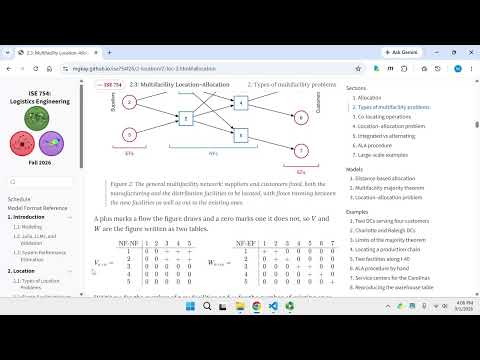
- The general network includes fixed existing facilities, new facilities, and potentially interactions between new facilities represented by an n-by-n V matrix; W is n-by-m for new-to-existing interactions.
- In the North Carolina example, 10 cities with populations above 100,000 are assigned to Charlotte and Raleigh using longitude-latitude distances.
- Adding Greensboro as a third distribution center reduces the example's total distance by 48 percent.
- When distribution-center locations change, customer assignments may need to change too; customers served by multiple centers can signal capacity limits.
- The collocating-operations problem asks where intermediate steps in a product's supply chain should occur when some operations, such as a Nagoya drop forge and Detroit paint assembly, are fixed.
- Transportation costs per mile act as monetary weights between operations, allowing the single-facility majority theorem to guide placement decisions.
- If the interaction weight between two new operations exceeds the relevant majority threshold, the operations should be colocated, reducing the number of location decisions.
- After combining colocated operations and their weights, the resulting composite operation may be assigned to an existing facility if its weight exceeds that facility's competing weights.
- A joint formulation can optimize facility locations X alongside allocation weights W, with the allocated portions summing to each original weight.
- An alternative mixed continuous-combinatorial formulation uses locations and an allocation vector alpha rather than explicit allocation weights.
- The integrated method embeds argmin assignment within the location objective; the alternating method repeatedly solves allocation and fixed-allocation location subproblems.
- Alternating updates stop when locations and assignments no longer change, yielding a local optimum; multi-start runs from different random initial locations and keeps the best result.
- For two facilities on a one-dimensional I-40 corridor, plotting the two location coordinates creates a two-dimensional view of the objective and reveals multiple local minima.
- The example compares a local solution near locations 200 and 300 with cost 1,340 against a better solution near 420 and 270 with cost 1,050.
- The contour plot illustrates why a single start cannot establish a global optimum, while visualizing three or more facility coordinates becomes impractical.
- Kay identifies the ALA procedure as a fundamental method to learn by hand and notes that LogJam includes an ALA implementation.
Transcript excerpt
0:03 In contrast to the previous lecture where we dealt with a single facility location problem, now we're going to be looking at locating multiple facilities. Also, we're going to see that compared to the single facility problem, which was a relatively easy problem, if you remember, it doesn't matter where you start, you would end up with the same optimal location. Well, for the multi-facility problem, that's not the case. And you can have uh different solutions, and it's much more difficult to find the overall best solution. The first problem when you have multiple new facilities is that potentially you can allocate the new facilities to a set of different
0:51 existing facilities. In general, on the left-hand side, for every new facility, potentially it could interact with all of the new facilities. But in many cases, it makes more sense to just have a new facility interact with a subset of the existing facilities. Most often, the ones that are closest or most convenient. When that's the case, then in addition to determining the location of the new facilities, you also determine what is the allocation. So, now you essentially have two problems combined together. The problem itself of allocation is introduced here in terms of a mathematical formulation, and it's
1:39 worthwhile to stop a minute to discuss the particulars of the of representing the problem this way. And what we're looking at is that assuming that we're going to do the allocation based on distance, in the sense that for every existing facility, it'll be allocated to the new facility, assuming we have multiple, that is closest in terms of distance. So, what is what this is saying is then for existing facility J, we want to find among all of the different new facilities indexed by I,
This is the start of the transcript. Save this video free for the whole transcript, searchable and time-coded.
Related notes
Summary, takeaways, and chapters were generated by AI from the video's transcript and may contain errors. The video belongs to its creator, Michael G. Kay.