IEE 475: Lecture J4 (2026-11-12): Estimation of Relative Performance
Overview
Ted Pavlic moves from absolute performance estimation to comparing simulation systems with confidence intervals on differences, where excluding zero indicates evidence of a performance difference. He explains paired-difference, pooled equal-variance, and Welch unequal-variance t intervals, then reviews steady-state batching and how Arena and the course Output Analyzer support analysis across two or more systems.
Key takeaways
- For two simulation systems, the central decision is whether zero lies in the confidence interval for mean A minus mean B, not whether their separate one-sample intervals overlap.
- Matched random inputs enable a paired-difference t-test; when they induce positive correlation between systems, the variance of the differences can shrink and make comparisons more precise.
- Use Welch's unequal-variance t-test for independent runs when equal variances are not justified; use the pooled test only when the equal-variance assumption is appropriate.
- In steady-state simulation, sufficiently long runs can be batched into pseudo-replications, but batch means must be long enough to reduce autocorrelation and neighboring batch means should be checked.
- For steady-state estimation, after establishing a reasonable replication count, lengthening each run can reduce both initialization bias and the variance of replication averages.
- Regression coefficient intervals support multiple hypothesis checks: the ant-colony exponent interval of about 0.671 to 0.898 excludes linear scaling at 1 while including the predicted 0.75.
Chapters
- The remaining course plan includes variance reduction techniques in Unit K, a pre-Thanksgiving wrap-up, and a final-exam review module.
- The final project model should include meaningful complexity, such as scheduled arrivals, nonlinear behavior, or shared resources that couple system components.
- A useful project model has a recognizable flow with at least one elaborated subsystem whose behavior is not obvious from basic queueing theory.
- A point estimate has zero width and is described in class as a 0% confidence interval because it will almost never contain the true population mean.
- A 95% confidence procedure means intervals constructed across repeated samples contain the population mean about 95% of the time.
- With comparable standard deviations, more samples make confidence intervals narrower; greater data variation requires more samples to achieve the same precision.
- A one-sample confidence interval displays the mean values not rejected by the corresponding t-test; values outside it are rejected for the observed data.
- For a benchmark such as a mean wait time of 5, check whether 5 lies inside the interval to assess whether the data support that hypothesis.
- The t-based interval relies on normality and independence assumptions, and its half-width shrinks roughly with the inverse square root of the replication count.
- In a regression meta-model, confidence intervals on coefficients communicate uncertainty more usefully than a fitted slope alone.
- The ant-colony example estimates a metabolic scaling exponent near 0.78, with a 95% interval of approximately 0.671 to 0.898; the interval excludes 1 but includes the theoretical value 0.75.
- In the cat-vocalization regression example, caregiver sex was the only listed predictor whose 95% coefficient interval excluded zero.
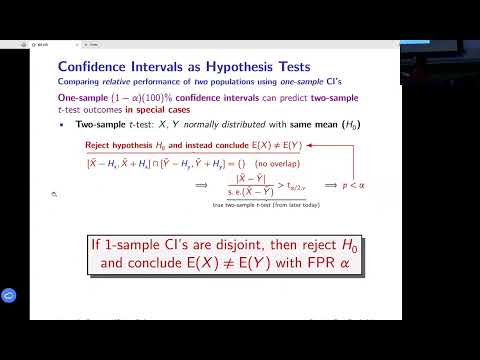
- Two separate 95% confidence intervals can overlap even when a two-sample t-test finds a statistically significant difference.
- Non-overlapping individual intervals are sufficient evidence of a difference in the illustrated setting, but overlap does not establish that the means are equal.
- The direct comparison is a confidence interval for mean A minus mean B; whether that interval includes zero determines whether the data distinguish the systems.
- For non-terminating simulations, discard an initialization warm-up period before collecting steady-state observations to reduce bias.
- A practical allocation guideline is to use enough warm-up relative to the retained data, then increase the number of replications toward about 25 when budget remains.
- After establishing enough replications, extending each replication can reduce both variance in its average and initialization bias more effectively than simply adding replications.
- Arena can divide a sufficiently long run into batches and treat batch averages as pseudo-replications, avoiding a separate warm-up for every replication.
- Use a correlogram to estimate the lag over which observations remain correlated, then start with batch lengths roughly 10 to 30 times that correlation length.
- Aim for about 10 to 30 batches and check that neighboring batch means have low lag-one correlation; if the checks fail, run the simulation longer.
- Relative performance asks whether a proposed model or design performs better than a baseline, such as a cross-trained call center versus separate billing and support teams.
- Construct the interval around the difference in sample means, using an appropriate standard error and t critical value for the experimental design.
- If zero lies outside the difference interval, the systems differ statistically; if zero lies inside, more replications may be needed to narrow an inconclusive interval.
- Pair replications by applying the same random input stream or challenge to models A and B, then calculate one difference per matched pair.
- Analyze those differences as a one-sample t interval centered on their average, with standard error equal to the standard deviation of differences divided by the square root of the number of pairs.
- The degrees of freedom are the number of pairs minus one, and the resulting interval is tested against zero.
- When paired systems respond similarly to shared inputs, the variance of their difference can be much smaller than the sum of their separate variances.
- The class Output Analyzer plots matched observations and their differences; the illustrated data had strongly correlated system outcomes and a difference interval that excluded zero.
- Consistent within-pair differences can yield a tight comparison interval even when each system's individual results vary substantially.
- When runs are independent and cannot be meaningfully matched, use an independent two-sample test rather than inventing arbitrary pairs.
- The pooled t-test assumes equal population variances and combines the two variance estimates; Welch's test allows unequal variances and uses a separate approximate degrees-of-freedom formula.
- Both methods produce an interval for the mean difference and compare it with zero; Pavlic notes that practice often favors Welch's test unless pairing is available.
- The course Output Analyzer provides a several-systems analysis option for comparing designs such as alternative staffing levels in a call center.
- Comparing more than two systems introduces multiple-comparison concerns; the next lecture will cover approaches including Bonferroni correction and post hoc tests after ANOVA.
- Choice of method depends on the experiment's assumptions and available statistical power, with specialized procedures helping when ideal comparisons require more samples than the budget allows.
Transcript excerpt
0:03 All right. So, um, end of this unit, shifting from absolute to relative, uh, performance measures. We'll get to that in just a second. Um, because I was late, I'll, uh, skip over most of these announcements. I do mention that there's uh, so the the, uh, the schedule here is we'll finish this unit today. Next week is unit K on variance reduction techniques. We'll do two of them on Tuesday, two of them on Thursday. Uh then um there's uh the week after that as our kind of wrap-up lecture before Thanksgiving. And um and that's one that if you have to miss, there's not going to be a lot of new content, but there will be um an emphasis on a lot of the K content and then some sort of just overall broad big picture uh topics about the course and
0:52 then Thanksgiving. And then we come back from Thanksgiving. Then that's lecture M, the midterm review lecture. Um, and there's a lot of I'm sorry, the final exam review lecture. And there's a lot of final exam uh review resources online. But again, to access that final exam uh module just like in the midterm, you'll have to do one of these lockdown browser compliance tests. Uh so um there is a homework, this new homework. It's due, I think, next weekend, not this weekend. And I think I've added a a couple days. Um, so I don't think it's actually due on Saturday. I think it might be set to be due on Monday. And that's fine. Uh, and then lab schedule. Last lab is this week. Lab 10. It's a lab with 20 bonus points. So, it's almost like two labs. It's almost like it you complete the whole thing, it drops another one of
This is the start of the transcript. Save this video free for the whole transcript, searchable and time-coded.
In this course
Related notes
Summary, takeaways, and chapters were generated by AI from the video's transcript and may contain errors. The video belongs to its creator, Ted Pavlic.