GERO 200 f2026 Module 2 Why population aging matters part 2 Video 2026 08 30 1
 Watch on YouTube →
Overview
The lecture uses an OECD report covering 37 high-income countries to explain how population aging affects pensions, poverty, inequality, and long-term care, arguing that longer lives and lower fertility are straining systems built around a larger working-age population. It contrasts the United States' reliance on Social Security and private retirement savings with stronger public supports in Nordic countries, and highlights the growing care burden on women, the reported Social Security funding pressure by 2032, and the role of education and job conditions in later-life health and financial security.
Key takeaways
- The lecture presents the U.S. retirement system as a combination of Social Security and private savings, leaving people with low lifetime earnings less able to fund retirement than workers with access to 401(k)s or IRAs.
- The lecture cites a projected Social Security funding pressure by 2032 and a decline toward two workers supporting one beneficiary, illustrating how aging and low fertility challenge pay-as-you-go systems.
- Education and work conditions affect later-life outcomes: higher education is associated with lower poverty and disability risk, while long careers in physically demanding work are associated with roughly 40% higher disability likelihood.
- Long-term care is both a staffing and gender-equity issue: the lecture cites 80% informal, unpaid care in Europe and women comprising about nine in ten formal care workers.
- Nordic countries are presented as expanding home and institutional care through higher taxation and public investment, while the United States provides comparatively less public support and relies more on private resources and unpaid family care.
Chapters
- The lecture focuses on the economic and social effects of a growing share of older adults, including government costs and individual financial well-being.
- Reading quizzes and discussions are due Monday, August 31, at 11:59 p.m.; discussion grades are expected to appear from Tuesday.
- The module continues a United Nations and OECD-based analysis of longevity, fertility, retirement support, poverty, and caregiving.
- The OECD report compares 37 high-income, market-based countries and their public support for older people.
- The lecture links longer life expectancy, approaching 80 years, and lower fertility with a higher old-age dependency burden.
- Gross domestic product and public expenditure are introduced as measures for comparing national economies and government support.
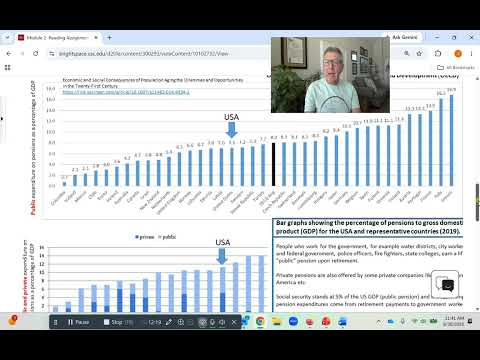
- The lecture contrasts U.S. public pension spending, presented at about 7% of GDP, with total public and private retirement expenditure of roughly 11%.
- Social Security accounts for about 5 percentage points of the U.S. public pension figure; other public pensions cover some state, local, and federal workers.
- Countries such as Greece, Italy, and France are described as relying much more heavily on government pensions, creating pressure to raise retirement ages or reduce benefits.
- The lecture says Social Security's trust fund began drawing down principal in 2021 as contributions and investment income no longer covered outflows.
- It cites a projected funding shortfall by 2032 if policy does not change, with benefit reductions or higher payroll taxes presented as possible responses.
- The worker-to-beneficiary ratio is described as falling from many workers per recipient in 1950 to about two workers supporting one recipient for younger generations.
- The lecture frames later-life inequality as cumulative, beginning with differences in childhood nutrition, health care, and early development.
- Unequal access to education and college shapes lifetime earnings, job quality, and the ability to build a 401(k), IRA, or other retirement savings.
- People with higher incomes can more readily afford healthy environments and medical care, while people with low lifetime earnings have fewer resources in old age.
- Comparisons show greater poverty among children and older adults than among working-age adults aged 25 to 64, with higher poverty overall in developing countries.
- The lecture notes that public pension systems can reduce old-age poverty in countries such as Italy, Spain, and Greece, while older Americans face greater poverty risks.
- Women face particular risks in later life because of career interruptions and lower access to employer retirement plans and private investments.
- The lecture presents education as a poverty-reduction factor, with high school and college education associated with lower poverty in developed and developing countries.
- Among adults aged 50 and older, higher education is associated with lower disability risk, partly because educated workers are more likely to hold less physically demanding jobs.
- The cited comparison reports roughly 40% higher disability likelihood after a long history of physically demanding work, and substantially higher risk for men without a high school education.
- Long-term care ranges from home health aides to assisted living and nursing homes, with longer life expectancy increasing demand for each level of support.
- The lecture cites European estimates that one in three women and one in five men over 65 need some form of long-term care.
- It reports that 80% of care is informal and unpaid, while women make up about nine in ten formal long-term care workers, often in low-paid, stressful jobs.
- A projected global shortage of 13.6 million long-term care workers underscores concerns about staffing, training, and access.
- Nordic countries such as Sweden, Norway, and Finland are presented as providing more home care and institutional care than the United States.
- The lecture links broader services, including long-term care, health care, education, and child care, to higher tax revenues and greater public investment.
- It contrasts Denmark's tax-to-GDP ratio of about 45% with a U.S. ratio described as nearly half as high, and notes that Nordic taxes reach higher rates at lower incomes.
- A 2025 comparison shows U.S. military spending substantially exceeding China's, while the lecture argues that defense priorities compete with domestic spending choices.
- The lecture warns that projected Medicaid reductions could threaten nursing facilities and home health services, particularly in heavily affected states.
- It says the loss of Affordable Care Act tax credits could more than double some insurance premiums, potentially pushing people to go without coverage.
- OECD comparisons are cited to show that the United States spends more per person on health care than other member countries.
- Charts distinguish paid from unpaid care work and show women performing much of the unpaid support, often one to five hours per day.
- Nordic countries such as Sweden, Norway, and the Netherlands are shown contributing more public funding to home care and residential care than the United States.
- The closing discussion contrasts Europe's gradual aging with rapid population aging in countries such as India and China, and points to Japan as an early example of demographic and social pressures.
- Students are directed to complete the quiz and discussion and review materials on Japan's aging-related economic pressures and declining childbearing.
Transcript excerpt
0:00 Hey, what's up? Joe Toner. Today is Sunday, August 30th, 2026, and it's time for me to uh do my module 2 lecture today. Uh we're going to continue on in in in getting a global perspective of the issues that having aging populations, meaning just we have a much higher percentage of older people in countries, communities, everywhere you look. and what what impact that has on society. That's what we're looking at. And and really the the the focus is sadly is is the financial impact. You know, this these are economics. And so we're we're going to spend a lot of time with the the in this course looking at the the real financial impacts and economic impact looking at you know
0:49 again at the at the government state level you know local government level federal government level and uh and then how it impacts you and your economic well-being. All right. So that's we're going to be jumping into that today. Just wanted to for those of you that are new um you you get it. Uh um uh it's we have Brightpace totally set up. So it send sends out an automated email to you welcome you to the class. Um it will then tell you you know to to you know watch this lecture that tells you how to navigate the course and again if you have any trouble u remember um to contact u Julia she is the point person. So she is the course coordinator along with um doing so much of the content and lecturing as well. Okay. Cuz she's the
1:37 bum. And Julia is my wife of 39 years. Just had her 39th anniversary August 15th. Okay. Um so she's an attorney, too. If you have any perspective um uh
This is the start of the transcript. Save this video free for the whole transcript, searchable and time-coded.
Related notes
Summary, takeaways, and chapters were generated by AI from the video's transcript and may contain errors. The video belongs to its creator, John Walsh.