GERO 200 f2026 Module 1 Why population Aging Matters part 1 Video 2026 08 22 1
 Watch on YouTube →
Overview
John Walsh introduces population aging as a global demographic and economic challenge: people are living longer while fertility falls, increasing the share of older adults and shrinking the pool of younger workers and caregivers. Using a United Nations report published in 2023, Walsh highlights projections that the global population aged 65 and over will more than double by 2050 and the population aged 80 and over will triple, then examines policy responses including immigration, family supports, longer working lives, technology, and healthier aging.
Key takeaways
- The UN report discussed by John Walsh projects that the global population aged 65 and older will more than double between 2021 and 2050, while the population aged 80 and older will triple.
- South Korea's projected 2050 age structure is especially pronounced: about 40% of its population is expected to be over 65, compared with about 30% of Japan's population in 2021.
- Falling fertility and longer lives combine to raise the old-age dependency burden, leaving fewer working-age people to provide taxes, paid care, and family support.
- Immigration can help fill labor shortages and elder-care jobs; Walsh notes that immigrants account for nearly 20% of the working-age population in high-income countries.
- Longer life expectancy is not equivalent to longer healthy life expectancy, so access to healthcare, exercise, nutrition, and community support affects whether added years increase independence or care needs.
- Unpaid childcare and elder care disproportionately constrain women's employment and retirement savings, making childcare, elder-care services, and more equitable caregiving important parts of aging policy.
Chapters
- John Walsh directs students to the course syllabus and a separate introductory walkthrough covering course navigation, requirements, and how to succeed.
- Each week corresponds to a course module, and class videos are collected in a dedicated YouTube playlist.
- Students are encouraged to contact administrator Julia by email as soon as an issue arises rather than waiting until late in the semester.
- The first discussion is an introduction rather than a content response, and students must post by August 31 at 11:59 p.m. and reply to at least one classmate.
- Walsh demonstrates Brightspace discussion threads and recommends returning to read classmates' replies throughout the semester.
- Weekly quizzes draw five questions from a pool of about 50, with questions randomized across students and based on readings, slide figures, and interpretation.
- Modules 1 and 2 establish demographic comparisons between wealthy, developed economies such as the United States, Japan, and France and developing countries.
- Population aging reflects longer survival alongside fewer births, changing the balance between older people and the working-age population.
- Walsh connects longer survival to modern healthcare, describing his own ankylosing spondylitis and multiple orthopedic surgeries as examples of living with chronic age-related health burdens.
- The overview contrasts roughly one in 12 people over age 65 in high-income countries in 1950 with a projection of about one in four by 2060.
- A growing retired population can mean fewer workers paying income, Social Security, and Medicare taxes while public spending on older adults rises.
- Proposed responses include Rest Less, a UK-based platform supporting older adults' engagement and work, and Buurtzorg, the Netherlands-origin community nursing model built around local relationships.
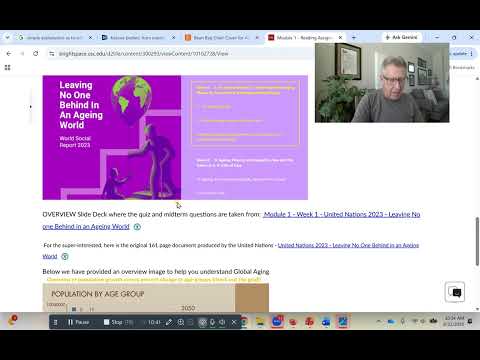
- The assigned United Nations report, published in 2023 with data through roughly 2021, is titled around leaving no one behind in an aging world.
- Walsh reduces the 161-page report to selected figures and interpretations, covering chapters 1 through 3 in Module 1 and chapters 4 and 5 in Module 2.
- The report draws on international demographic and economic evidence, including work associated with the OECD, an organization of 37 member countries focused on policy and sustainable growth.
- The figures show the global share of people aged 65 and older rising from about 5% in 1950 to 16% in 2021, while the share under age 19 declines.
- The report projects that the number of people aged 65 and over will more than double from 2021 to 2050, while the number aged 80 and over will triple.
- Japan had about 30% of its population over 65 in 2021; South Korea is projected to lead by 2050, with roughly 40% over 65.
- Europe and North America are already older regions, while many African countries have younger populations, higher fertility, and shorter life expectancy.
- Fertility rates have fallen across world regions, with Europe among the earliest and steepest declines; the US rate is below the roughly two-child replacement level used in the lecture.
- When the number of children falls while older populations grow, the dependency ratio increasingly reflects later-life support needs rather than child-rearing alone.
- Immigration can expand the working-age population and help staff elder-care settings, including nursing homes and retirement communities.
- International immigrants account for nearly 20% of the working-age population in high-income countries, according to the figures Walsh discusses.
- Walsh links low fertility partly to the difficulty of combining professional careers with the expense and demands of raising children.
- Norway is cited as offering nearly two years of free childcare, while broader social supports and work-family balance are presented as potential policy levers.
- South Korean companies Booyoung Group and Krafton are cited for substantial childbirth incentives, including a reported $72,000 payment from Booyoung and payments plus annual installments from Krafton.
- More young adults can strengthen the future workforce and reduce the relative caregiving burden placed on each working-age person.
- Longer life expectancy does not necessarily mean more years in good health: the figures show healthy life expectancy lagging behind total life expectancy for both women and men.
- Older adults' health outcomes are shaped by access to hospitals, doctors, safe parks, and other health-promoting resources, which vary by income and location.
- Walsh points to physical activity, improved diets, and access to treatments such as GLP-1 and GIP medications as possible ways to narrow the gap between lifespan and healthy lifespan.
- Longer lives also mean more people may experience morbidity and disability and need support to remain active and independent.
- Children and older adults typically consume more services than they produce through paid work, creating fiscal pressure when tax contributions fall short of support needs.
- Workers may leave employment before older age, while medical and care needs rise; Walsh connects this imbalance to Social Security, Medicare, and future expectations to work longer.
- Women face unequal economic effects because caregiving for children and older relatives can interrupt careers, reduce pension and 401(k) contributions, and extend into retirement.
- The country comparisons show the United States as a high healthcare spender, while older countries such as Norway, Austria, and Japan also face substantial health expenditure needs.
- In developed countries, older adults may rely on labor income, pensions, personal retirement accounts such as 401(k)s, Social Security, and private transfers; many developing-country older adults depend more heavily on continued work and family support.
- Unpaid care work, performed disproportionately by women in both developed and developing countries, is often missing from economic accounting and can limit labor-force participation.
- Walsh outlines responses including higher fertility, immigration, later retirement, more gender parity in caregiving, and better social support for childcare and elder care.
- Japan's use of online platforms such as Zoom and other work-from-home technologies illustrates how technology can help older adults remain socially connected and participate in employment.
Transcript excerpt
0:01 All right, Jarro 200, how are you? It's Sunday, August 23rd. Okay. Um, that means tomorrow is the first day of classes. Monday, August 24th. Um, remember, as I told you last time in my tax down here if you want to stay cool, um, this is what I recommend to you. Go find a nice place to hang out in an air conditioned building, right? Um, it's going to be like this for a couple weeks, so it's time to buckle down. All right. So, we're going to start a class, okay? And every week is a module and um you can learn all about this, okay, by um watching this video right here. So, if I just get my face out of the way here and I pop this in um up popups the video.
0:47 >> What's up, Joe 200? All right. So, today is August 21st. >> So, 2026. >> In about 30 minutes time, I go through the syllabus right here. I explain how to navigate the course and everything. >> Two writing assignments at 10% each. Um um I wrote this. >> There it is right there. All right. And and in the meantime, I tell you how to get an A, which is what what it's all about. Okay. So, watch that, right? And you'll know exactly what's going on. We're we have our own playlist, okay, in my YouTube channel. So, every single video that we do make for this course, you'll find in that playlist. All right. Okay. So, um, as you can see, uh, we can set up an impersonation of a student. Um, Julia set it up. So, it says Julia
1:36 Walsh test impersonating. So, um, anything I do will reflect Julia, not me. But it's all good. But this way,
This is the start of the transcript. Save this video free for the whole transcript, searchable and time-coded.
Related notes
Summary, takeaways, and chapters were generated by AI from the video's transcript and may contain errors. The video belongs to its creator, John Walsh.