GERO 200 f2026 Intro on how to navigate and get an A Video 2026 08 21 1
 Watch on YouTube →
Overview
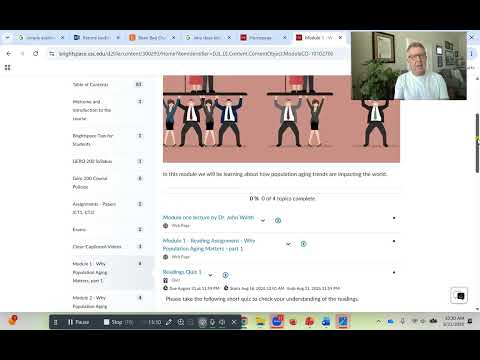
John Walsh introduces GERO 200 as a 100% online, asynchronous USC course applying aging research to chronic disease, caregiving, public programs such as Medicare and Social Security, personal financial planning, and estate law. He explains how to navigate Brightspace, complete weekly five-question quizzes and discussions, submit two data-based papers, and prepare for exams, emphasizing that keeping a calendar and meeting deadlines are central to earning an A.
Key takeaways
- GERO 200 connects population aging and chronic disease to practical concerns, including caregiving expenses, Medicare and Social Security funding, retirement investing, and estate planning.
- The course is asynchronous but deadline-driven: weekly lectures arrive on Sundays, and the associated quiz and discussion are due the following Monday at 11:59 p.m.
- Each weekly quiz has five multiple-choice questions selected from a pool of about 50, while discussions require an initial one-to-two-paragraph post and at least one substantive classmate reply.
- The two 10% papers require students to collect data, generate figures, and interpret results; the second includes 401(k) calculations using an AARP calculator and individual retirement accounts.
- Late papers lose 10% per day and become ineligible for credit after seven days, while weekly activities close on schedule, making a personal calendar essential.
- The midterm is a 60-question multiple-choice exam with a two-hour limit, and students should contact Julia early about course problems or OSAS accommodations.
Chapters
- John Walsh describes GERO 200 as a 100% online, asynchronous course beginning August 24, 2026, and advises students to calendar every deadline.
- Course topics span global aging patterns, chronic diseases, caregiving costs, Medicare and Social Security, personal financial planning, and applied law.
- Financial planning activities introduce retirement accounts, including brokerage accounts, IRAs, and Roth IRAs through providers such as Fidelity.
- Three applied legal lectures, led by attorney and professor Julia, include estate planning.
- Walsh recommends downloading the syllabus and saving course materials in a dedicated GERO 200 folder; the course uses free open educational resources rather than textbooks.
- Two short papers require students to gather data from websites, create figures, and explain their findings; each counts for 10% of the grade.
- The midterm and final each count for 20%, while weekly quizzes and discussions together make up 40%; the course uses a traditional grading scale.
- Late papers lose 10% per day and receive no credit after seven days; students should disclose any AI use and explain it fully.
- Brightspace’s homepage provides a to-do list and upcoming-events calendar, while the Content area opens the course table of contents.
- The course has 14 modules across a 15-week semester, with time set aside for fall and Thanksgiving breaks.
- Each module organizes lectures, readings, videos, quizzes, and discussions; weekly lectures are posted on Sundays and guide students through assignments.
- The first quiz and discussion are due August 31, 2026, at 11:59 p.m.; Walsh directs students to contact course administrator Julia early about problems or OSAS accommodations.
- Weekly quizzes contain five multiple-choice questions drawn from a pool of about 50, so students may receive different question sets.
- Readings are supported by lecture videos and condensed PowerPoint materials; the opening module uses a United Nations report on global aging.
- Discussion posts should answer the prompt in one to two paragraphs, followed by at least one substantive reply to a classmate.
- Walsh recommends addressing classmates by name and returning to the discussion to check for responses to an original post.
- Both writing assignments are available through Brightspace with instructions, data links, summary videos, FAQs, and grading rubrics.
- The second paper involves financial planning, including 401(k) contribution calculations with an AARP calculator and analysis of individual retirement accounts.
- Weekly quizzes and discussions close each week, so students should not assume they can be reopened after the deadline.
- The midterm consists of 60 multiple-choice questions with two hours to complete; the final also has a two-hour window selected during the scheduled exam period.
Transcript excerpt
0:00 Hey, what's up Joe 200? All right, so today is August 21st, 2026. So yeah, it's hard to believe, but fall semester 2026 is here. And uh so the official first day of classes is next Monday, August 24th. And so this uh is an introductory video that's going to explain to you everything you need to know about how to navigate Gerro 200 and basically how to get an A in this class. There's absolutely no reason why you should not get an A in this class. You do the work, you're going to need to get an A. Okay. Um so uh this is 100% online asynchronous. Okay? meaning that uh you just go at it um at your own time. Um
0:50 but you got to stay on track. And so I really encourage you guys to um get out your phone, okay? And calendar up. I should have my phone with me right now, but I don't calendar up um uh the due dates for everything that's that is ongoing in this class, okay? because uh we have to be kind of hardline about due dates because this is a very large class meaning there are a lot of you taking this class. I think a lot of you are taking this class because um there's a lot of folklore behind this class and uh uh you have have a lot of friends saying you got to take this class and that's what this is all about. Short statement on the on the content of this class. uh too often we we take classes um that are theoretical or that fulfill a major.
1:39 This class is 100% applicable from the day you start getting into it. Okay. So, you're going to find this class very useful in terms of how you um are
This is the start of the transcript. Save this video free for the whole transcript, searchable and time-coded.
Related notes
Summary, takeaways, and chapters were generated by AI from the video's transcript and may contain errors. The video belongs to its creator, John Walsh.