ES.1802, October 19, 2026
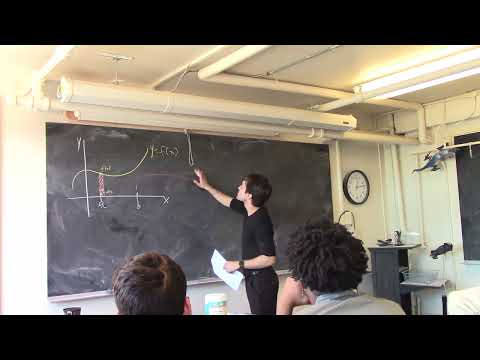 Watch on YouTube →
Overview
The lesson builds double integration from single-variable area: an integral of 1 measures length in one dimension and area in two, while integrating a height over a two-dimensional region gives volume. It explains how to choose an integration order by drawing the region and testing directional slices, then begins an exercise on the area between y = 4 and y = x² for −1 ≤ x ≤ 2; the transcript ends before the exercise is completed.
Key takeaways
- A one-dimensional integral of 1 over [a, b] measures length, while a double integral of 1 over a planar region measures area.
- Integrating a height function over a planar region produces volume by summing height times each small area element dx dy.
- For a region bounded vertically by y = fₐ(x) and y = fᵦ(x), the area setup is an inner y-integral from fₐ(x) to fᵦ(x), followed by an outer x-integral over the constant horizontal limits.
- Drawing directional slices reveals whether one integration order uses consistent bounds or whether the region must be split into multiple integrals.
- The center of mass of a one-dimensional distribution is the integral of position times linear density divided by total mass.
Chapters
0:00
Review: Constrained and Unconstrained Optimization
- For unconstrained optimization, set the gradient to zero and use the Hessian to classify critical points as maxima or minima.
- For constrained optimization, use Lagrange multipliers or substitute the constraint, depending on which approach gives a more manageable system.
- Check endpoints when optimizing over a constrained region; the ordinary Hessian alone does not account for the constraint.
3:45
From Single-Variable Riemann Sums to Area
- A narrow slice under y = f(x) has approximate area f(x) dx, using function height times a small horizontal width.
- Adding these slices from x = a to x = b gives the area as the integral of f(x) dx.
- The differential is the small increment, the integrand is the quantity being accumulated, and the bounds specify the interval.
8:30
What Single Integrals Measure: Length, Area, Mass, and Center of Mass
- With integrand 1, the one-dimensional integral from a to b equals b − a, the interval's length.
- Integrating a height function over x gives area, while dividing that integral by b − a gives the function's average value over the interval.
- Integrating linear density gives total mass; integrating position times density gives the first moment, which must be divided by total mass to find the center of mass.
17:15
Double Integrals: Area Elements and Volume
- The product dx dy represents a tiny rectangular area element, and integrating 1 over a two-dimensional region adds those elements to find its area.
- Integrating a height function over the same region adds height times area elements, yielding volume.
- A double integral is an iterated integral: evaluate the inner integral first, then integrate its result with respect to the outer variable.
23:30
Setting Up an Area Integral with Curved Boundaries
- For a region between y = fₐ(x) and y = fᵦ(x), with x running from c to d, integrate y from fₐ(x) to fᵦ(x), then integrate x from c to d.
- Using integrand 1 makes the double integral represent area; evaluating the inner integral reduces it to the single-variable expression fᵦ(x) − fₐ(x).
- The order of integration determines which variable has function-valued bounds and which has constant outer bounds.
26:25
Choose Inner Bounds by Drawing Directional Slices
- Start by drawing the region and its boundary curves before writing any integral bounds.
- To choose the inner variable, sketch arrows in that variable's direction and verify that each slice enters and exits the region along the same boundary types.
- After handling variable dependence in the inner bounds, use constant extreme values of the other variable for the outer bounds.
30:40
Reversing Integration Order Can Require Multiple Integrals
- For the region between y = fₐ(x) and y = fᵦ(x), vertical slices give one consistent pair of curved bounds.
- Horizontal slices may enter or exit through different boundaries in different parts of the region, requiring the region to be split into separate integrals.
- Rectangular regions with constant bounds in both directions are the main simple case where swapping integration order does not change the bounds' structure.
36:35
Practice Region: y = 4 and y = x² from x = −1 to 2
- The assigned problem asks for the area between the horizontal line y = 4 and the parabola y = x² over −1 ≤ x ≤ 2, using both integration orders.
- The class begins the required first step by sketching the parabola, the line y = 4, and the vertical limits at x = −1 and x = 2.
- The transcript ends as the class starts setting up an integral, before either order is fully written or evaluated.
Summary, takeaways, and chapters were generated by AI from the video's transcript and may contain errors. The video belongs to its creator, ChristianAltoSax.